


Custom Spice Packaging Bags & Rollstock
Printed pouches, seasoning sachets and rollstock film for ground spices, whole spices and dry seasoning blends. Match the format, barrier structure and printing route to your product, filling process and order plan.
Start with your spice type, fill weight and quantity. Complete specifications are not required to begin.
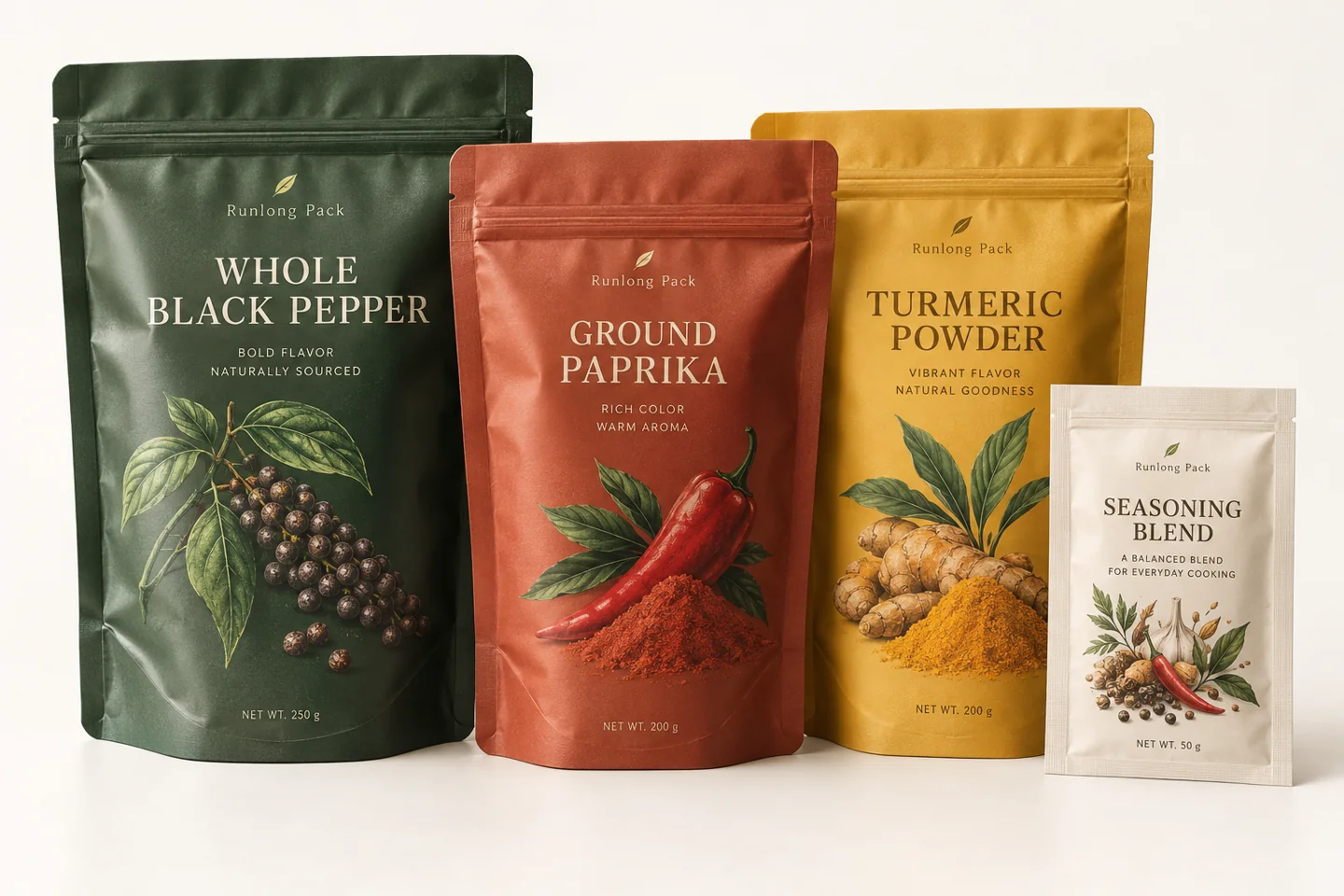
Spice Packaging: Quick Buying Facts
| Decision | What to confirm |
|---|---|
| Product | Ground powder, coarse particles, whole spices or a blend; include salt, sugar or oil-containing ingredients where relevant. |
| Formats | Premade stand-up and flat pouches, portion sachets or printed rollstock for compatible machinery. |
| Protection | Moisture, aroma, oxygen and light requirements selected for the product and intended storage. |
| Order route | Digital for suitable smaller or multi-SKU projects; gravure for suitable larger repeat runs. |
| Optional static evaluation | For observed powder adhesion or filling issues; feasibility and food-contact suitability need separate confirmation. |
Packaging for Ground Spices, Whole Spices & Seasoning Blends
Ground spices
Paprika, turmeric, ground pepper and similar powders. Review powder flow, moisture sensitivity, headspace and keeping the final seal area clear during filling.
Whole spices
Peppercorns, cumin seeds, cloves and other whole spices. Check actual bulk volume, irregular shapes and resistance to puncture or handling damage where relevant.
Seasoning blends
Dry rubs, curry blends and soup seasonings. Salt, sugar, oils and different particle sizes can affect handling and moisture behavior; evaluate the actual formulation.
Choose the Packaging Format Around Filling and Use
| Format | Useful when | Confirm before ordering |
|---|---|---|
| Stand-up zipper pouch | Retail packs intended for repeated use. | Bottom gusset, usable capacity, zipper position and top heat-seal clearance. |
| Three-side-seal pouch | Compact flat packs, refill portions or samples. | Open filling side, tear notch, seal margins and filling access. |
| Seasoning sachet | Single-use portions and meal-kit components. | Dose, opening behavior, actual pack dimensions and production route. |
| Printed rollstock | Your machine forms, fills and seals the pack. | Film and roll specifications, sealing compatibility and a suitable trial plan. |
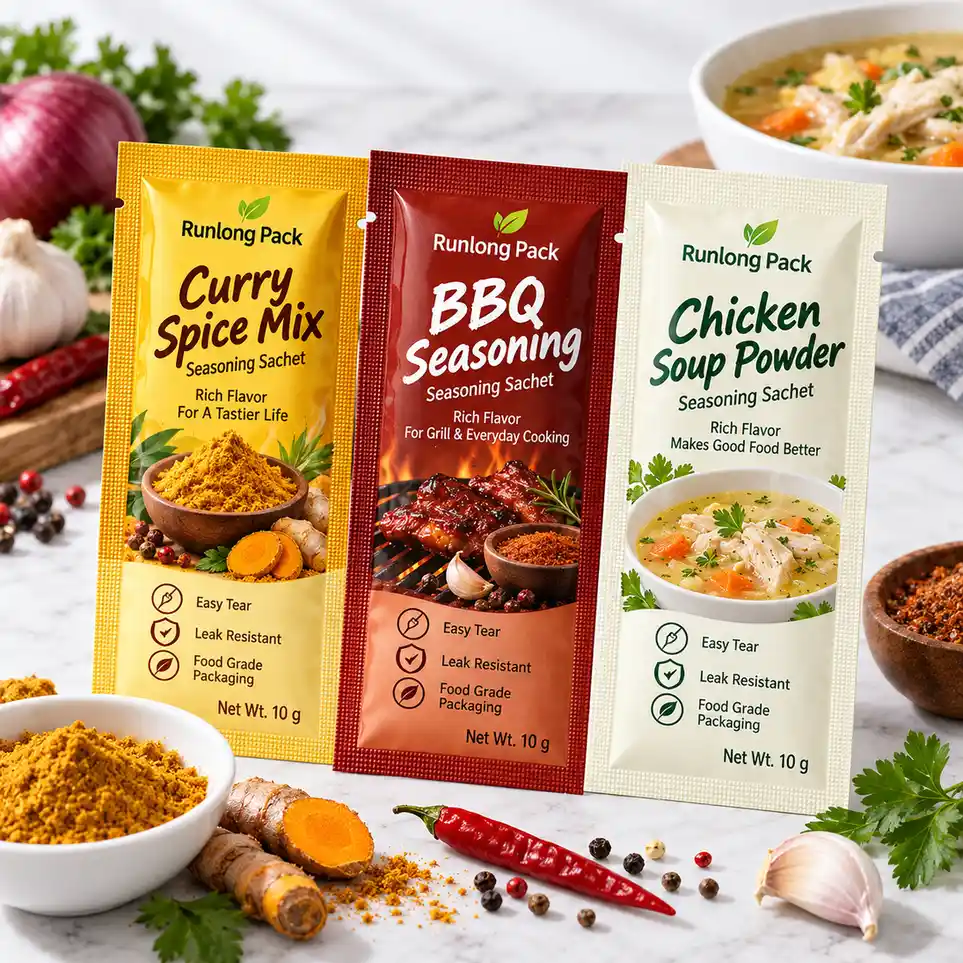
Explore stand-up pouches, three-side-seal pouches, sachet packaging or printed rollstock.
Which Format Fits Your Spice Product?
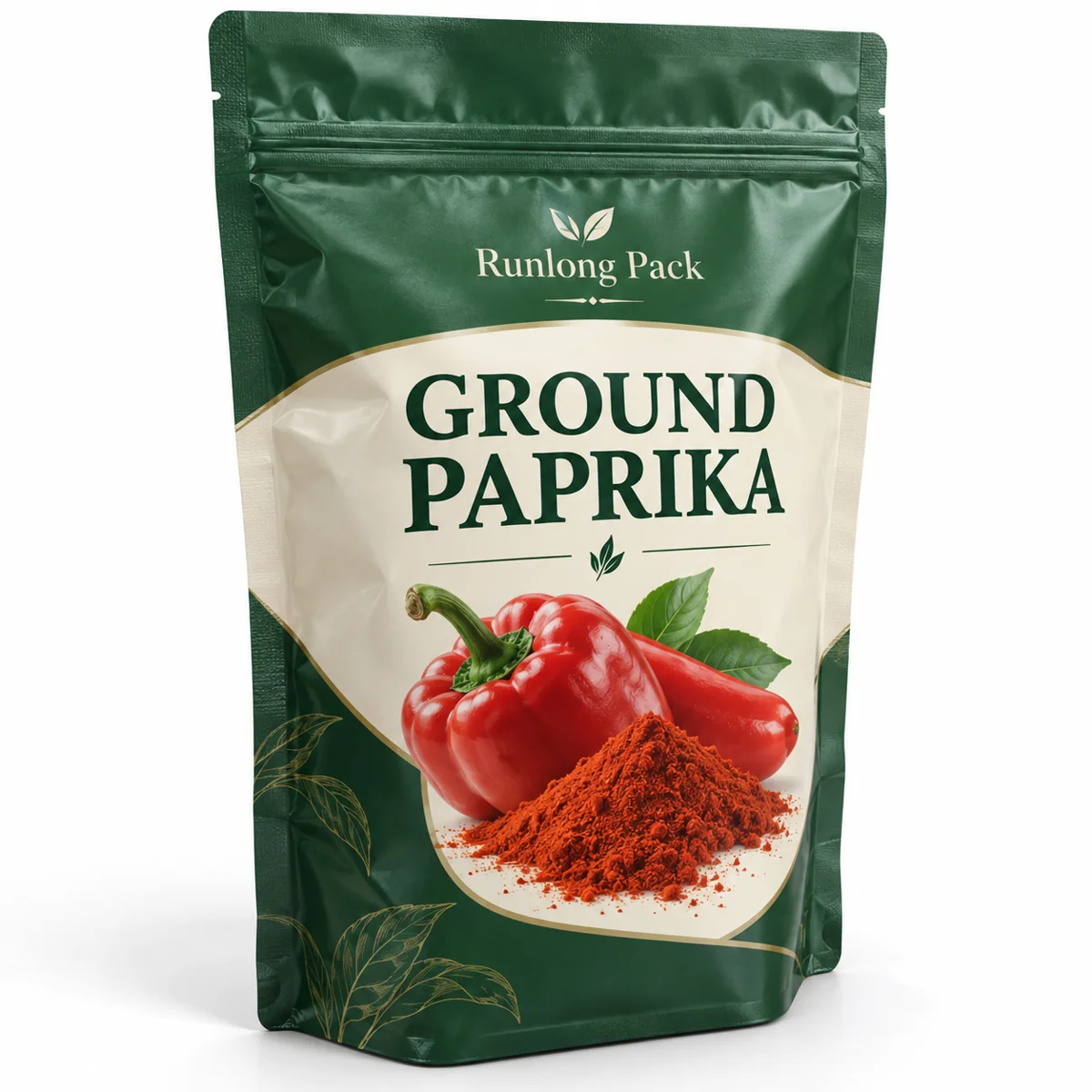
Resealable spice pouches
A stand-up format for retail shelves and repeated use. Confirm usable volume, zipper position and top sealing clearance.
Discuss this format on WhatsApp →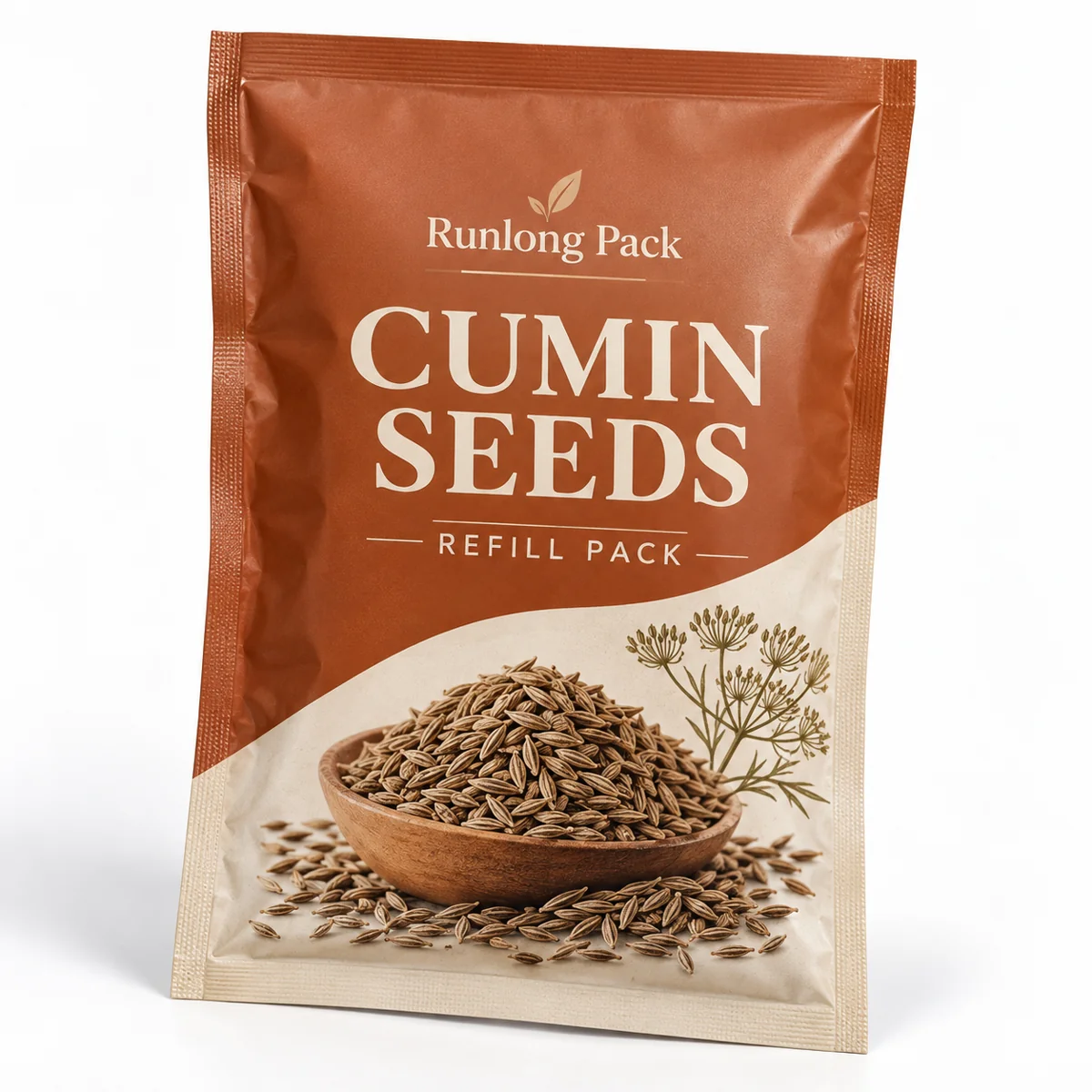
Flat spice refill packs
A compact option for refill packs and recipe portions. Confirm the filling opening, seal margins and handling requirements.
Discuss this format on WhatsApp →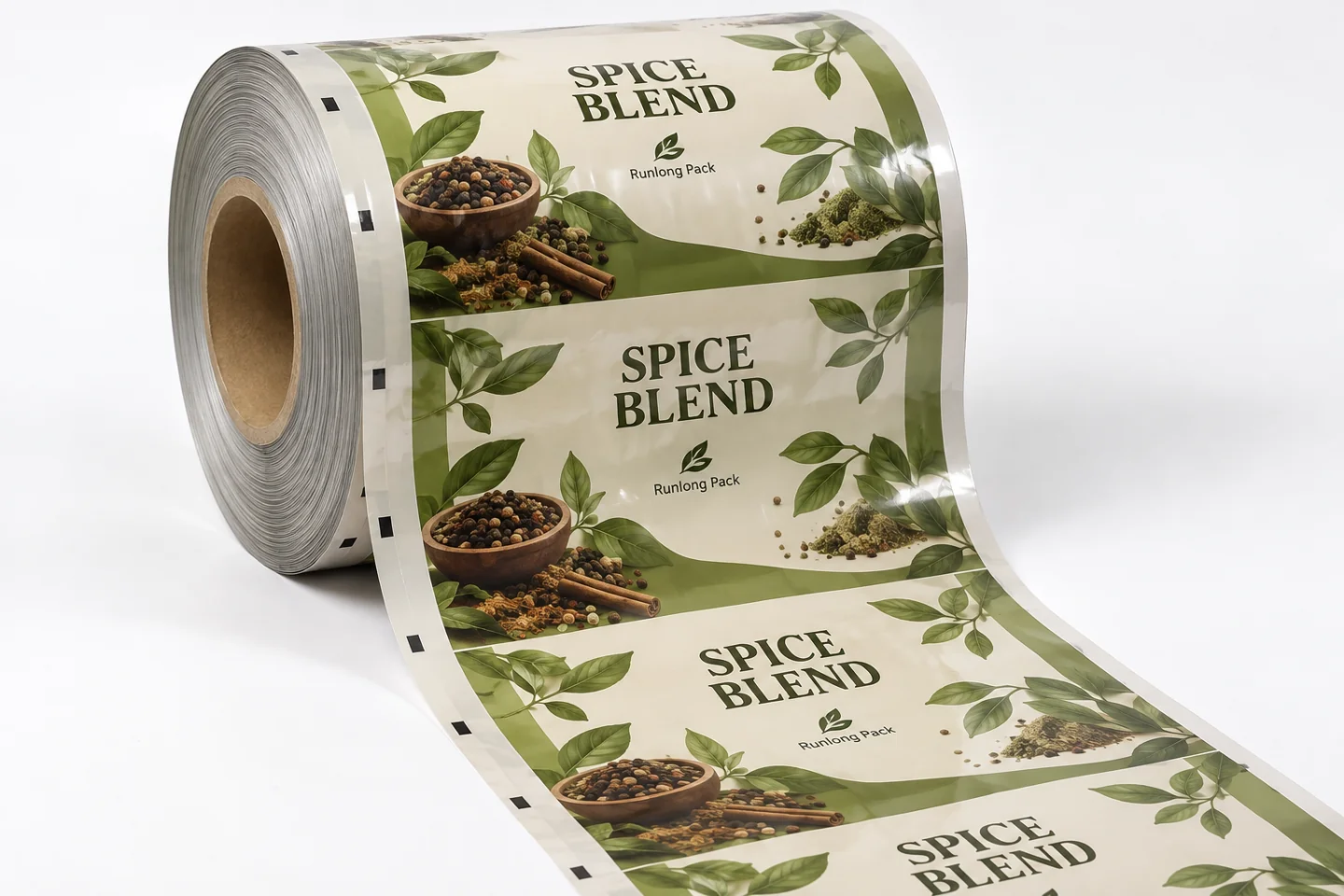
Printed spice rollstock
For compatible form-fill-seal lines. Share your machine drawing, web width, print repeat and winding requirements.
Discuss this format on WhatsApp →Select Materials for Protection, Not Appearance Alone
There is no universal spice pouch laminate. Share your product formulation, target shelf life, humidity, distribution conditions and any light sensitivity. The outer finish and the barrier layers serve different purposes.
| Option to evaluate | Potential role | Important qualification |
|---|---|---|
| PET/PE or other suitable clear laminates | Printability, strength and heat sealing for an appropriate application. | Do not assume adequate aroma or oxygen protection without checking the intended use. |
| Metallized laminates | An option where stronger light and gas protection is needed. | Confirm the actual structure and barrier specification. Metallic appearance does not indicate a specific barrier level. |
| Aluminum-foil laminates | An option for demanding light and barrier requirements. | Confirm handling durability and seal performance; foil does not establish a shelf-life guarantee. |
| Transparent barrier structures | Product visibility with a defined barrier requirement. | Review barrier data under relevant conditions and the whole pouch construction. |
A clear window changes the protection provided by the package. An opaque foil or ordinary metallized layer cannot cover the transparent window itself. Discuss the window size and the complete structure before approving artwork.
Review available food-contact documentation against the ordered material and intended use. A report for one sample is not blanket approval for every laminate or formulation.
Powder Filling, Seal Cleanliness & Optional Anti-Static Evaluation
Fine spice powder may cling to a film surface, scatter during filling or collect near the sealing area. These are observations, not proof of a single cause. Product characteristics, humidity, filling speed, drop height, equipment condition and electrostatic effects may all need review.
When should anti-static packaging be discussed?
If your line shows persistent powder adhesion or related filling problems, share a video, powder information, current film specification and operating conditions. Runlong Pack can evaluate whether a suitable anti-static packaging approach is feasible for the project. Material compatibility, food-contact suitability and performance under actual use conditions must be confirmed before production.
Anti-static treatment is not a standard feature of every spice pouch and is not a guarantee of dust-free filling, leak-free seals or equipment safety.
Leave appropriate filling headspace and keep powder out of the final heat-seal zone. A zipper supports repeated opening after purchase; it does not replace the initial heat seal. Agree the sealing trial and inspection method with the filling team.
Printing, MOQ & Production Lead Time
Digital printing
Suitable ordinary premade pouch projects can start around 100 pieces; approximately 1,000–3,000 pieces is often more practical. No gravure cylinder fee. Confirm quantity per design and structural suitability.
Approximately 8–10 working days after artwork, specifications and order arrangements are confirmed. Shipping is additional.
Gravure printing
Suitable standard pouches often start around 10,000+ pieces. Larger repeat runs, particularly around 40,000+ pieces, merit a cost comparison. Small sachets can require a higher piece count because of material usage.
New cylinders: approximately 7–9 working days, followed by approximately 15–20 days for production. Final timing is confirmed with the order; shipping is additional.
Printed rollstock
Plan around 300 kg as a starting guideline. Trial feasibility and production timing are assessed separately. This is not a finished-bag-count MOQ.
Supply machine model, film width, print repeat, winding direction, core size and maximum roll diameter.
These are general Runlong Pack production guidelines, not fixed limits for every spice pack. Final MOQ, cost and timing depend on size, material, artwork, SKU split, accessories and any special treatment.
Read the MOQ guide and compare digital and gravure printing.
Spice Packaging Specification Checklist
| Information | Your project details |
|---|---|
| Spice and formulation | Product name; ground / coarse / whole / blend; relevant salt, sugar or oil content. |
| Pack quantity | Target fill weight; actual product volume or a physical sample if available. |
| Pouch or roll | Bag style and dimensions, or machine model and film/roll specifications. |
| Use and storage | Single-use or resealable; intended shelf life; storage and shipping conditions. |
| Order and artwork | Total quantity, quantity per SKU, design count, print files and finishing requirements. |
| Special concerns | Powder adhesion, seal contamination, sharp particles, window or anti-static evaluation. |
| Delivery | Destination country, required arrival date and preferred shipping arrangement. |
Compare ground and whole spice packaging in our buying guide.
Confirm the Sample Before the Production Specification
Limited stock or historical samples are normally free, with shipping paid by the customer. Ordinary custom-design printed samples are typically USD 50–70 per piece; special UV or hot-stamping samples are typically USD 100–150 per piece. Availability and suitability are confirmed for the project.
For qualifying gravure bulk orders of more than 20,000 pieces per design, sample-fee refunds may apply, subject to project confirmation. A visual sample is not proof of barrier performance, food-contact suitability, anti-static behavior or reliable operation on your filling line.
Check fill volume, sealing access, opening and resealing, appearance and any agreed functional tests with your actual product. See sample options and costs.
Frequently Asked Questions
Can you supply both spice pouches and printed rollstock?
Yes. Runlong Pack supports suitable premade pouch and printed rollstock projects. The format and specification are selected around the product and filling equipment.
What is the MOQ for custom spice packaging?
Suitable ordinary digital pouch projects may start around 100 pieces, with 1,000–3,000 often more practical. Suitable standard gravure pouches often start around 10,000 pieces. Printed rollstock is planned around 300 kg. Small sachets and special structures require separate confirmation.
Do all spice bags need anti-static treatment?
No. Anti-static requirements should be evaluated when there is an observed or specified need. Confirm the cause of the filling issue, material compatibility, food-contact suitability and performance in actual trials.
Can a clear window be combined with high-barrier packaging?
Suitable transparent barrier or mixed-construction options can be evaluated. The window area cannot be covered by an opaque foil or ordinary metallized layer. Review the performance of the complete pouch, not only its opaque sections.
Can you guarantee a shelf life from the pouch material alone?
No. Shelf life depends on the food, initial condition, processing, package construction, sealing and distribution conditions. Agree the packaging requirements and validate the packed product for the intended use.