


Custom Contours • Practical Packaging Engineering
Custom Shaped Pouches
Distinctive flexible packaging for brands that need more than a rectangular bag.
Explore shaped stand-up, spout and flat sachet formats, including tear-open film-neck designs without a separate plastic spout. Runlong Pack reviews the shape together with usable capacity, sealing, filling and printing—not just the artwork.
Packaging images are design concepts. Printed brands, contents and weights illustrate presentation, not approved customer work or validated capacity.
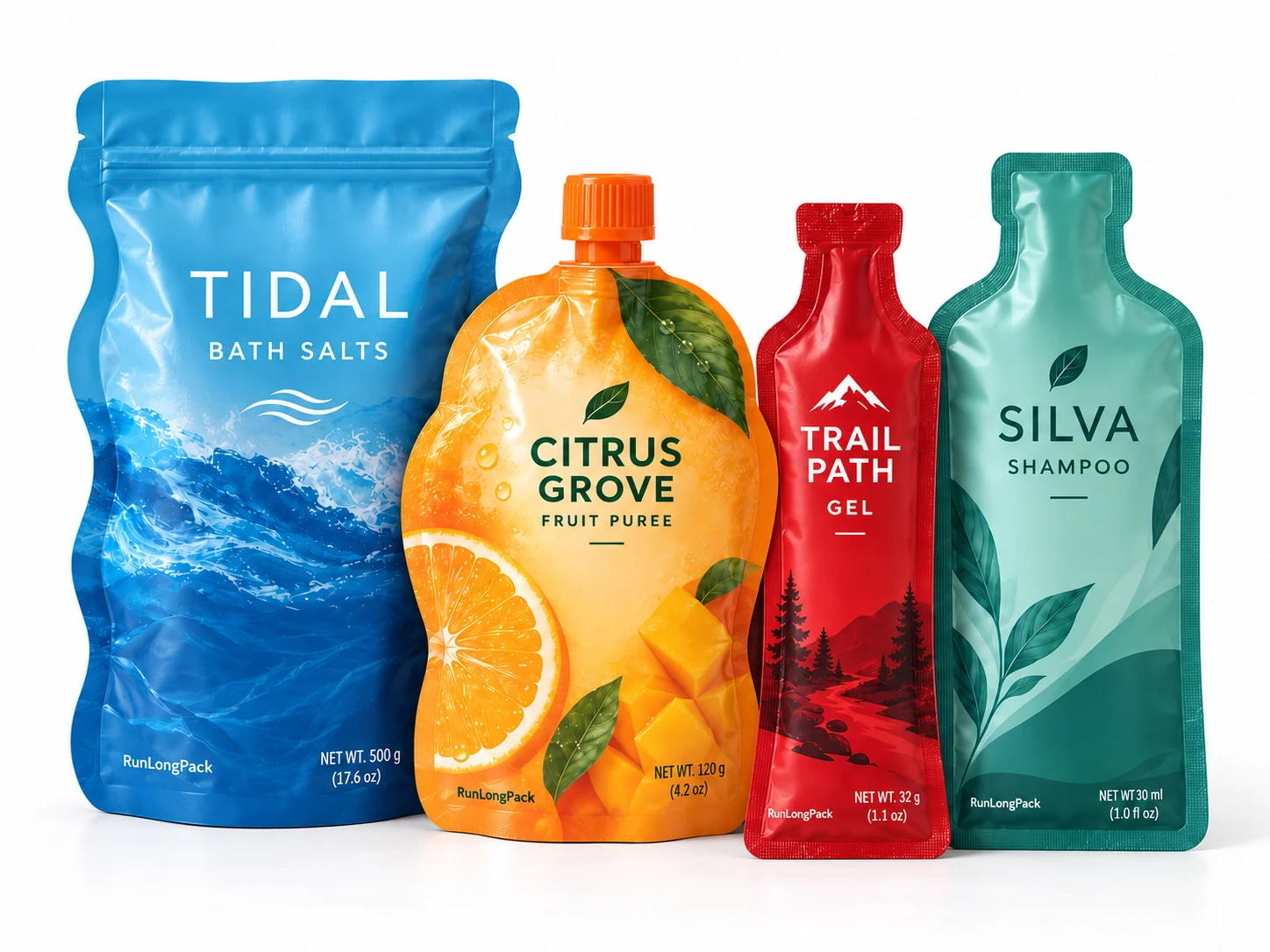
Start With the Structure
Custom Shaped Pouches: Quick Answer & Facts
Quick Answer: Shaped pouches use a custom-cut outer contour rather than a standard rectangle. Choose the base and opening around your product and filling process, then confirm the usable volume, seal path and print layout. Eligible ordinary digital projects may be evaluated around 100 pcs, with approximately 1,000–3,000 pcs normally recommended. Plastic-spout structures have separate quantity guidance. Custom cutting-die fees range from USD 100–1,000, depending on shape and size.
| Formats | Shaped stand-up, shaped spout, spout-shaped tear-open, and contour-cut three-side/four-side-seal pouches. |
|---|---|
| Ordinary digital reference | Some eligible projects around 100 pcs; approximately 1,000–3,000 pcs recommended. Not a blanket minimum for every shape or structure. |
| Structure exceptions | Plastic-spout pouches: digital recommended from approximately 1,000 pcs; gravure approximately 15,000 pcs. |
| Ordinary gravure reference | Generally approximately 10,000 pcs, subject to structure, dimensions, material, colors and quantity per artwork. |
| Custom cutting die | USD 100–1,000, depending on shape and size. Confirm separately from bag unit pricing and any gravure cylinder charges. |
| Digital size limit | Maximum finished-pouch width approximately 37 cm. The complete shaped outline and production layout must still be checked. |
| Typical production | Digital approximately 8–10 working days. Gravure cylinders approximately 7–9 working days, then production approximately 15–20 days after cylinder completion. |
Production timing depends on final specification/artwork approval and receipt of required payment. New shape development, tooling, sampling and transport require separate schedule confirmation.
What Is a Custom Shaped Pouch?
A custom shaped pouch is flexible packaging with an intentionally contoured outer profile. It may resemble a bottle, fruit, jar or another brand-specific outline, while still needing a practical filling opening, heat-seal area and suitable base.
A silhouette is not a pouch structure.
A bottle-shaped flat sachet is not a rigid bottle. A pouch with a nozzle-like film neck is not automatically a plastic-spout pouch. The bottom construction, seal pattern and actual opening determine how the package is filled, displayed and used.
“Die-cut pouches” and “shaped packaging bags” are useful buying terms, but a shape sketch alone cannot establish production feasibility. Provide the intended contents, dimensions and filling process so the outline and construction can be reviewed together.
Four Custom Shaped Pouch Formats
Select the underlying structure first. The images illustrate design directions; final contours, seals and capacity require an approved specification.
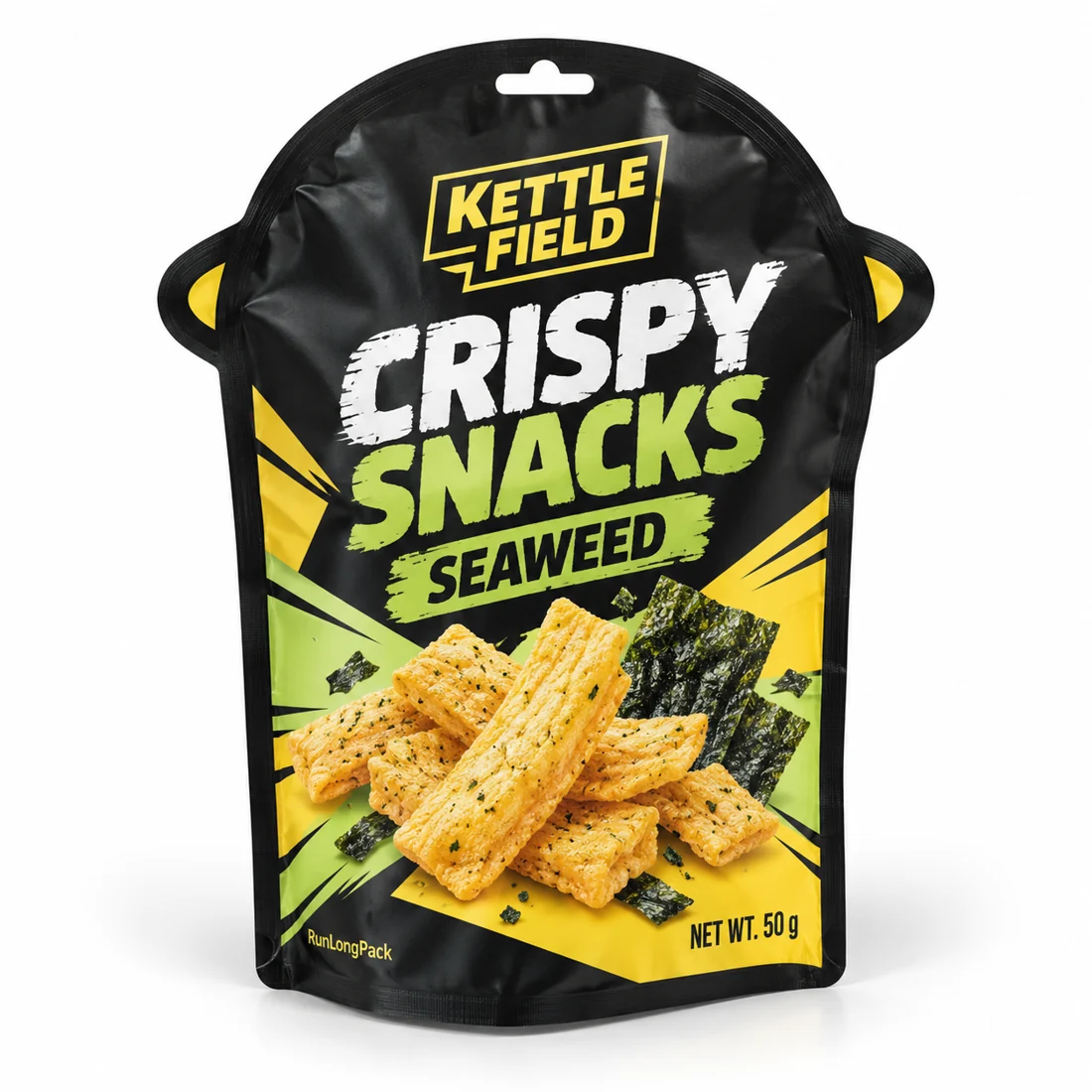
Shaped Stand-Up Pouches
A contoured body with a bottom gusset can combine shelf display with a distinctive outline. Consider suitable dry goods, bath products or other compatible contents; assess stability with the actual fill.
Choose when standing presentation matters and the contour leaves practical filling and sealing space.
Review stand-up pouch structures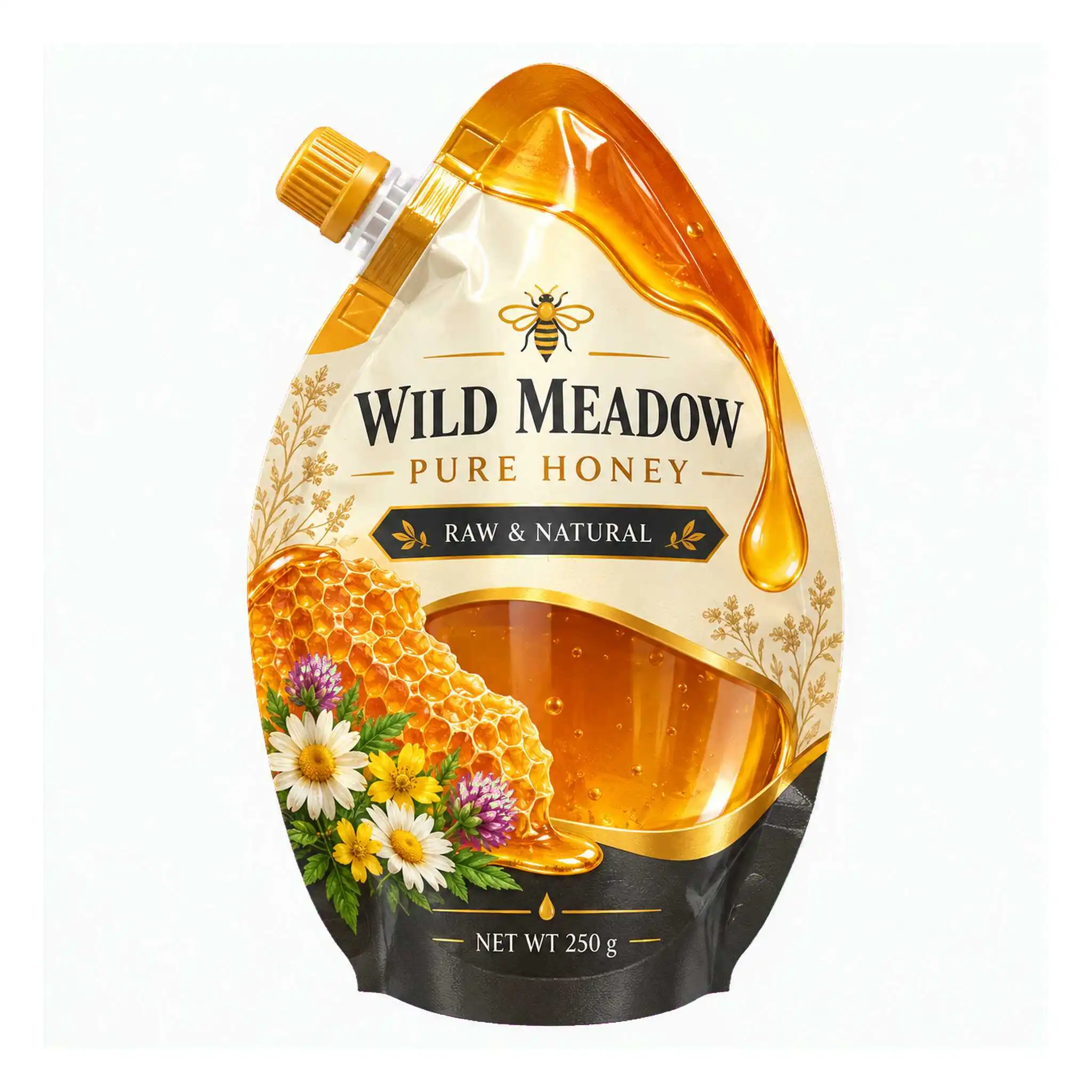
Shaped Spout Pouches
A separate plastic spout and cap provide a defined opening for suitable liquids or pastes. Confirm viscosity, particles, filling temperature, spout position and filling connection before selecting the package.
Choose when a fitted dispensing opening suits the product and use requirements.
Review plastic-spout pouch options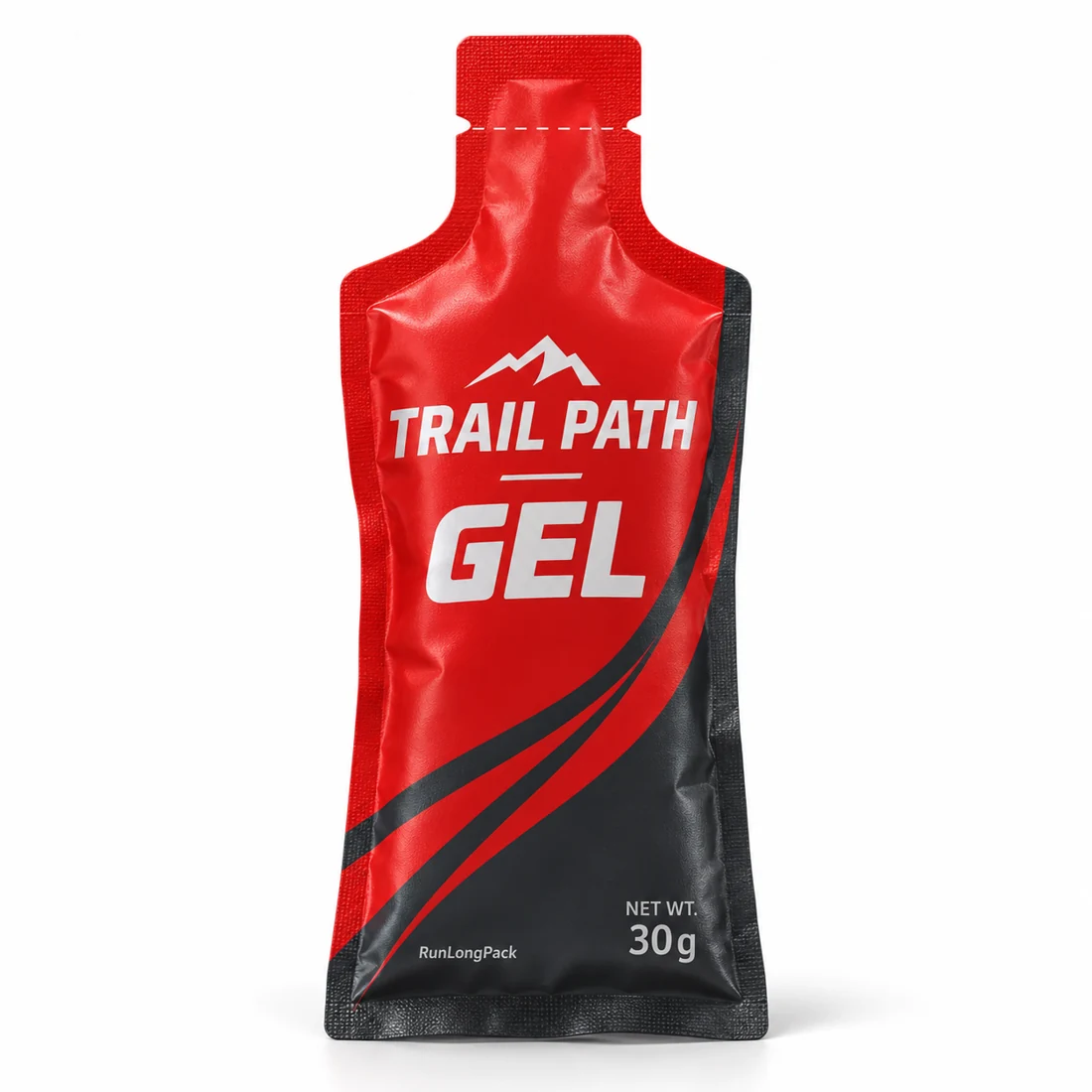
Spout-Shaped Tear-Open Pouches
The pouch film itself forms a narrow, nozzle-like outline. There is no separate plastic spout or cap. A defined tear-open area exposes the outlet for a suitable single-use pour or squeeze application.
Choose when a tear-open format suits the product. Do not assume it can be reclosed or that it shares fitted-spout machine settings.
Compare the two opening routes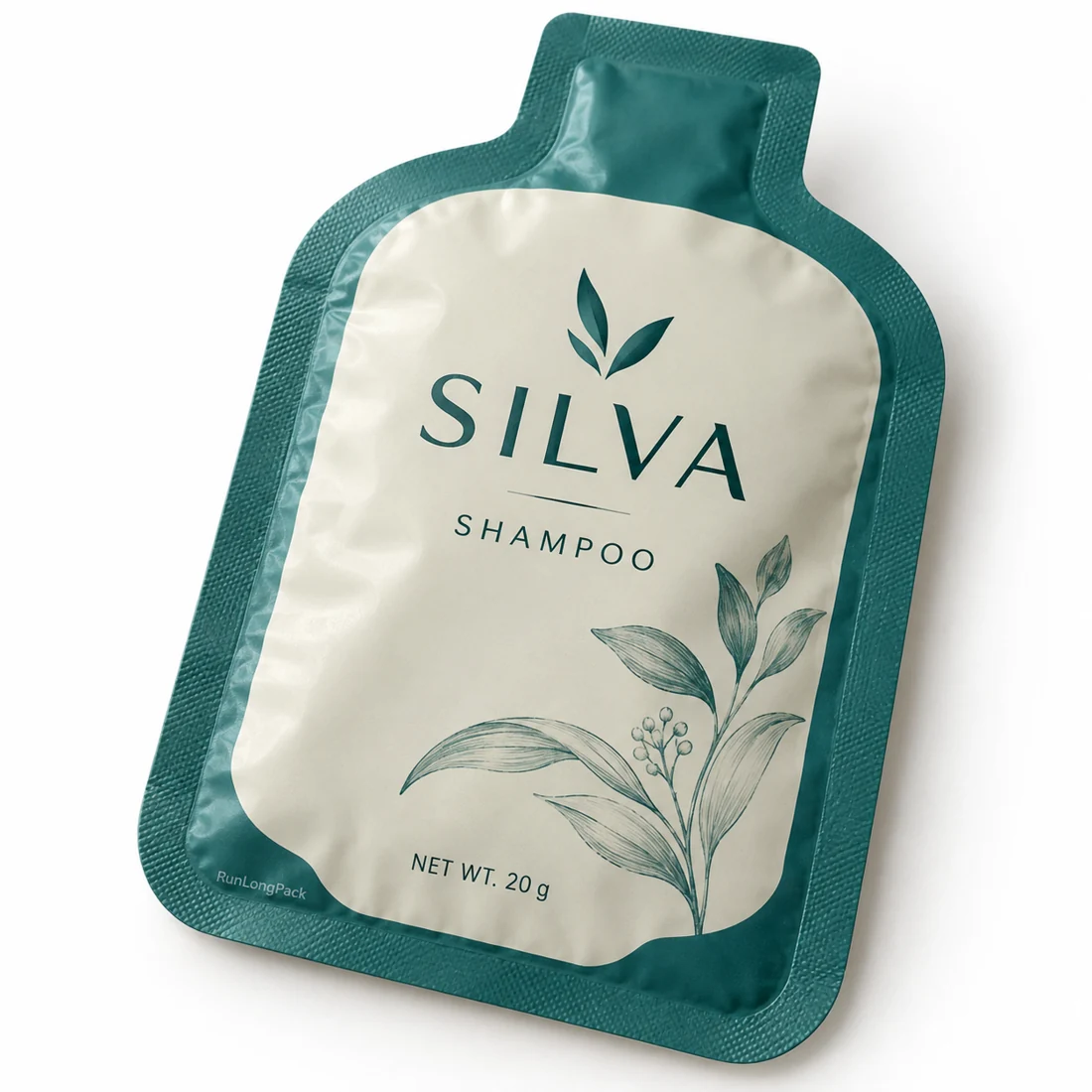
Contour-Cut Three-Side / Four-Side-Seal Pouches
Flat sachets can use a special outer contour without a standing base. Confirm the actual seal layout, filling opening and conversion sequence through a drawing rather than the format name alone.
Choose for suitable portions or sample packs where a flat presentation and practical opening are preferred.
Review flat pouch fundamentalsApplications: Match the Shape to the Product
Food Portions & Fruit Products
Review product consistency, fill volume and dispensing needs; heat treatment requires its own material assessment.
Sauce packaging optionsGels & Single-Use Portions
Confirm the film-neck opening, tear behavior, seal cleanliness and how the contents flow in real use.
Personal Care & Toiletries
Review compatibility with oils, fragrances and the actual formulation, as well as controlled emptying.
Dry Products & Retail Packs
Confirm usable volume, base stability and closure needs for powders, bath salts or other suitable contents.
Powder packaging considerationsAn application name does not approve a laminate, shelf life or filling method. Product-specific and thermal-processing restrictions still apply.
Plastic Spout vs. Tear-Open Film Neck
These may look similar in a drawing but are different purchasing specifications.
| Decision | Plastic-spout pouch | Spout-shaped tear-open pouch |
|---|---|---|
| Opening | A separate plastic fitment is attached to the pouch. | A narrow outlet is formed from the pouch film and opened by tearing. |
| Closing after opening | A suitable cap can support reclosing; actual leak performance needs review. | No separate cap. Do not assume the torn outlet is reclosable. |
| What to specify | Spout drawing, position, cap, filling interface and product behavior. | Film-neck outline, tear location, outlet after opening and dispensing behavior. |
| Filling | Confirm through-spout or pouch-opening filling with the actual equipment. | Confirm the intended filling opening and final seal sequence separately. |
| Quantity guidance | Spout-specific guidance applies, not the ordinary 100-piece reference. | Evaluate the actual pouch structure against applicable printing and conversion rules. |
Confirm the opening with a sample, not a silhouette.
Check how the filled pouch tears, pours or squeezes. Products with particles, high viscosity or contamination at the seal can behave differently from a clean design mockup.
Materials & Barrier for Shaped Packaging
Runlong uses food-grade raw materials for all flexible packaging production and does not use recycled, secondary or scrap materials. This raw-material policy also applies to non-food applications; it is not automatic approval of every finished-package use.
Moisture, Oxygen & Light
Define the actual protection needed for the product and target storage conditions. Foil, metallized or transparent structures are evaluated by performance, not appearance alone.
Handling & Contour Stress
Review film toughness, cut-edge quality and handling around narrow sections and curves. A visually attractive outline still needs acceptable performance in a filled package.
Heat Sealing & Compatibility
The inner layer must suit the contents, filling temperature and sealing conditions. Oils, fragrance, acidity and any thermal processing require specific review.
Final structure should be confirmed around the product, shelf-life target, filling method and market requirements. A clear window cannot have a continuous opaque foil or metallized layer in its viewing area.
Review barrier material selectionDigital vs. Gravure Printing & Shaped Pouch MOQ
Shaped pouches follow the applicable printing route, while the actual base, fitment, dimensions and conversion requirements remain part of the minimum-order review.
Suitable Smaller Projects
Digital Printing
~100 pcs evaluated
Some eligible ordinary structures may be evaluated around 100 pcs; approximately 1,000–3,000 pcs recommended for better value. Suitable for smaller launches and compatible multi-design projects.
Maximum finished-pouch width approximately 37 cm. Digital normally uses CMYK; exact Pantone matching is not guaranteed.
Stable Artwork & Larger Runs
Gravure Printing
Generally ~10,000 pcs
Ordinary pouch projects generally start around 10,000 pcs. Evaluate total cost with the actual size, structure, colors and quantity per design.
Each artwork normally requires separate cylinder evaluation. Cylinder charges are different from shape-cutting tooling.
Structure-Specific Review
Plastic-Spout Formats
Plastic-spout digital projects are normally recommended from approximately 1,000 pcs; spout gravure approximately 15,000 pcs.
The plastic fitment, filling interface and conversion requirements must be confirmed. Do not apply an ordinary 100-piece reference automatically.
Provide quantities for each design, not only the total order. Compatible digital artworks can be evaluated together, but combined pricing and minimums per design require confirmation. A fully custom contour should not be assumed available as a stock pouch for simple overprinting.
See the MOQ guide and digital vs. gravure comparison.
Separate the Cost Items
Custom Cutting-Die Cost
USD 100–1,000
Custom cutting-die fees depend on the shape and size. This is a tooling reference range, not a pouch unit price or a fixed fee for every project.
Shape Tooling
The cutting die supports the agreed outer contour. Send a dimensioned outline so the required tooling and cost can be reviewed.
Print Setup
Any gravure cylinders are quoted separately. A cutting die does not replace the cylinders needed for a gravure artwork.
Pouch Production
Compare the bag price using the same structure, size, features, quantity and design split. Sample, tooling, print setup and freight should be clear in the quotation.
For repeat orders, ask whether the existing approved tooling suits the specification. Changes to the outline or size require review; tooling reuse, storage and any additional fee must be confirmed rather than assumed.
Size, Capacity & Production Limits
Outside width and height do not equal usable volume. Curves, shoulders, narrow necks, gussets and seals all affect the space available for contents.
| Confirm | What the buyer should provide | Why it matters |
|---|---|---|
| Complete outline | Dimensioned drawing with overall width/height, curves, narrow sections and base details. | Allows the shape, seal path and production layout to be evaluated together. |
| Fill volume | Actual product, fill weight or volume, density/viscosity and headspace requirements. | Printed concept weights are not validated capacities. |
| Filling access | Opening dimensions, nozzle/interface, machine type and intended final sealing sequence. | A narrow retail outlet may not be the manufacturing filling opening. |
| Seal & cutting areas | Proposed seal boundaries, tear position and important artwork clearance. | Complex curves must leave workable sealing and cutting space. |
| Standing base | Bottom-gusset details and required display conditions. | A wide-looking front does not establish filled-pouch stability. |
| Production route | Finished size, material, quantity per artwork and chosen printing method. | Digital width and format-specific restrictions still apply. |
Sharp turns, very narrow necks or strongly irregular contours require feasibility review; no universal minimum radius, seal width or gravure maximum size is promised here. Finished widths above approximately 37 cm cannot use the digital route. Confirm the dieline and actual filling fit before production.
Use the packaging size guideRelated Capabilities: Artwork, Filling & Samples
Dieline & Artwork Review
Keep critical text and graphics clear of the agreed cut, seal and tear areas. Editable print-ready files are preferred. Final outline, copy, spelling, barcode and market labeling require buyer approval.
Filling-Line Confirmation
Check how the equipment grips, opens, fills and seals the shaped pouch. Request a representative trial where needed; a rendered design does not prove automatic-machine compatibility.
Reference & Custom Samples
Available reference samples are normally free with buyer-paid freight. Eligible ordinary custom printed samples are approximately USD 50–70 each; special-finish samples approximately USD 100–150. A new shaped sample and any tooling needs are reviewed separately.
Review the sample policyApplicable material/sample reports can be reviewed for the intended market. No blanket FDA certification, guaranteed shelf life, automatic recyclability or universal leak-proof claim is made.
Review compliance document scopeCustom Shaped Pouch Project Workflow
Product & Use
Define contents, fill amount and market.
Base & Opening
Select standing/flat structure and fitted/tear opening.
Outline Review
Check dimensions, seals, neck and useful volume.
Material & Printing
Confirm structure, artwork and quantities.
Tooling & Sample
Agree die requirements and applicable trial route.
Filling Validation
Review actual filling, opening and handling.
Approval & Production
Approve specifications, then print and convert.
QC & Shipment
Inspect as agreed and confirm delivery.
Typical digital production is approximately 8–10 working days. Gravure cylinders take approximately 7–9 working days, followed by approximately 15–20 days of production after cylinders are completed. Final approval and required payment must be complete. Shape development, tooling, trials and shipping are separate schedule items.
Plan production lead timeWhy Runlong Pack for Shaped Packaging?
Structure-Led Selection
Compare standing, fitted-spout and tear-open routes before committing to a silhouette.
Small Runs to Scale-Up
Evaluate suitable digital launches and gravure repeat production using the actual format and design quantities.
Clear Project Cost Review
Separate contour tooling, printing setup and pouch production so the quotation answers real procurement questions.
Runlong Pack is based in Shantou, Guangdong, China. Learn about our flexible packaging business and share your project requirements for a specific evaluation.
Custom Shaped Pouches FAQ
What is the MOQ for custom shaped pouches?
Some eligible ordinary digital structures may be evaluated around 100 pcs; approximately 1,000–3,000 pcs is normally recommended. Ordinary gravure projects generally start around 10,000 pcs. Plastic-spout digital projects are recommended from approximately 1,000 pcs and spout gravure around 15,000 pcs. Shape, dimensions, material, conversion requirements and quantity per artwork determine the final minimum.
How much does a custom cutting die cost?
Custom cutting-die fees range from USD 100–1,000, depending on shape and size. This is a tooling reference, not a pouch unit price. Confirm it separately from gravure cylinder charges, samples, pouch production and freight.
Which shaped pouch formats can you evaluate?
This page covers shaped stand-up pouches, shaped spout pouches, spout-shaped tear-open pouches without a separate plastic fitment, and contour-cut three-side/four-side-seal pouches. The outline must be compatible with the chosen base, seal path and filling process.
Is a spout-shaped tear-open pouch the same as a spout pouch?
No. A fitted-spout pouch has a separate plastic spout and usually a cap. A spout-shaped tear-open pouch uses the laminated pouch film to form a narrow neck, with no separate plastic spout or cap. Confirm tearing, dispensing and the production filling opening; do not assume the torn pouch can be reclosed.
Can every shape stand upright?
No. Standing behavior depends on the base construction, contour, product and fill amount. Flat contour-cut sachets do not have a standing base. Stand-up concepts must be assessed with the actual contents and display conditions.
What sizes can be made?
Provide a dimensioned outline, fill amount and intended structure. Digital finished-pouch width is limited to approximately 37 cm; exceeding that width requires another route. Being under this width does not automatically approve every contour. Seal areas, necks, gussets, material and machine layout require review; no universal gravure maximum dimension is stated here.
Can shaped pouches run on an automatic filling machine?
Compatibility is not assumed from the outline. Confirm the machine, gripping/opening method, nozzle or spout connection, fill conditions and final sealing sequence. A representative trial may be needed. A narrow dispensing neck may be different from the production filling opening.
Can the cutting die be reused for a reorder?
Ask whether the existing approved tooling matches the repeat specification. Shape or size changes require review. Tooling suitability, storage, reuse terms and any additional charge must be confirmed; no automatic lifetime reuse is promised.
What are the sample and lead-time arrangements?
Available reference samples are normally free with buyer-paid freight. Eligible ordinary custom printed samples are approximately USD 50–70 each; special-finish samples approximately USD 100–150. New contour samples and tooling needs require separate evaluation. Typical digital production is approximately 8–10 working days; gravure cylinders approximately 7–9 working days, then production approximately 15–20 days after cylinder completion. Final approval, required payment, shape development, sampling, tooling and shipping affect the overall schedule.
What should I send for a shaped pouch quotation?
Send product and fill amount, underlying pouch structure, dimensioned shape drawing, material or barrier requirements, quantity per artwork, SKU count, print files, opening/spout details, filling conditions and destination market. Confirm the actual fill fit and final specification before production.
Start Your Custom Shaped Packaging Project
Send your product, fill weight/volume, pouch type, dimensioned outline, material or barrier requirements, quantity per design, artwork, opening/spout details, filling method and delivery market.
We can review the shape, suitable printing route and tooling requirements before preparing a quotation. Final capacity, structure, MOQ and production schedule require written confirmation.