

How should you choose a packaging bag size?
Use the actual product volume, density, shape, pouch geometry, headspace, filling method and functional features. Net weight alone cannot determine the final dimensions. Narrow the options with reference sizes, then confirm the pouch with the real product or a suitable filling test before artwork and mass production.
Choosing a packaging bag size by net weight alone is unreliable. A 500 g bag of rice, 500 g of tea, 500 g of coffee beans and 500 g of another lightweight food can require very different internal volumes. A practical packaging bag size guide therefore needs to consider product density, shape, pouch construction, required headspace and filling method together.
The most useful rule is simple: choose packaging size by product volume and packing requirements, not net weight alone. Size charts are useful for narrowing the options, but the final pouch should ideally be confirmed with the actual product before mass production.
Runlong Pack develops custom flexible packaging around the actual product, bag format, dimensions and filling requirements. This guide covers stand-up pouches, flat bottom pouches and back-seal snack bags, including market capacity references, Runlong Pack coffee pouch reference sizes and measurements from commercially available nitrogen-flushed potato chip bags.
Key Takeaway
There is no universal pouch size for 100 g, 500 g or 1 kg. The correct dimensions depend on product volume, bulk density, pouch geometry, headspace and the way the product is packed.
Packaging Bag Size Guide: Start With Product Volume, Not Weight
Net weight tells you how much product is being sold, but it does not tell you how much physical space the product occupies.
The main reason is bulk density. Dense products can fit more weight into a smaller volume, while lightweight or irregular products require more space for the same net weight.
Rice packs relatively efficiently. Flour settles differently. Tea leaves occupy much more space. Coffee beans contain significant air space between individual beans. Potato chips are lightweight, irregular and fragile.
This means a buyer asking only, “What size pouch do I need for 500 g?” has not yet provided enough information for an accurate recommendation.
How to Read Flexible Packaging Bag Dimensions
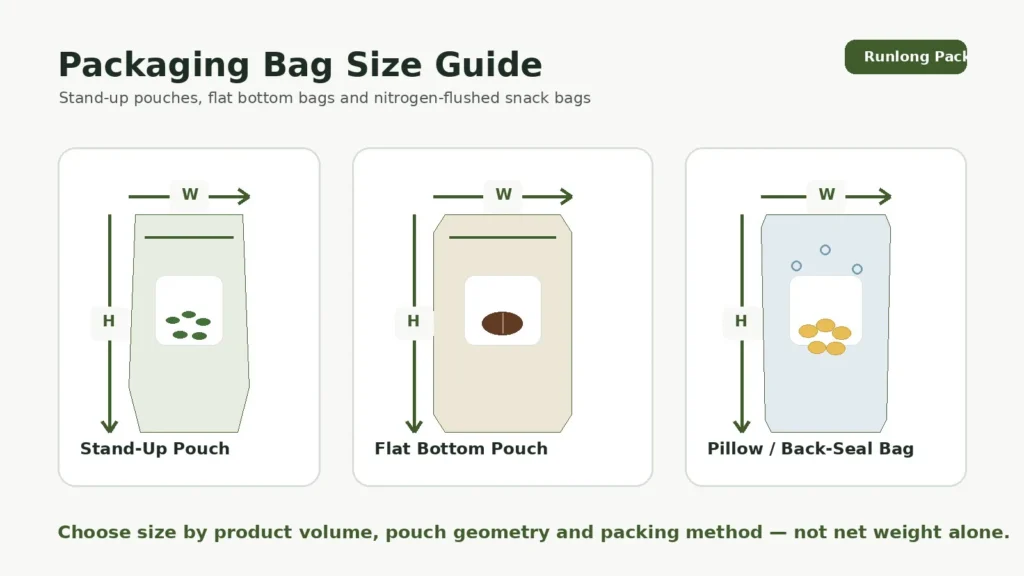
Flexible packaging dimensions are commonly described using width, height and gusset or depth. However, size notation is not completely standardized between packaging suppliers, especially for gussets.
Stand-Up Pouch Dimensions
A stand-up pouch is generally described using:
- W: pouch width
- H: finished pouch height
- G: bottom gusset or bottom fold measurement
For example, you may see a stand-up pouch described as 12 × 20 + 4 cm. Before using that number for artwork or production, confirm exactly how the supplier defines the “+4 cm” gusset.
Flat Bottom Pouch Dimensions
A flat bottom pouch has front and back panels, side gussets and a flat bottom panel. Dimensions may be written as width × height × depth or in another supplier-specific format.
For this reason, Runlong Pack recommends confirming the finished pouch drawing rather than assuming that two suppliers use identical size notation.
Back-Seal and Pillow Bag Dimensions
Snack and pillow bags are often discussed using finished width and length. For automatic packing, the specification can also depend on film width, repeat length, back-seal configuration and packaging-machine requirements.
Buyers using automatic packaging equipment can also review custom printed roll film packaging when deciding between premade bags and rollstock.
Why the Same Net Weight Can Need Different Bag Sizes

Several factors determine how much usable capacity a pouch actually provides.
- Bulk density: dense products occupy less volume per gram than lightweight products.
- Particle shape: powders settle differently from nuts, coffee beans, kibble or dried foods.
- Product settling: some products compact significantly after filling or transportation.
- Required headspace: a pouch normally should not be filled completely to the top.
- Zipper position: product must remain below the zipper and final heat-seal area.
- Valve or spout position: functional components can affect usable filling space.
- Nitrogen flushing: snack packaging may intentionally retain substantial gas volume around the product.
- Pouch geometry: stand-up, flat bottom and pillow bags use internal volume differently.
Important
Capacity charts should be treated as reference tools rather than guaranteed fill capacities. Actual capacity depends on the product, pouch construction, filling method and required headspace.
Stand-Up Pouch Size and Capacity References

The following figures come from a market stand-up pouch capacity reference supplied for comparison. They are useful for showing how different products behave in the same nominal pouch size.
Reference capacity only. These figures are not guaranteed Runlong Pack filling capacities.
Before using these figures: the market reference does not specify a verified product density or filling-test method. These gram values are not tested capacities for your product and should not be used alone to order packaging.
| Pouch Size | Tea | Sunflower Seeds | Flour |
|---|---|---|---|
| 12 × 20 + 4 cm | 100 g | 100 g | 220 g |
| 18 × 26 + 4 cm | 350 g | 380 g | 650 g |
| 20 × 30 + 5 cm | 610 g | 620 g | 1,290 g |
| 23 × 35 + 5 cm | 840 g | 920 g | 1,650 g |
| Pouch Size | Nougat | Dog Food | Rice |
|---|---|---|---|
| 12 × 20 + 4 cm | 130 g | 140 g | 330 g |
| 18 × 26 + 4 cm | 570 g | 490 g | 490 g |
| 20 × 30 + 5 cm | 1,100 g | 840 g | 880 g |
| 23 × 35 + 5 cm | 1,450 g | 1,200 g | 1,200 g |
The 20 × 30 + 5 cm example demonstrates the problem clearly. The same nominal pouch is referenced at approximately 610 g for tea, 620 g for sunflower seeds and 1,290 g for flour.
This is why a statement such as “20 × 30 cm holds 1 kg” is not reliable unless the product and gusset are also specified.
Explore our custom stand-up pouches for available formats and customization options. Dimensions and usable capacity are confirmed for each project.
Flat Bottom Pouch Size and Capacity References
Flat bottom pouches, also commonly called eight-side seal bags in the Chinese packaging industry, provide a different internal shape from conventional stand-up pouches.
The following figures come from a market flat bottom pouch capacity reference. They are practical comparison values rather than guaranteed specifications.
| Pouch Size | Rice | Flour | Tea |
|---|---|---|---|
| 12.5 × 20 + 7 cm | 750 g | 300 g | 120 g |
| 15.5 × 24 + 7 cm | 1,000 g | 500 g | 150 g |
| 18 × 28 + 8 cm | 2,000 g | 1,500 g | 350 g |
| 20 × 30 + 8 cm | 2,500 g | 2,000 g | 500 g |
| Pouch Size | Red Dates | Sunflower Seeds | Dog Food |
|---|---|---|---|
| 12.5 × 20 + 7 cm | 200 g | 250 g | 250 g |
| 15.5 × 24 + 7 cm | 400 g | 500 g | 500 g |
| 18 × 28 + 8 cm | 550 g | 850 g | 1,000 g |
| 20 × 30 + 8 cm | 800 g | 1,100 g | 1,250 g |
A 20 × 30 + 8 cm flat bottom pouch is referenced at approximately 2,500 g for rice but only around 500 g for tea.
This difference reinforces the main sizing rule: the product name and target net weight should be evaluated together.
Explore our flat bottom pouches for available formats and customization options. Dimensions and usable capacity are confirmed for each project.
Runlong Pack Flat Bottom Coffee Pouch Reference Sizes
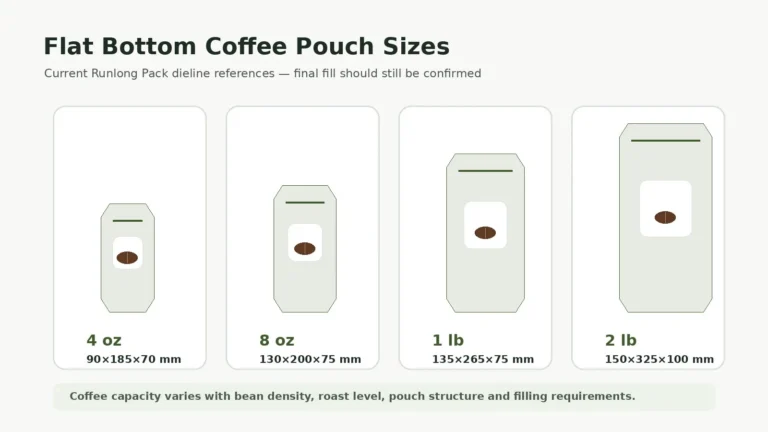
Coffee packaging provides a useful example of product-specific sizing. Runlong Pack’s coffee pouch dieline reference library includes the following flat bottom pouch reference dimensions.
| Coffee Capacity | Approx. Metric Weight | Reference Finished Size |
|---|---|---|
| 4 oz | 113 g | 90 × 185 × 70 mm |
| 8 oz | 227 g | 130 × 200 × 75 mm |
| 1 lb / 16 oz | 454 g | 135 × 265 × 75 mm |
| 2 lb | 907 g | 150 × 325 × 100 mm |
These are Runlong Pack reference dimensions rather than universal coffee bag standards. Actual coffee capacity can vary with bean density, roast level, pouch construction, valve position, zipper position and desired headspace.
A darker roasted coffee may occupy a different volume from a denser coffee even when both packages contain the same net weight.
Important
Use a coffee pouch dieline as a starting point rather than an automatic capacity guarantee. Confirm the final pouch before production artwork is approved.
Nitrogen-Flushed Potato Chip Bag Size References
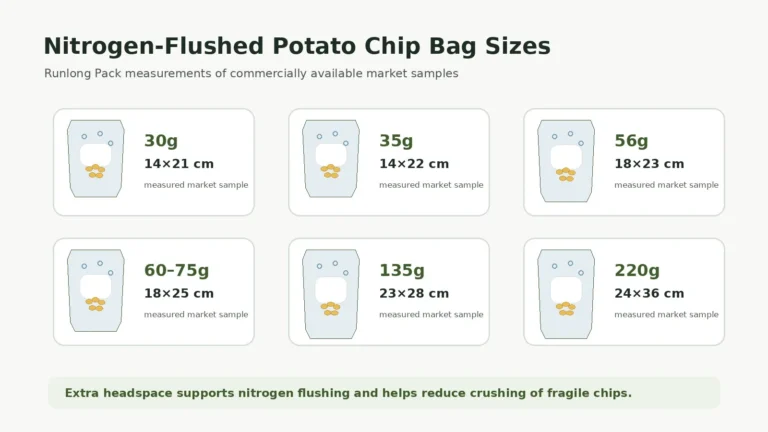
Potato chip packaging works very differently from dense dry-food packaging. Runlong Pack measured several commercially available nitrogen-flushed potato chip bags to create practical real-market references.
| Potato Chip Net Weight | Measured Bag Size | Reference Source |
|---|---|---|
| 30 g | 14 × 21 cm | Commercial market sample |
| 35 g | 14 × 22 cm | Commercial market sample |
| 56 g | 18 × 23 cm | Commercial market sample |
| 60–75 g | 18 × 25 cm | Commercial market sample |
| 135 g | 23 × 28 cm | Commercial market sample |
| 220 g | 24 × 36 cm | Commercial market sample |
These measurements are practical market references, not universal potato chip packaging standards. Different chip shapes, fill ratios, nitrogen levels, sealing areas and brand presentation requirements can result in different finished bag dimensions.
Why Nitrogen-Flushed Snack Bags Need More Space
A potato chip bag can look unusually large compared with the printed net weight because the package is not intended to be filled completely with chips.
Nitrogen-flushed snack packaging intentionally retains additional gas space around the fragile product. This gas-filled headspace supports the packing process and can help reduce crushing during transportation and handling.
A 60 g nitrogen-flushed potato chip bag therefore should not be compared directly with a 60 g pouch of flour, nuts or coffee.
Key Takeaway
For nitrogen-flushed snacks, the bag must accommodate both product volume and required gas volume. Net weight alone is especially unreliable for fragile snack products.
How to Choose the Right Bag Size for Your Product
- Confirm the product. Tell the packaging supplier exactly what will be packed.
- Confirm the target net weight. Examples include 100 g, 250 g, 500 g, 1 kg, 8 oz or 1 lb.
- Select the pouch format. Stand-up, flat bottom, side gusset and pillow bags use volume differently.
- Consider product density and shape. Provide bulk density if known, or send a physical sample when practical.
- Allow suitable headspace. Consider zipper position, top seal, valve, spout and the desired filled appearance.
- Confirm the filling method. Manual filling, automatic filling, vacuum packaging and nitrogen flushing create different dimensional requirements.
- Perform a filling test when necessary. Testing the actual product is safer than relying entirely on a generic size chart.
How Zippers, Valves and Other Features Affect Usable Capacity
Zipper
A resealable zipper normally sits below the top seal. Product should remain below the zipper area so the pouch can be closed and heat sealed correctly.
Coffee Degassing Valve
A one-way coffee degassing valve must be positioned relative to the zipper, top seal and artwork. It can affect the usable filling and design area even though it does not directly define the bag’s capacity.
Spout
Spouted pouches need sufficient space for the spout fitment and sealing area. Liquid volume, headspace and filling process should be evaluated together.
Hang Hole and Tear Notch
Hang holes and tear notches also occupy structural areas near the top of the pouch and should be considered before the final dieline is approved.
Does Bag Size Affect MOQ?
Yes, but not always in the way buyers expect. At Runlong Pack, a larger bag does not automatically mean a higher minimum order quantity when MOQ is expressed in finished pieces.
The reason is film consumption.
- Smaller bag: consumes less film per finished piece, so more finished pieces may be needed to reach the practical minimum film usage.
- Larger bag: consumes more film per finished piece, so fewer finished pieces may sometimes reach the same minimum film requirement.
Therefore, a larger pouch can sometimes have a lower practical piece MOQ than a much smaller pouch.
Bag size is only one factor. Material structure, printing method, SKU quantity and whether the film is a standard or special material can also affect the practical MOQ.
Why Bag Size Also Affects Packaging Cost
Bag size changes the amount of film consumed per finished piece. A larger pouch normally consumes more material, but dimensions alone are not enough to calculate the final packaging price.
Material structure, thickness, printing method, color count, order quantity, zipper or valve requirements, pouch type and number of SKUs all need to be evaluated together.
Common Bag Size Selection Mistakes
Assuming 500 g Always Uses the Same Bag Size
There is no universal 500 g pouch. Five hundred grams of flour, coffee beans, dog food, tea and dried fruit can all require different dimensions.
Copying a Competitor’s Dimensions Without Testing
A competitor may use a different product density, fill ratio, pouch structure, sealing area or presentation style. Their package can be useful as a reference, but it does not guarantee the same result for another product.
Ignoring Headspace
A pouch that can physically hold the target weight when completely filled may still be too small for practical production. Sufficient room is required for the zipper, top seal and handling area.
Confusing Gusset Notation
A “+4 cm” gusset from one supplier may not be defined exactly the same way by another supplier. Always confirm the finished dimensional drawing.
Finalizing Artwork Before Confirming the Bag Size
Changing pouch dimensions after artwork has been created can require substantial layout changes. Confirm the production dieline before artwork approval.
Information to Provide for a Bag Size Recommendation
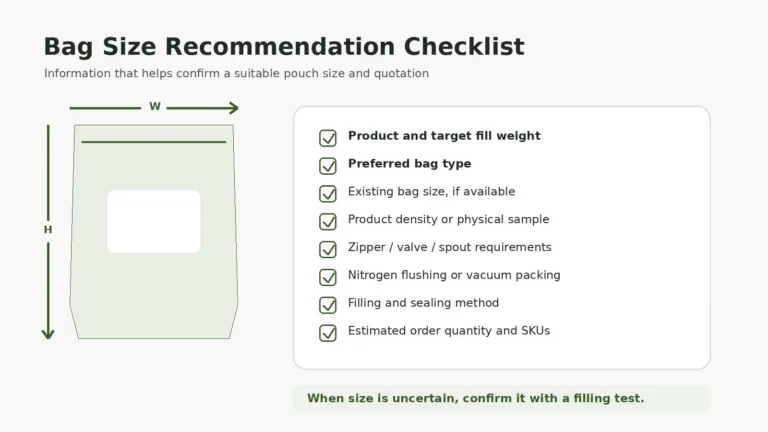
Start with three simple details
- Product: what you want to pack.
- Target fill weight or volume: for example, 250 g or 1 lb.
- Pouch style or reference photo: if you are unsure, tell us and we can discuss the options.
If known, include your estimated order quantity and whether filling will be manual or automatic. You do not need a finished drawing or confirmed bag dimensions to start a conversation.
Confirm these details before sampling or production
- Existing bag dimensions, product density or a suitable sample, where available.
- Material and barrier requirements, finished dimensions and gusset notation.
- Zipper, valve, spout, tear notch and other functional features.
- Headspace, nitrogen flushing or vacuum requirements, and filling/sealing equipment.
- Quantity per design, number of SKUs and final artwork/dieline.
What happens next: we review the information, discuss candidate pouch formats and dimensions, and identify any filling or sample checks needed. A photo or capacity chart alone cannot validate final fit.
Packaging Bag Size Guide FAQ
What size pouch do I need for 500 g?
There is no universal 500 g pouch size. The required dimensions depend on product bulk density, shape, pouch format, headspace and filling method.
How much can a 20 × 30 cm stand-up pouch hold?
There is no guaranteed fill weight for a 20 × 30 cm stand-up pouch. Confirm the gusset definition, product bulk density, zipper and sealing allowance, headspace and filling method. Use the market charts only to compare possible options, then validate capacity with the actual product before production.
What flat bottom pouch size is used for 1 lb of coffee?
Runlong Pack’s current reference size for a 1 lb / 16 oz flat bottom coffee pouch is 135 × 265 × 75 mm. The final size should still be confirmed for the actual coffee and filling requirements.
Why is a potato chip bag much larger than its net weight suggests?
Nitrogen-flushed potato chip packaging needs additional gas space around the product. This headspace supports the packing process and helps protect fragile chips during transportation.
Does a larger bag always have a higher MOQ?
No. At Runlong Pack, larger bags consume more film per piece and can sometimes reach the practical minimum film usage with fewer finished pieces.
Should I rely on an online pouch capacity chart?
Use capacity charts only as a starting point. A filling test with the actual product is safer when the final capacity is uncertain.
Confirm Your Packaging Bag Size Before Production
The most reliable pouch size is not simply the dimension that appears most often on an online chart. It is the size that provides the required capacity, headspace, sealing area, filled appearance and packing performance for the actual product.
If you already have an existing pouch, provide its dimensions and a photo. For a new project, send the product, target fill weight, preferred bag type, required features and estimated order quantity.