

Does the Paperwork Match Your Package?
Before you approve a pouch order, connect the paperwork to the package you will actually use. This guide helps purchasing and QA teams identify document gaps before committing to a material, filling process or production order.
How should U.S. buyers check food packaging compliance documents?
Food packaging compliance documents should connect the actual packaging specification to its intended food-contact use. Start with the food, contact time, temperatures and processing conditions, then ask for applicable supplier statements, supporting reports and traceability. Check product identity, construction, use conditions and regulatory basis together. A report marked Pass, a BPA result or a food-grade statement alone does not establish suitability for every finished pouch.
Quick Facts
Swipe tables sideways on smaller screens to see all columns.
| Buyer question | Practical answer |
|---|---|
| Is there one universal FDA certificate for every pouch? | Do not treat a generic certificate as blanket coverage. Ask what product and intended use the documentation supports. |
| What should purchasing request first? | A current packaging specification plus a clear intended-use brief. |
| Must every project have identical tests? | No. The evidence needed depends on the construction, regulatory basis, use conditions and buyer requirements. |
| Does a report prove shelf life or seal performance? | Only if those properties were actually evaluated under relevant conditions; chemical testing is not a complete production trial. |
| Who should resolve applicability questions? | The supplier and the buyer’s QA or regulatory team, with laboratory or specialist input where needed. |
1. Define the Food and Intended Use Before Requesting Documents
The most useful opening question is not “Do you have FDA certification?” It is “Which documentation supports this packaging specification for our intended use?” Two buyers purchasing visually similar pouches may need different supporting information.
Give the supplier a short project brief: food identity and relevant characteristics, direct-contact surfaces, fill temperature, any post-fill treatment, storage conditions and expected contact duration. Identify the U.S. destination market and your company’s additional requirements. Where relevant, include acidity, fat content and alcohol content so your QA team can define the appropriate food-contact category and evaluation conditions.
Distinguish filling temperature from later thermal treatment. Cold filling, hot filling, in-pack pasteurization, retort and frozen storage are not interchangeable assumptions. Include the complete cycle and any consumer heating instructions rather than a single peak temperature. The pasteurization pouch selection guide explains why the process must be confirmed separately from the pouch name.
Keep Performance and Regulatory Review Connected—but Separate
A food-contact document does not necessarily demonstrate oxygen barrier, drop resistance, machine compatibility, seal reliability or product shelf life. Ask for the applicable evidence in each area. Use the same specification revision across the compliance review and filling trials, so the approved paperwork does not describe a different pack from the tested sample.
2. Know What Each Document Shows—and What It Does Not
A useful evidence package may combine several document types. This table is a purchasing aid, not a universal legal list of mandatory documents. Agree the actual requirements with your QA team.
| Document type | What it helps establish | What to check before relying on it |
|---|---|---|
| Packaging specification or technical data sheet | Product code, construction, thickness, dimensions and accessories | Revision, tolerances, contact layer and linkage to the quoted and supplied product |
| Supplier food-contact statement or letter of guaranty, as applicable | The supplier’s stated basis and scope for an intended use | Issuer, identified product, U.S. regulatory basis, restrictions and accountable contact |
| Laboratory test report | Findings for identified samples, methods and test conditions | Complete report, sample description, methods, limits, conditions and scope of conclusions |
| Upstream material or component documentation | Support for identified inputs used in the package | Link to the actual supplier, grade, construction and intended use; not just a generic resin name |
| Batch quality or conformity record | Evidence of agreed production checks for a shipment | Relevant lot, specification revision, test method and agreed acceptance criteria |
| BPA-related statement or analysis | Evidence addressing the specific BPA question within its scope | Whether it is a formulation statement or an analytical result, and what sample and detection limit it covers |
A safety data sheet may help describe a substance or handling hazard, but it is not a substitute for a food-contact applicability review. A specification describes the pack; a report describes an evaluation. Neither should silently stand in for the other.
Read Beyond the Cover Page
Keep the complete report, including sample photographs or descriptions, test conditions, results, notes and limitations where provided. Check the issuer and report identity through a reliable channel if authenticity is uncertain. Do not accept a cropped Pass result without knowing what was submitted and evaluated.
“Not detected” means below the reported method’s detection or reporting threshold for that evaluation; it is not a claim of absolute absence. Results on a mixed test portion should not automatically be assigned to every individual layer or accessory.
3. Match the Paperwork to the Actual Pouch in Six Checks
Use a single review sheet and record a supporting document or clarification for each check. Material names such as PET/PE are a starting description, not a complete document-to-product linkage.
| Matching check | What the buyer should record | Question to resolve if unclear |
|---|---|---|
| Product identity | Supplier, product code, specification revision and report sample identity | How is the evaluated sample linked to the ordered pouch or film? |
| Construction and components | Layers, grades where relevant, thicknesses, printing, adhesives and accessories | Does the evidence address the actual construction and relevant component uses? |
| Food and contact surfaces | Food characteristics and which surfaces or parts contact it | Are the intended food and contact arrangement within the stated scope? |
| Conditions of use | Filling, treatment, storage, contact time and any intended heating | Do the restrictions and evaluation conditions support this use? |
| Regulatory basis | Applicable U.S. references and supplier explanation | What basis supports the relevant substances and their intended uses? |
| Traceability and change control | Material linkage, lot records and notification expectations | Can the supplied product be connected to the reviewed evidence after a change? |
Review the Whole Construction, Not Just the Inner Film
For a printed laminated pouch, ask how the supplier’s supporting evidence relates to the finished construction. Consider the contact layer, other relevant layers, inks, adhesives and components such as spouts, caps, zippers or valves, as applicable. Your QA team should determine which substances and pathways require evaluation; this does not mean identical tests must be performed on every part.
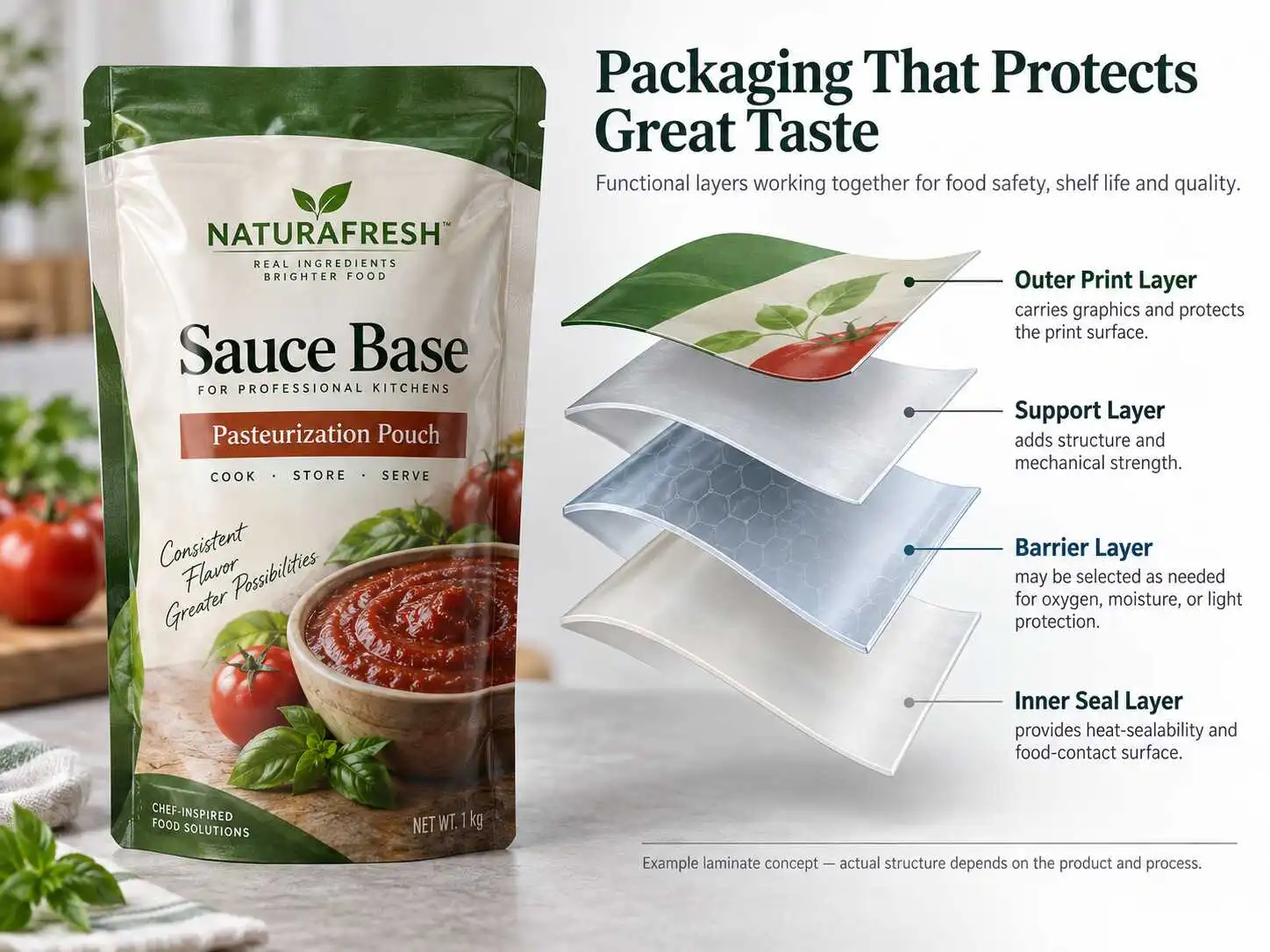
An outer print layer does not make all ink questions irrelevant, and a food-contact resin statement does not automatically explain the entire laminate. Ask for the supplier’s linkage and intended-use assessment rather than assuming either blanket coverage or blanket failure. For construction terminology, see the flexible packaging material structure guide.
4. Check the Regulatory Basis, Not Just an FDA Reference
FDA explains that relevant substances need an applicable basis for their intended food-contact use, such as a regulation, GRAS status, prior sanction, a Threshold of Regulation exemption or an effective food-contact notification. Ask your reviewer to check substance identity, specifications and use limitations—not simply whether an FDA reference appears on the page.
The FDA guide to determining regulatory status is an official starting point. It does not replace a project assessment by a qualified reviewer.
If an FCN Is Cited, Confirm the Supply Link
An FCN is specific to the named manufacturer or supplier, substance and conditions. Check the FDA inventory of effective notifications and the documented supply linkage. A pouch converter need not itself be the named upstream manufacturer if the relevant material is traceable to an applicable source. Not every component needs an FCN; another applicable basis may support its use.
A statement referring to European requirements can be useful information, but it does not by itself answer the U.S. applicability question. Likewise, a U.S. food-contact review does not automatically resolve separate state, customer, sustainability or labeling requirements. Ask QA to identify the additional rules relevant to the project rather than combining every requirement into one “certified” claim.
5. Work Through a Document-to-Project Mismatch
Consider this hypothetical example. A buyer plans a printed laminated spout pouch for an acidic sauce, followed by in-pack pasteurization. The first document supplied describes an unprinted PE film evaluated under room-temperature contact conditions. No statement links that sample to the finished pouch.
The correct initial conclusion is applicability not yet established, not “the report is fake” or “the pouch is unsafe.” The report may be useful input, but the buyer needs an explanation of its relationship to the proposed project and any additional support QA requires.
| Observed gap | Follow-up request | Decision until resolved |
|---|---|---|
| Report sample describes PE film, while the order is a printed laminate | Link the report to the specific contact layer and explain support for the finished construction | Keep the construction review open |
| Spout and cap are not identified | Identify the accessory specification and applicable supporting evidence | Do not assume the film report covers accessories |
| Evaluation conditions differ from the intended food and thermal cycle | Ask QA and the supplier whether existing support applies or further evaluation is needed | Do not infer process suitability from a Pass label |
| No revision or supply linkage is provided | Record the proposed specification and supporting material sources | Hold final approval pending traceability clarification |
6. Handle Missing Information and Changes Without Guessing
Use three clear review states: sufficient for QA review, information missing, or applicability uncertain. These are workflow states, not certificates or final legal determinations. Record the open question, responsible person, evidence needed and target date.
“Sufficient for QA review” means the evidence package is ready for an informed decision; it does not mean purchasing has independently approved compliance. If a report omits the sample linkage, request clarification. If use conditions exceed the stated scope, ask whether a different supporting basis or additional evaluation is needed. Do not rename the gap “approved” merely to meet a shipping date.
Re-Review When the Specification or Use Changes
Set a change-notification process for relevant material grades or suppliers, construction, thickness, inks, adhesives, accessories and manufacturing changes. Also re-check when the food, filling conditions, thermal process or storage use changes. The responsible reviewer decides whether existing evidence still applies or additional support is required.
An older report is not automatically expired solely because of its age. Check whether the evaluated product and conditions remain representative, whether its stated validity or customer requirements apply, and whether the underlying regulatory basis remains current. Agree a practical review schedule with QA rather than inventing a universal one-year expiry rule.
7. What Runlong Pack Can Discuss for Your Project
Runlong Pack uses food-grade raw materials for flexible packaging production and does not use recycled, secondary or scrap materials. That sourcing policy does not replace the review of your particular material structure and intended food-contact use.
Depending on the applicable material and project, available support may include FDA-related test reports, BPA-related files and upstream supplier compliance documentation. The packaging compliance and quality-control page presents sample-specific report summaries and their limitations. Read those summaries as scoped evidence, not as approval for every pouch, food or thermal process; request the complete documentation and confirm its relationship to your project.
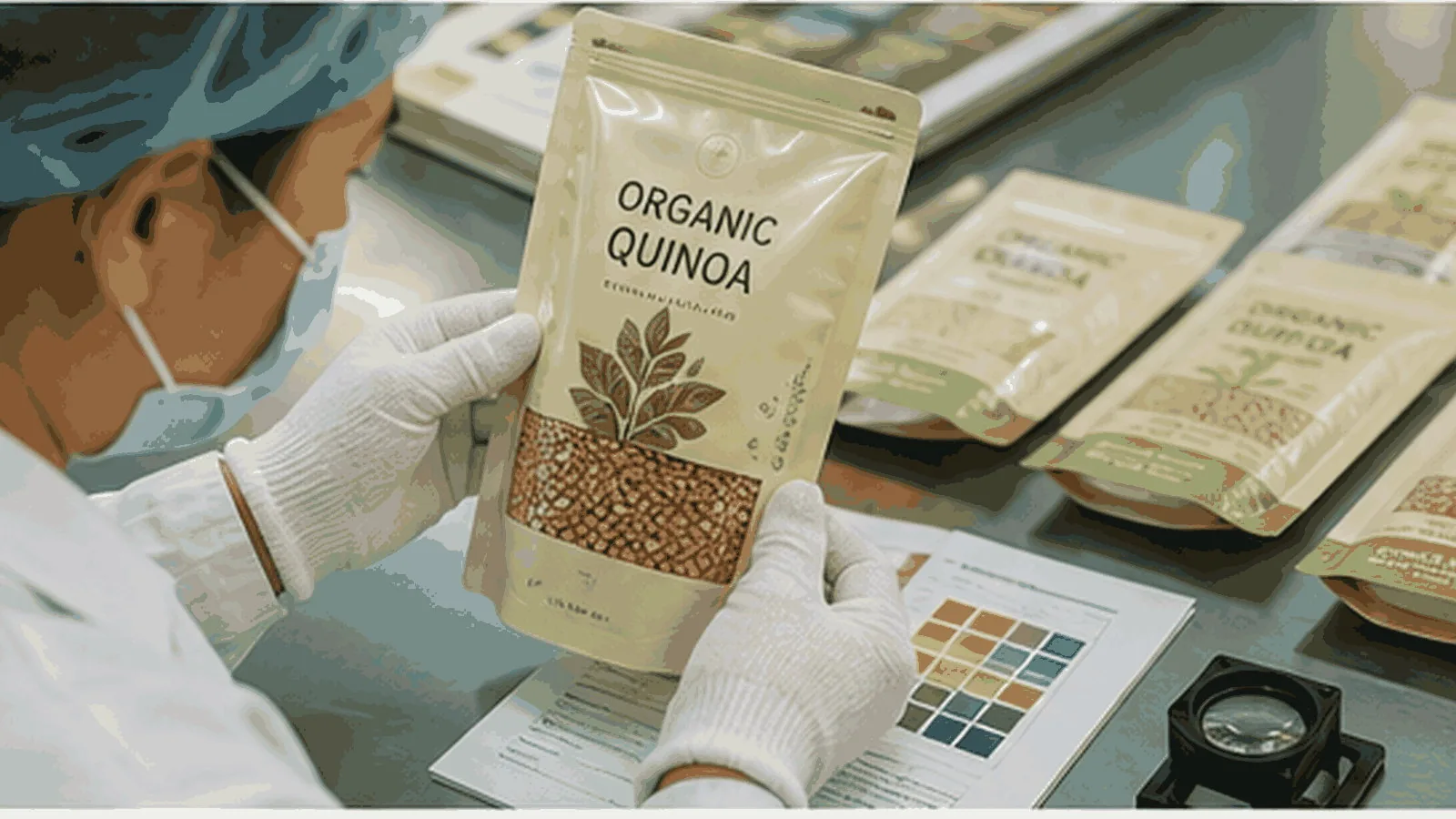
Customer-specified third-party testing can be discussed where needed. Confirm the test scope, laboratory requirements, sample, timing, cost and responsibility separately before committing. Do not assume every project receives the same testing or that testing is automatically free.
For the separate production-performance review, use the flexible packaging quality-control checklist. Appearance and seal checks complement document review but do not establish chemical food-contact suitability by themselves.
8. Use This Buyer Worksheet Before Final Approval
Copy the following fields into your procurement or supplier-approval form. Enter document references rather than ticking boxes from memory. This worksheet is a practical starting point; QA should adapt it to the actual project.
| Review field | Buyer entry | Evidence or action to record |
|---|---|---|
| Project / food / U.S. destination | __________ | Relevant food characteristics and additional buyer requirements |
| Pouch or film code / specification revision | __________ | Current specification, construction and accessory list |
| Contact surfaces / fill and processing conditions | __________ | Food-contact arrangement, full cycle, storage and contact duration |
| Supplier statement / regulatory basis | __________ | Document identity, intended-use scope and applicable references |
| Reports and upstream support | __________ | Sample linkage, methods, restrictions and material-source relationship |
| Open questions / responsible person / due date | __________ | Missing information or applicability clarification |
| Change-control agreement / lot linkage | __________ | Notification expectations and production traceability |
| QA decision / approver / date | __________ | Approved scope, remaining conditions and controlled evidence version |
Keep a Controlled Approval Package
Collect the specification and intended-use brief, obtain supporting documents, resolve gaps, have QA record its decision, and link that decision to the purchase order and relevant lots. Keep any conditions of approval visible to both purchasing and production.
Before a reorder, confirm that the reviewed specification and intended use have not changed. Where a sample or filling trial is needed, agree what it is intended to demonstrate; the custom packaging sample cost guide helps separate sample purposes and project-specific arrangements.
Food Packaging Compliance Documents FAQ
Is there a universal FDA certificate for every food pouch?
No single generic certificate should be treated as coverage for every pouch, construction and intended use. Ask the supplier to identify the product, supporting U.S. regulatory basis, conditions and limitations, and have your QA or regulatory reviewer assess applicability.
Can raw-material documentation support a finished laminated pouch?
Yes, it can form part of the evidence package when it is linked to the actual materials and their uses. It does not automatically cover the complete printed laminate, accessories or every food-contact condition. Ask how the supplier connects upstream support to the finished specification.
Does a BPA Free statement establish complete food-contact compliance?
No. It addresses a specific BPA-related question within its stated scope. A test result must be read with its sample, method and detection limit, and it does not replace the broader review of construction, relevant substances and intended use.
Do material or accessory changes require new testing every time?
Not automatically. Relevant changes require an applicability review. The responsible QA or regulatory reviewer should decide whether existing evidence still supports the revised project, supplier clarification is sufficient or additional testing is needed.
Is an older food-contact report automatically expired?
No universal expiry period should be assumed. Review stated validity, customer requirements, sample representativeness, specification changes and the current regulatory basis. An unchanged date alone cannot establish either continuing suitability or failure.
Can European food-contact documents replace U.S. checks?
Not by themselves. They may provide useful supporting information, but your reviewer still needs to assess the applicable U.S. basis and intended-use scope, along with any relevant state or customer requirements.
Request Documents for the Package You Intend to Buy
Share your product, pouch or rollstock format, proposed material, accessories, filling temperature, processing cycle, storage conditions and required documents. We can help discuss available applicable support and what needs further confirmation before production.
Related Guides
Sources and Scope
Official reference: FDA — Determining the Regulatory Status of Components of a Food Contact Material.
Official reference: FDA — Inventory of Effective Food Contact Substance Notifications.
This article is a procurement checklist, not legal advice, a laboratory assessment or project-specific compliance approval. The example is hypothetical. Review the actual construction and intended use with your QA or regulatory team and consult the current applicable sources when making an approval decision.