

When Is the Larger Order Worth It?
A practical order-size review for food brands, coffee roasters and packaging buyers planning their next custom pouch order.
When does a lower pouch price save money?
Larger orders can lower custom pouch costs when the specification is stable, demand supports the quantity and the additional packaging will remain usable. A lower quoted price is not enough: compare the total purchase commitment, expected consumption, stock remaining and any confirmed artwork or specification changes over the same planning period. Do not treat usable inventory as waste, but do include packaging that will genuinely become obsolete.
Quick Facts
On smaller screens, swipe each table sideways to view all columns.
| Buyer question | What to establish before increasing an order |
|---|---|
| How many pouches do we need? | Forecast usage by SKU, usable stock, confirmed incoming stock and a justified buffer. |
| Are the quotes comparable? | The same approved pouch specification, cost scope and delivery conditions. |
| Can the extra stock still be used? | Artwork validity, product plans, storage conditions and any specification changes. |
| Is the printing route suitable? | Actual pouch format, dimensions, material, design count and quantity—not total volume alone. |
| What is the decision? | A documented order quantity and reorder plan, not a universal discount threshold. |
1. Establish the Quantity You Can Actually Use
Before asking for a larger-volume price, check the packaging already available to the business. Stock counts can be misleading if they include an old design, the wrong pouch size or material that no longer meets the approved specification.
Use one row per SKU or artwork version. A stable core product and a new flavor should not automatically receive the same inventory coverage.
Order-Quantity Planning Worksheet
| Field | Buyer entry | Why it matters |
|---|---|---|
| SKU and approved artwork version | __________ | Separates usable packaging from superseded designs. |
| Planning period and expected usage | __________ | Defines the demand the order is intended to cover. |
| Usable stock on hand | __________ | Prevents purchasing stock already available. |
| Confirmed incoming stock and arrival date | __________ | Avoids double-ordering and identifies stock that arrives too late. |
| Closing inventory buffer and its justification | __________ | Makes the contingency visible rather than hiding it in a larger order. |
| Known artwork or specification change date | __________ | Identifies when the current version may stop being usable. |
| Storage capacity and applicable storage requirements | __________ | Checks whether the additional packaging can be held appropriately. |
A simple planning calculation is:
Planning quantity = max(0, forecast usage + justified closing buffer − usable stock on hand − eligible confirmed incoming stock).
Only subtract incoming stock that arrives before the demand it is intended to cover. Forecast usage and the closing buffer must relate to packaging that will remain suitable under the approved artwork and specification. Check receipt and usage dates separately: enough stock at period end does not prevent an earlier shortage.
The zero floor means the calculation cannot create a negative order. This is a planning starting point, not a production commitment; check supplier feasibility and forecast uncertainty before placing an order.
The useful question is not “How much more can we buy to get a lower price?” It is “What quantity can this business reasonably use while the approved specification remains valid?”
2. Compare Order Sizes Over the Same Planning Period
A quote for 40,000 pouches and a quote for 60,000 pouches represent different cash commitments. Comparing their unit prices alone hides that difference.
Choose a common review period—for example, the period covered by your production forecast—and examine both options against it. Record:
- The quantity purchased and the full cost scope of the quotation.
- Packaging expected to be consumed during the period.
- Packaging expected to remain usable afterward.
- Packaging known to become unusable because of a confirmed change.
- Any separately estimated freight, storage or other costs not included in the quoted price.
Do not count usable stock remaining at the end of the period as an automatic loss. It still has a future use. Show it separately as inventory and cash committed, then assess how likely that future use is.
For the basic order-size comparison, keep the approved specification unchanged. If the supplier proposes a different material, dimension, pouch format or feature, treat it as a separate option requiring its own evaluation.
For a wider explanation of price drivers, see What Affects Custom Flexible Packaging Cost?. To compare different suppliers on equivalent terms, use the Flexible Packaging Quote Comparison Guide.
3. A Lower Pouch Price Can Still Create a More Expensive Outcome
Consider this hypothetical example. It is not a Runlong quotation, a market price benchmark or a promise of volume savings.
Both order sizes use the same approved specification. The common planning period requires 40,000 pouches. This example includes pouch purchase spend only; it excludes tooling, freight, storage, filling and other expenses.
| Order option | Quantity purchased | Assumed price per pouch | Purchase spend |
|---|---|---|---|
| A | 40,000 | USD 0.24 | USD 9,600 |
| B | 60,000 | USD 0.22 | USD 13,200 |
The larger order requires USD 3,600 more purchase spend upfront. What happens to its additional 20,000 pouches determines how to interpret that commitment.
| Outcome for the same 40,000-pouch demand | Pouches used | Remaining stock | Purchase-only cost attributed per pouch used |
|---|---|---|---|
| A: all purchased stock is consumed | 40,000 | None | USD 0.24 |
| B: extra stock remains usable | 40,000 | 20,000 usable pouches | USD 0.22 |
| B: extra stock becomes obsolete | 40,000 | 20,000 unusable pouches are written off | USD 0.33, including the write-off |
In the usable-stock case, USD 8,800 of Option B’s purchase spend relates to the 40,000 pouches consumed, while USD 4,400 remains in usable inventory at the assumed purchase price. The business still paid USD 13,200 upfront; the lower consumption cost does not remove that additional cash commitment.
If a confirmed design change instead makes the remaining 20,000 pouches unusable, attributing the purchase spend—including that write-off—to the 40,000 pouches used gives:
USD 13,200 ÷ 40,000 pouches used = USD 0.33 per pouch used.
This is an illustrative purchasing calculation, not a new supplier unit price or a full accounting-cost model. If the remaining 20,000 pouches can be consumed later, the USD 0.33 write-off calculation does not apply. If all 60,000 are eventually used, the purchase cost per pouch used remains USD 0.22.
Check the Downside Before Approving the Extra Volume
For each larger-order option, ask:
- How much additional cash does it commit?
- How many of the additional pouches have a credible production use?
- What happens if the next label review, product change or artwork update occurs sooner than expected?
- Would a smaller initial order and a planned reorder better match the uncertainty?
There is no universal percentage saving that answers these questions for every project.
4. Give Each SKU Its Own Volume Decision
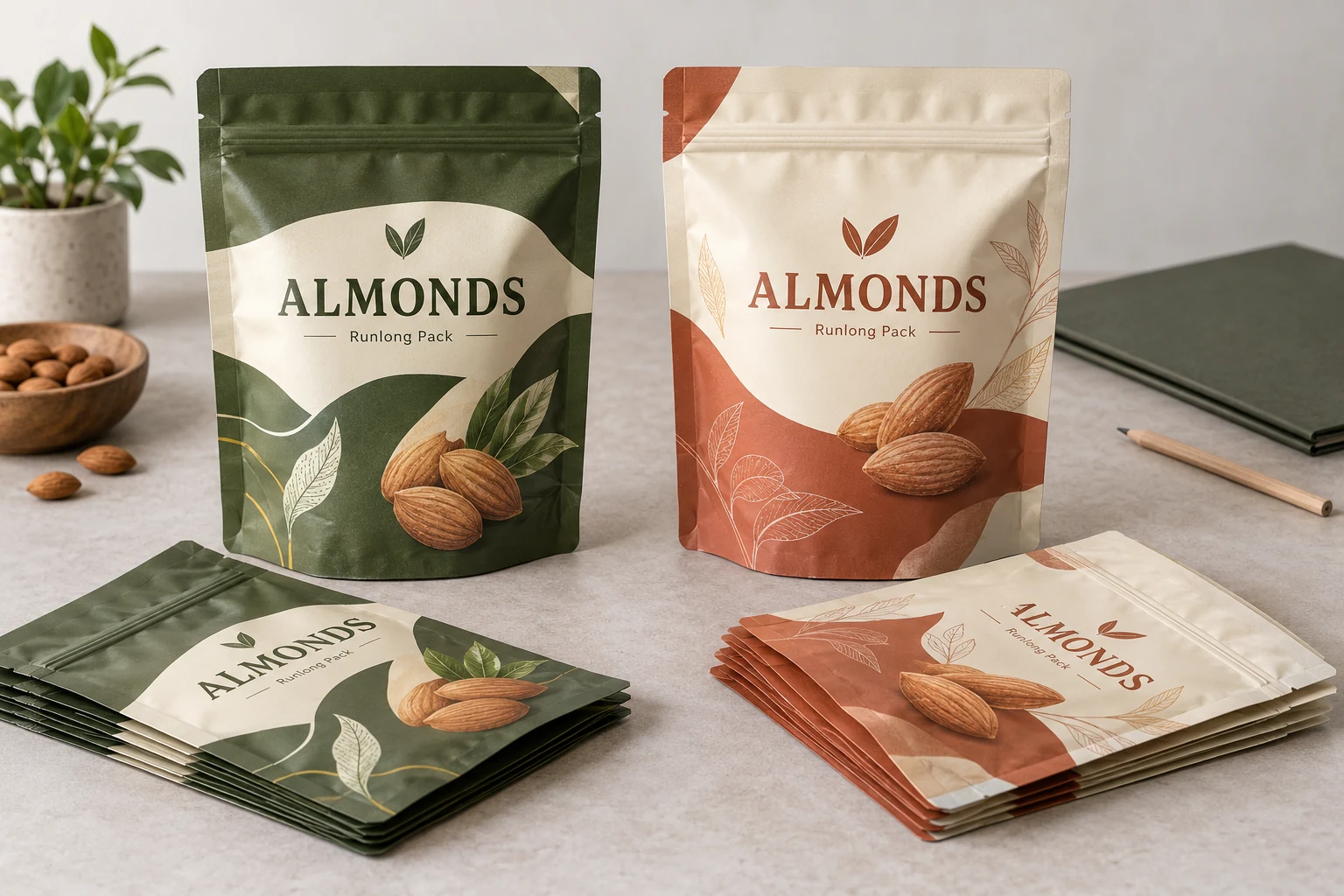
A combined order of 60,000 pouches does not mean every design should be produced in the same quantity. One SKU may be a stable repeat seller; another may be seasonal, experimental or due for an artwork change.
Record quantity and expected usage separately for each design before comparing printing routes. This allows a buyer to increase volume on a proven SKU without creating unnecessary stock for a slower one.
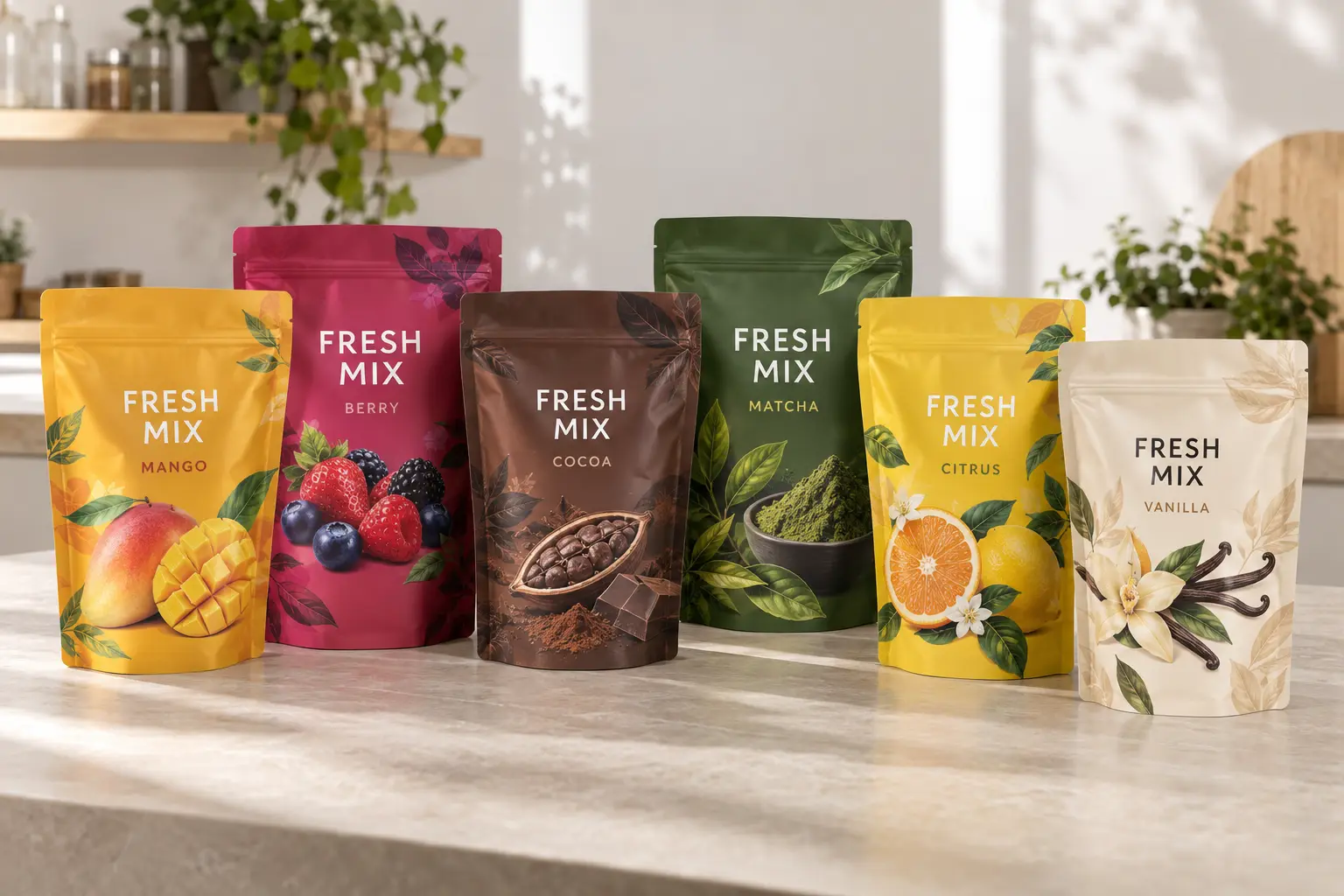
At Runlong Pack, compatible multi-SKU digital projects may be evaluated by total quantity when material, dimensions and production conditions allow. This does not guarantee combined pricing for every combination of designs. Gravure projects normally require separate cylinders for each design, so total order volume should not be treated as a substitute for per-design evaluation.
Before increasing the order, establish how much of each approved version your business can use. For a detailed coffee-specific planning example, see Multi-SKU Coffee Bag Orders.
5. Choose the Printing Route After Establishing a Realistic Quantity
An order should not be increased purely to fit a printing method. First establish realistic demand, then ask which feasible route provides the better overall result.
For suitable ordinary custom pouch projects, Runlong Pack generally recommends around 1,000–3,000 pieces for digital printing, although some smaller projects can be evaluated. Ordinary gravure projects typically start around 10,000 pieces. These are not universal rules for every pouch.
For example, spout pouches have different guidance: digital printing is normally recommended from around 1,000 pieces, while gravure printing starts around 15,000 pieces. Flat-bottom pouches, large formats and special processing applications also require their own evaluation.
The comparison should reflect the actual format, size, material, artwork and quantity. A digital route may suit changing designs or a demand test; a suitable stable repeat project may justify evaluating gravure. Neither method is automatically the lowest-cost choice at a single universal threshold.
Use the Digital vs. Gravure Printing Guide for the detailed printing comparison and the MOQ Guide for product-specific quantity considerations.
6. Request a Baseline and a Clearly Identified Alternative
If the larger-order quotation still does not fit the budget, ask for an alternative evaluation without losing the reference specification.
Request two distinct proposals:
- Baseline: the current approved specification at the quantity options you are considering.
- Alternative: a separately identified proposal showing exactly what changes, why it may be suitable and what must be revalidated.
Any alternative must still meet the required barrier, sealing and product-protection requirements. A cheaper quotation for a changed specification is not a same-specification saving.
Specification-Alternative Review Sheet
| Review item | Record before accepting the alternative |
|---|---|
| Baseline and non-negotiable requirements | Approved specification and artwork version; product protection, filling, sealing, shelf-life and applicable market requirements. |
| Proposed changes | Every difference from the baseline, including printing method or pouch specification. |
| Expected cost effect | The quoted cost difference and any new one-time or repeat charges. |
| Validation and approval | Required checks for the changed specification; final approved specification and artwork version. |
Runlong Pack selects material structures according to the contents, target shelf life, filling and sealing conditions, temperature exposure and customer requirements. We use food-grade raw materials for all flexible packaging production and do not use recycled, secondary or scrap materials. That raw-material policy does not replace project-specific suitability and compliance checks.
If an alternative changes the production route from premade pouches to rollstock, use a separate operational evaluation rather than comparing packaging purchase prices alone. The Premade Pouches vs. Rollstock Guide addresses that decision in more detail.
7. Confirm What a Repeat Order Actually Repeats
A reorder can retain an approved design and specification, but the quotation still needs current confirmation.
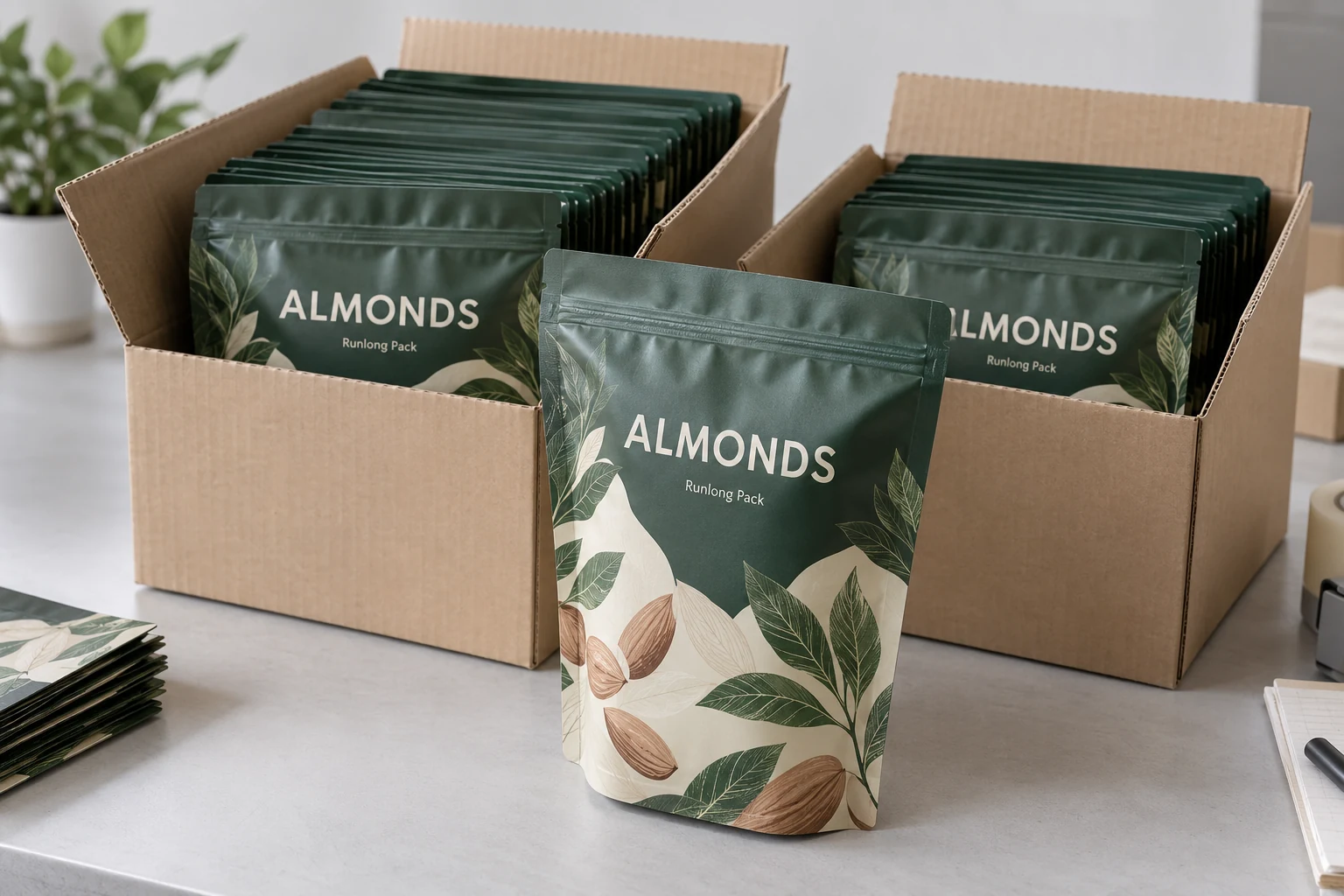
Before relying on an earlier price or setup arrangement, check:
- Whether the artwork, dimensions, material and features remain unchanged.
- Whether the existing gravure cylinders, where relevant, are available and match the order.
- Which one-time and repeat charges apply to this quotation.
- The quantity and delivery conditions covered by the price.
- The current production schedule and shipping plan.
Do not assume that every reorder has no cylinder charge or that the previous price remains valid indefinitely.
Reorder timing also affects how much inventory is needed. Runlong Pack’s typical digital production lead time is around 8–10 working days. For gravure projects, cylinder preparation is around 7–9 working days, followed by around 15–20 days of production after the cylinders are ready. Actual timing depends on the project and schedule; shipping is additional.
Production timing normally begins once the final artwork and specifications are approved and the required payment conditions are met. Use the Custom Packaging Lead-Time Guide when planning the full replenishment schedule.
8. Record the Decision Before Placing the Order
A defensible larger-order decision should be able to answer five questions:
- Demand: Which production forecast supports the quantity for each SKU?
- Version: Will the artwork and specification remain usable for the intended consumption period?
- Cost: What is included in the price, and what additional cash or inventory does the larger order require?
- Validation: Are any specification changes still awaiting necessary checks or approval?
- Replenishment: When should the next review or reorder occur?
Record the chosen quantity, approved specification and artwork version, expected usage period, cost scope and next review date.
The result may be a larger order for one stable product, a smaller order for a changing design, or a split plan across SKUs. The aim is not to buy the most pouches. It is to secure suitable packaging at a quantity the business can use with a manageable replenishment plan.
Custom Pouch Costs FAQ
Does buying more always reduce custom pouch costs?
No. A larger quantity may produce a lower quoted price per pouch, but the result depends on the specification, printing method, quantity by design and quotation scope. Extra stock also creates a larger purchase commitment. Assess whether it can be used before the design or specification changes.
Should unused pouches be treated as a loss?
Not automatically. Packaging that remains suitable and can be used later is inventory, not an immediate write-off. Show the stock and associated cash commitment separately. A loss calculation applies when packaging actually becomes unusable or obsolete.
Can several designs be combined to get one volume price?
Compatible multi-SKU digital projects may be evaluated by total quantity when material, dimensions and production conditions allow. Combined pricing is not guaranteed. Gravure projects normally require separate cylinders for each design and need a per-design evaluation.
How many months of packaging should I buy at once?
There is no single coverage period suitable for every project. Base the decision on forecast reliability, stock already available, production and shipping timing, storage requirements and how long the current design will remain usable. Review the dates within the period, not only its total demand.
Will a repeat gravure order have no cylinder charge?
Do not assume this automatically. Confirm whether the existing cylinders are available and still match the approved artwork and specification, then ask which setup and repeat charges apply to the current quotation.
What should I send Runlong Pack for an order-size comparison?
Send the product, pouch format, approved dimensions and material or performance requirements, features, artwork version, quantity by SKU, proposed order quantities, required delivery timing and destination. Identify known design or specification changes so the quantity options can be evaluated in context.
Plan the Order Your Business Can Use
Share your product, pouch specification, quantity by design, purchasing schedule and destination. Runlong Pack can evaluate suitable printing and quantity options for the project, with final feasibility and pricing subject to confirmation.