


Custom Flour Packaging Bags
A practical flour bag begins with clean seals and a tested fill.
Custom printed flexible bags for wheat flour, rice flour and other dry flour products. Compare retail zipper pouches, suitable gusseted formats and machine-film options around powder behavior, filled weight and your production process.
Share your product photo, target fill and quantity per design. We supply empty packaging; pictured brands and weights are illustrative concepts.
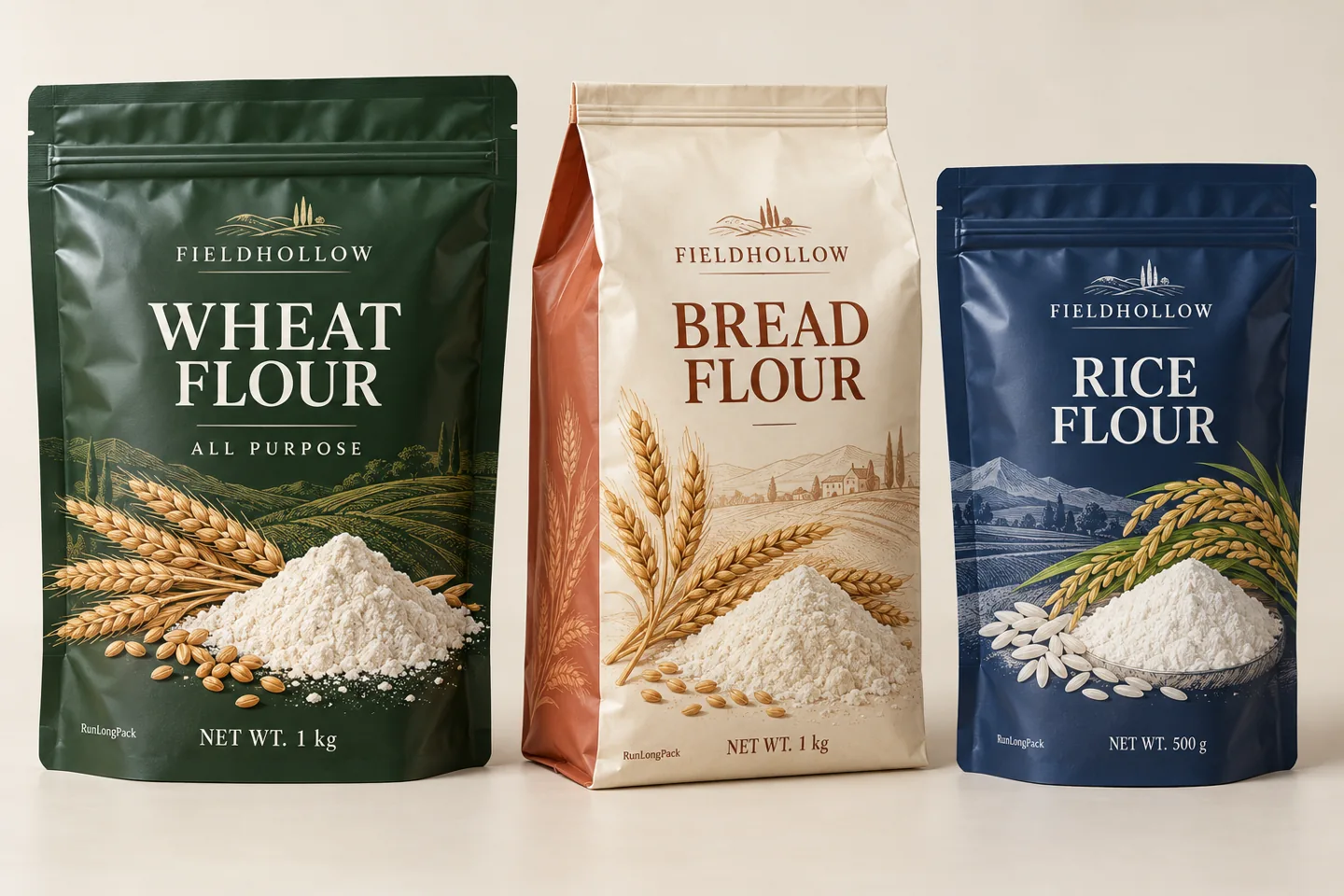
Which Packaging Route Fits Your Product?
For suitable retail fills, start by evaluating a resealable stand-up pouch with enough opening and top-seal clearance. A gusseted format may suit another shelf presentation or larger fill. Confirm loose and settled powder volume, dust near the seal and filled-pack handling rather than choosing dimensions from net weight alone.
For dry flour products. Baking mixes, protein powders and infant nutrition have separate formulations and requirements; this page does not treat them as interchangeable.
Develop the Pack for Your Actual Product
Wheat & Bread Flour
Confirm flour grade, intended weight and filling method. A fluffy fresh fill may occupy more volume than settled powder in storage.
Rice Flour
Use actual product and density information when available. Rice flour and rice noodles are different products and need different sizing briefs.
Whole-Grain & Specialty Flour
Share the grain or seed source, fat content category and intended storage. Whole-grain and nut-derived powders may need a different oxidation review.
Compare Your Packaging Formats
Resealable Retail Pouches
For suitable retail fills and repeated use. Keep flour out of the zipper track and the final heat-seal area.
Stand-up pouches →Side-Gusset Bags
Evaluate the expanded shape, closure and carton arrangement for the actual filled mass.
Side-gusset options →Printed Machine Film
For a compatible forming and powder-filling line. Send the approved film drawing and filling/sealing brief.
Rollstock film options →Choose Flour Bag Dimensions with a Real Filling Trial

Allow for Loose and Settled Flour
Flour can occupy different volumes immediately after filling and after settlement. Review the actual flour grade, target weight, bulk density if available and your dosing equipment before choosing the bag width, height and gusset.
Leave enough usable opening for the filling nozzle or funnel and practical space for the first heat seal. Check the shelf presentation after settlement so the bag is neither overfilled nor unnecessarily oversized.
For larger fills, assess the proposed film, seal areas, gusset and carton arrangement together using representative filled packs.
Match the Laminate to the Flour and Storage Conditions
Review moisture requirements, fat content category, oxidation sensitivity, light exposure, target shelf life and storage. Whole-grain and specialty flours may need a different assessment from refined wheat flour.
Evaluate food-contact suitability, the sealant and powder contamination during representative sealing trials. A paper-look print does not identify the underlying structure. Paper-containing flexible laminates are not automatically single-layer paper or accepted in paper recycling.
Request applicable food-contact documentation for the chosen structure and use conditions. Flour identity, allergen wording and claims such as gluten-free require the buyer’s own product and process evidence.
Send a Useful Brief for a Size Recommendation
| Information | What to share |
|---|---|
| Actual product | Product photos, recipe category, dimensions or powder density where available. |
| Intended fill | Net weight or count, normal product variation, tray size if used, and filled volume. |
| Packing method | Premade bag opening and closing route, or the approved film drawing for your machine. |
| Order & destination | Quantity per design, number of SKUs, storage, target shelf life and delivery destination. |
Use our bag size guide to prepare measurements. Confirm the gusset convention, usable interior and seals on the final drawing, then check fit with actual product. A printed weight on a concept image is not a standard capacity.
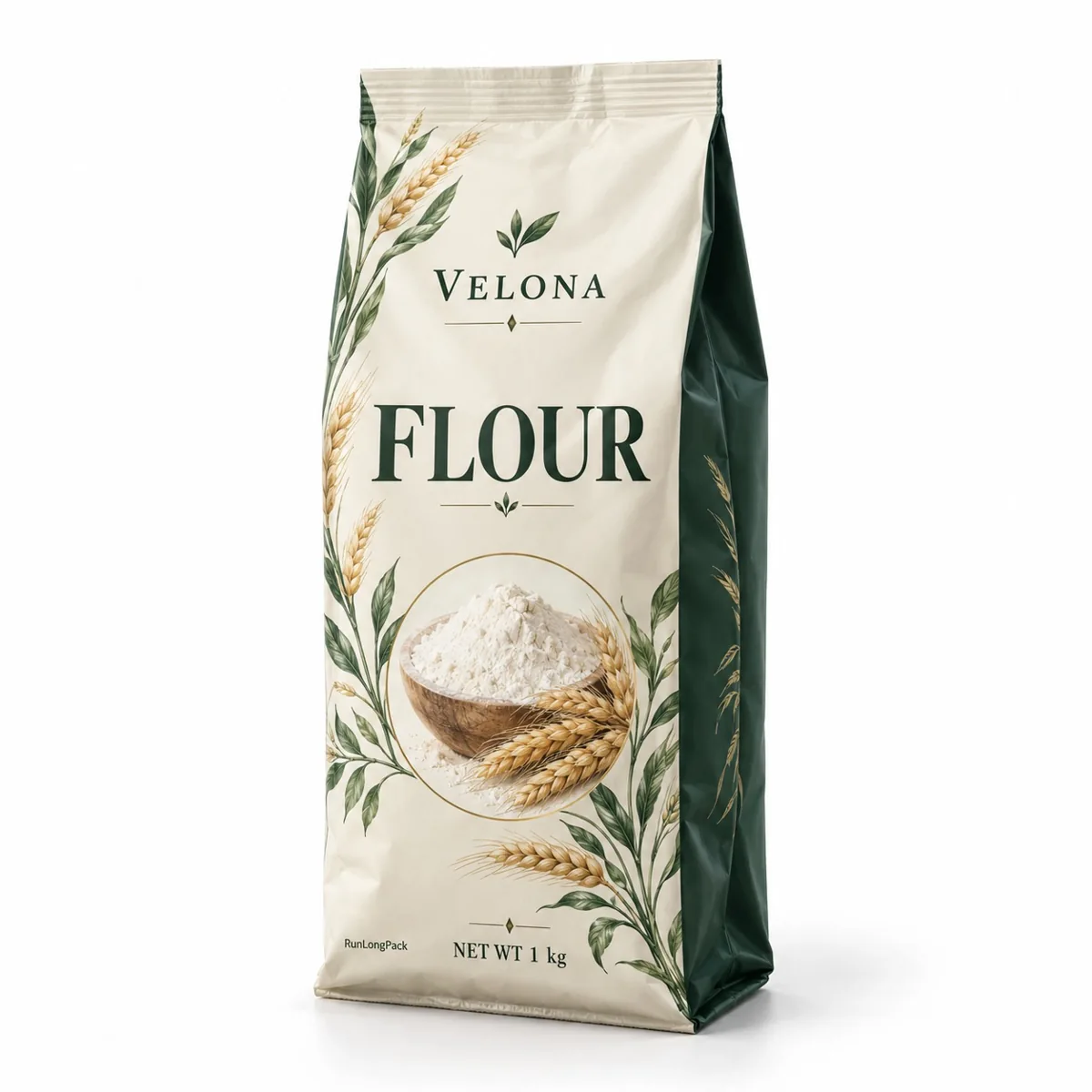
Gusseted Bags or Machine Film: Match Your Filling Route
The pictured side-gusset bag illustrates a premade format. Review filling access, gusset expansion, top closure and carton arrangement with the actual flour. For automatic form-fill-seal production, we can separately evaluate printed rollstock: send the machine supplier’s film width, repeat, registration marks, unwind, reel limits and seal requirements. Powder dosing, dust control and line suitability remain part of your equipment and process review.
Approve artwork separately from machine geometry. Registration, seal areas, usable interior and product clearance need to work together in representative trials.
Build a Printed Range That Is Easy to Reorder
Identify Each SKU
Make the product and variety easy to read. Coordinate colors across the range while keeping recipes and fill sizes distinct.
Reserve Functional Space
Allow room for approved ingredients, relevant allergens, net quantity, barcode, storage instructions and lot/date coding. Keep important text away from seals and folds.
Approve the Production File
Confirm dieline, artwork version, material, quantity per design and color expectations. AI artwork can start a discussion; it is not automatically a print-ready production file.
MOQ, Samples and Production Planning
| Route | Planning reference | Confirm before quote |
|---|---|---|
| Ordinary digital pouches | Some suitable projects around 100 pieces; approximately 1,000–3,000 generally recommended for value. | Bag format, size, material, finishes and quantity per design. |
| Ordinary gravure pouches | Generally around 10,000 pieces. | Colors, cylinders, structure, order volume and repeat-order plan. |
| Printed rollstock | Some suitable digital trials around 10 kg; normal commercial recommendation around 300 kg+. | Machine film drawing, material, sealing requirements and separately quoted trial scope. |
Flat-bottom flour bags have separate references: around 1,000–2,000 pieces may be considered digitally; 3,000+ merits comparing digital and gravure, and around 10,000 is often more economical in gravure. Ordinary flat-bottom printed samples are USD 110 each before separately quoted extra finishes.
These are conditional references. Format, dimensions, film consumption, material, special processes and artwork count determine suitability. Very small bags and special formats use separate assessment.
Sample Plan
Available reference samples are normally free with buyer-paid freight. Ordinary printed samples are typically USD 50–70 each; selected special finishes may be USD 100–150. Other formats and film trials are quoted separately.
Production Timing
Digital production is typically around 8–10 working days. Gravure cylinder making typically takes 7–9 working days, followed by around 15–20 days of production after cylinders are ready.
Approvals & Delivery
Timing follows final specification/artwork approval and required payment. Material availability, trials, special processes, production scheduling, holidays and transport affect the actual delivery plan.
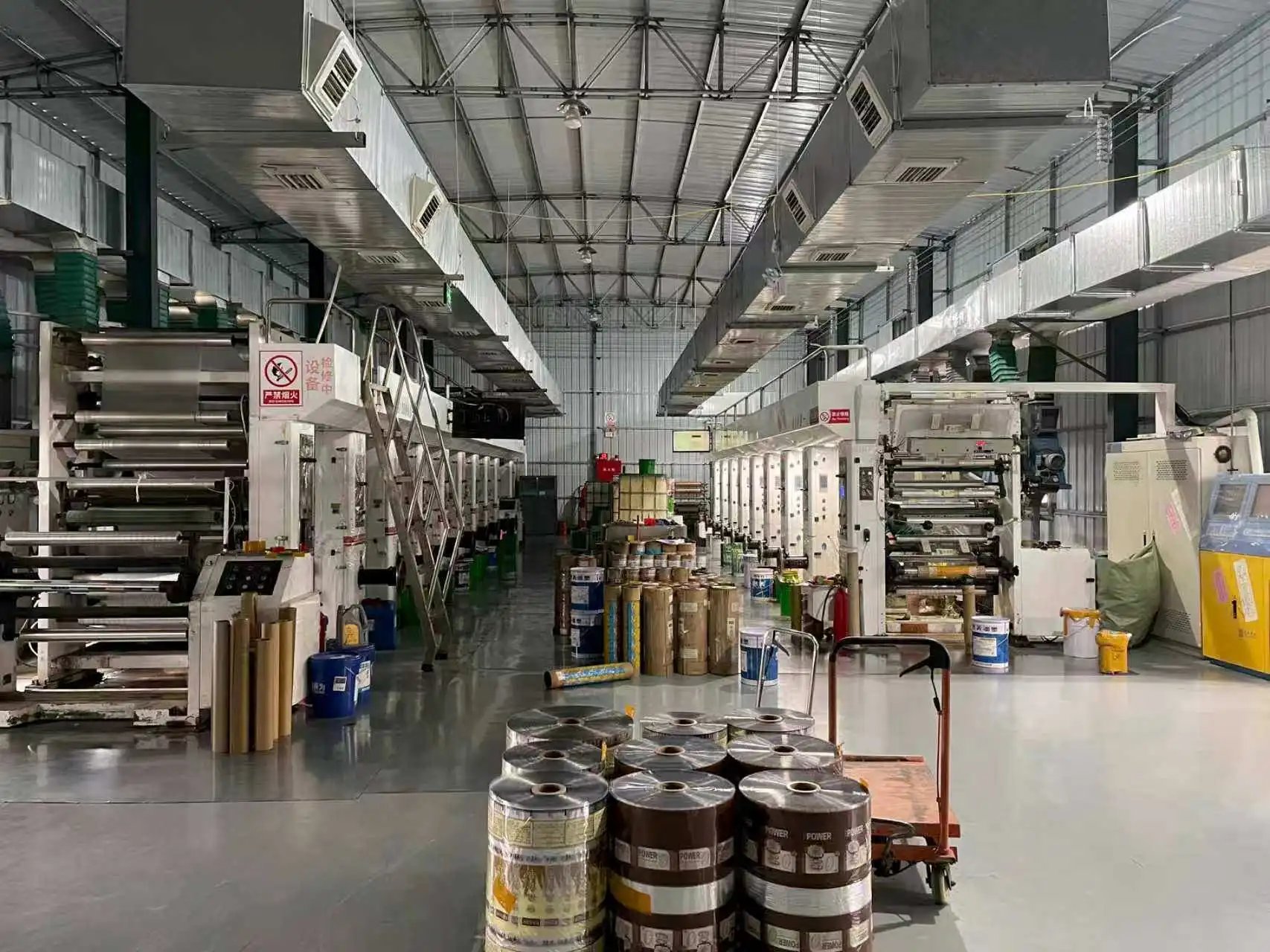
Work with Runlong Pack
Runlong Pack is the brand of Shantou Runlong Packaging Co., Ltd., a flexible packaging manufacturer in Shantou, China. We supply printed pouches and rollstock for food brands, processors, importers and private-label businesses.
We use food-grade raw materials without recycled, secondary or scrap materials. Request available food-contact documentation applicable to the selected structure and intended use. Product shelf life is validated in the final filled package.
Learn about Runlong Pack →Flour Packaging Bags FAQ
Can you make printed packaging for wheat and rice flour?
Yes. Suitable dry-flour projects can use custom printed flexible pouches or machine film. Share the actual flour, bulk density if available, target weight, filling process, storage and quantity per design. Materials and dimensions are confirmed for the application.
What size bag do I need for 1 kg of flour?
A fixed weight does not determine a reliable bag size. Flour grade, aeration and settlement change the volume. Check actual loose and settled fill, usable opening, gusset expansion and closing clearance, then approve a filled sample.
How do I avoid flour getting trapped in the heat seal?
Review dosing position, dust extraction and product settlement with the equipment supplier. Keep the zipper and heat-seal area clean and validate sealing on representative filled packs. No universal seal temperature or dust-control solution is inferred from the bag artwork.
Can flour bags have a resealable zipper?
Suitable retail pouches can include a zipper for repeated use after the initial top heat seal is opened. Assess pouring or scooping access and contamination of the tracks. The zipper does not replace the first heat seal or restore unopened-pack conditions.
Are these ordinary single-layer paper flour sacks?
This page focuses on printed flexible laminates. A kraft-look or paper-containing construction must still be reviewed for its food-contact and heat-seal layers, moisture requirements and actual use. It is not automatically a recyclable single-layer paper sack.
Can you make bags for larger flour fills?
Suitable larger projects require actual finished dimensions, filled mass, seals, gusset and carton or handling requirements. There is no universal load rating. Finished digital-pouch width is approximately limited to 37 cm; wider bags need a different printing route.
Are flat-bottom flour bags available?
Suitable projects can be evaluated separately. Around 1,000–2,000 pieces may be considered digitally; 3,000+ merits a digital/gravure cost comparison, and around 10,000 is often more economical in gravure. Ordinary flat-bottom printed samples are USD 110 each before separately quoted extra finishes.
Can flour be packed automatically using printed film?
Suitable rollstock can be evaluated for your forming and powder-filling equipment. Supply the approved web drawing, repeat, unwind, reel limits and seal requirements. Confirm powder handling and clean sealing with your equipment supplier. Film quantities are assessed separately in kilograms.
What is the MOQ for ordinary custom flour pouches?
Some suitable ordinary digital pouch projects can be evaluated around 100 pieces, with approximately 1,000–3,000 generally recommended for value. Ordinary gravure pouches generally start around 10,000 pieces. Dimensions, structure, finishes and quantity per design affect the final minimum; special formats and very small bags require separate confirmation.
Can I get flour bag samples and a packaging design concept?
Available reference samples are normally free with buyer-paid freight. Custom samples are quoted for their format and specification. A free static mockup is normally prepared within two days after the required logo, product details and design idea are received; the drawing, materials and filled samples are approved separately.