

Custom Supplement Stick Pack Film
A compact printed stick format, specified around your formula and your machine.
Develop custom printed supplement stick-pack film with Runlong Pack, a flexible packaging manufacturer in Shantou, China. We review the product, wrapper layout, laminate and printing route around your automatic packing process, from eligible trials to planned commercial orders.
Send your product, target portion, machine drawing and order weight per design. We supply empty packaging; pictured brands and weights are design examples.
Is Printed Supplement Stick-Pack Film Right for Your Project?
Choose supplement stick-pack film when you or your co-packer have compatible automatic forming, dosing and sealing equipment. The film specification must match the powder, lane geometry and reel requirements. A slim printed stick in a mockup does not establish filling accuracy, shelf life or machine compatibility.
For suitable dry nutrition and dietary powder packaging. Explore other sports nutrition packaging formats. We supply empty packaging, not supplements, formulation services or pharmaceutical packaging validation.
Stick-Pack Film for Dry Nutrition Powders
Electrolyte and Drink-Mix Powders
Share the actual formula category, dose and bulk volume. Review moisture sensitivity, flavor ingredients and powder behavior rather than selecting film from the word electrolyte alone.
Collagen and Protein Portions
A relatively large powder dose may need a wider or longer pack than a concentrated blend. Confirm the filled volume and usable opening before adopting a narrow retail format.
Daily Nutrition and Trial Portions
Coordinate individual-stick artwork with any outer box and serving instructions. Give each formula and flavor a controlled artwork version and a defined coding area.
Start with the Formula, Dose and Filling Volume
A stick pack is a format, not a universal size for every nutrition powder. Fine electrolyte mixes, denser mineral-containing blends and light protein powders can occupy different volumes at the same weight. Send the actual formula category, target dose and measured bulk volume where available, along with any known filling or storage concerns.
The machine team should review powder flow, bridging, dust, settling and any applicable static behavior. Dosing performance belongs to the complete line and process. Film stiffness and friction can influence handling, but the roll alone cannot establish portion accuracy or solve every powder-feeding issue.
Allow room for the real fill, the dosing nozzle and clean transverse seals. Choosing a very narrow stick for appearance before assessing the filling process can make an otherwise attractive format impractical. Confirm an achievable pack before expanding the flavor range.
One Lane and Multiple Lanes Need Different Drawings
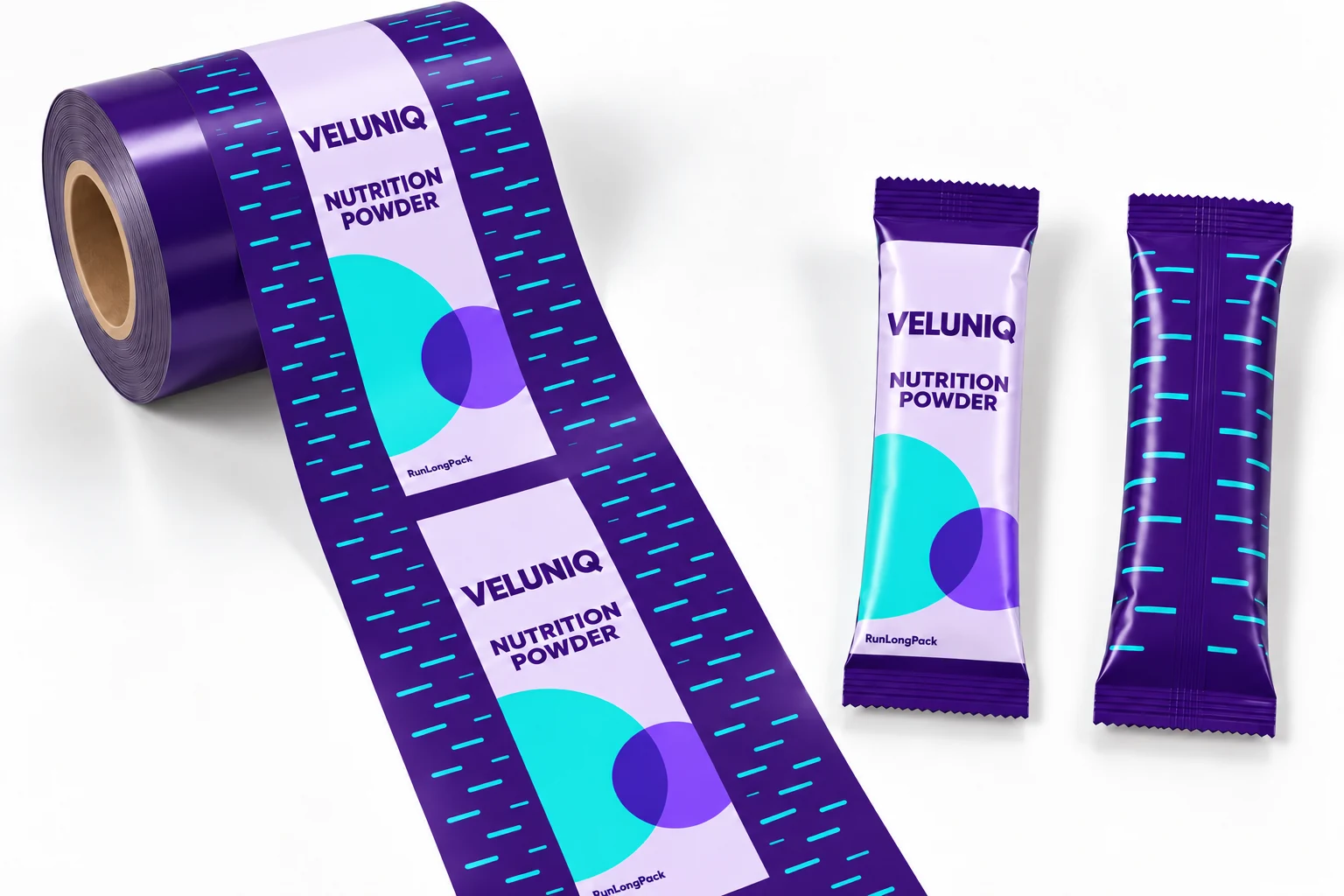
The illustrated hero uses a single-lane concept: one wrapper across the web and consecutive repeats along the machine direction. Many stick-pack projects use several lanes. In that case, obtain the actual full-web drawing from the machine supplier or co-packer rather than multiplying a mockup by an assumed lane count.
Each finished stick must correspond to its own lane, print repeat and seal allowances. Confirm where the web is slit or cut, how print registration is controlled and which artwork belongs in each lane. A wider reel with random duplicate fronts is not a substitute for that layout.
Coordinate the Stick and the Retail Box
Plan the stick count, orientation, visible product name and batch identification with the outer pack. Confirm which required information appears on the stick and which appears on the box for the intended market. Do not shrink a full pouch label until small text becomes unreadable.
Keep each formula, flavor and language version under a clear file revision. The brand owner approves serving instructions, ingredients, warnings, claims, barcodes and legal copy before production. We can support packaging layout and print preparation; we do not determine the legality or effectiveness of a supplement claim.
Rollstock or Premade Bags: Confirm the Supply Route
| Supply route | What you receive | What to verify |
|---|---|---|
| Printed film on reels | Continuous unconverted film for a compatible forming, filling and sealing line. | Machine drawing, powder dosing, full wrapper layout, seal system and reel limits. |
| Premade open-top bags | Separately quoted empty bags for a suitable manual or semi-automatic filling process. | Usable opening, funnel/nozzle access, product clearance and clean final sealing area. |
| Existing co-packer specification | Film made to an agreed specification for the co-packer’s line. | Written approval of materials, artwork, reel details and a representative trial. |
A finished-pack picture is useful for discussing appearance, but it is not an equipment specification. Confirm who will fill the product and which machine will be used before ordering printed film. If you are still choosing equipment, obtain the proposed format and reel requirements from the equipment supplier first.
For a startup without automatic equipment, a suitable premade pouch can be a more practical route. Very narrow openings may be difficult to fill cleanly. Test access with the actual powder and filling tools, rather than choosing the smallest possible bag from a retail example. See our premade pouches and rollstock comparison.
Specify the Film from Your Actual Machine Drawing
Approve the web geometry before adapting the artwork. The finished width is not the full reel width, and the printed repeat is not simply the visible front panel. The layout must include the front, back, longitudinal seam and transverse seal areas required by the chosen process.
| Specification | Information to send |
|---|---|
| Finished format | Finished width and length, back seal or other agreed structure, usable product area and tear feature. |
| Web and repeat | Full web width, print repeat, seal allowances, lane count and lane widths; slit/cut positions for multi-lane projects. |
| Print registration | Eye-mark dimensions, contrast and position; print orientation, coding area and approved artwork version. |
| Reel construction | Core inside diameter, maximum outside diameter and weight, unwind direction and print facing. |
| Operating conditions | Sealing method, known-running film reference, agreed structure/thickness, friction and stiffness requirements. |
The film is supplied as a continuous unsealed web wound on a core. Seals are made during the packing operation. A single-lane wrapper repeats along the unwinding direction; its front and back areas become the corresponding finished pack after forming. A multi-lane project needs its own verified lane arrangement.
Agree a practical operating trial with your machine supplier or co-packer. Check feeding, tracking, registration, cutting, powder clearance and finished seals under the intended conditions. We do not assign one universal running speed or seal temperature to this product category. Our VFFS rollstock compatibility guide can help organize the technical brief.
Review Barrier and Sealing Needs Together
Product Protection
Describe moisture, oxygen, aroma and light requirements, plus the intended storage and distribution conditions. Appropriate foil-containing, metallized or other suitable barrier laminates can be assessed for the complete product and process.
Machine Handling
Thickness, stiffness, friction and sealing behavior must suit the actual forming and sealing system. Do not approve a material solely because it looks similar to a sample or carries a generic high-barrier description.
Filled-Pack Validation
Use the agreed laminate with the real powder and sealing conditions. Check the finished pack and conduct the product-specific shelf-life work needed for your target. No universal storage period is established by these concept images.
We use food-grade raw materials without secondary, recycled or scrap materials. Request available food-contact documentation relevant to the proposed structure and intended use. Confirm the tested sample and conditions rather than treating a report as a blanket certificate for every packaging project.
For nutrition powders, the product owner should define the stability and labeling requirements. Packaging documents do not establish nutrient potency, medical performance, pharmaceutical GMP status or approval of a finished supplement.
Turn Your Design Direction into a Machine-Specific Layout
Send an editable logo, design reference and your machine drawing. We can assess existing artwork or help with basic refinement and layout. If you start with an AI-generated image, use it to communicate the visual direction, then prepare the approved front, back, mandatory copy and seal areas as a proper print layout.
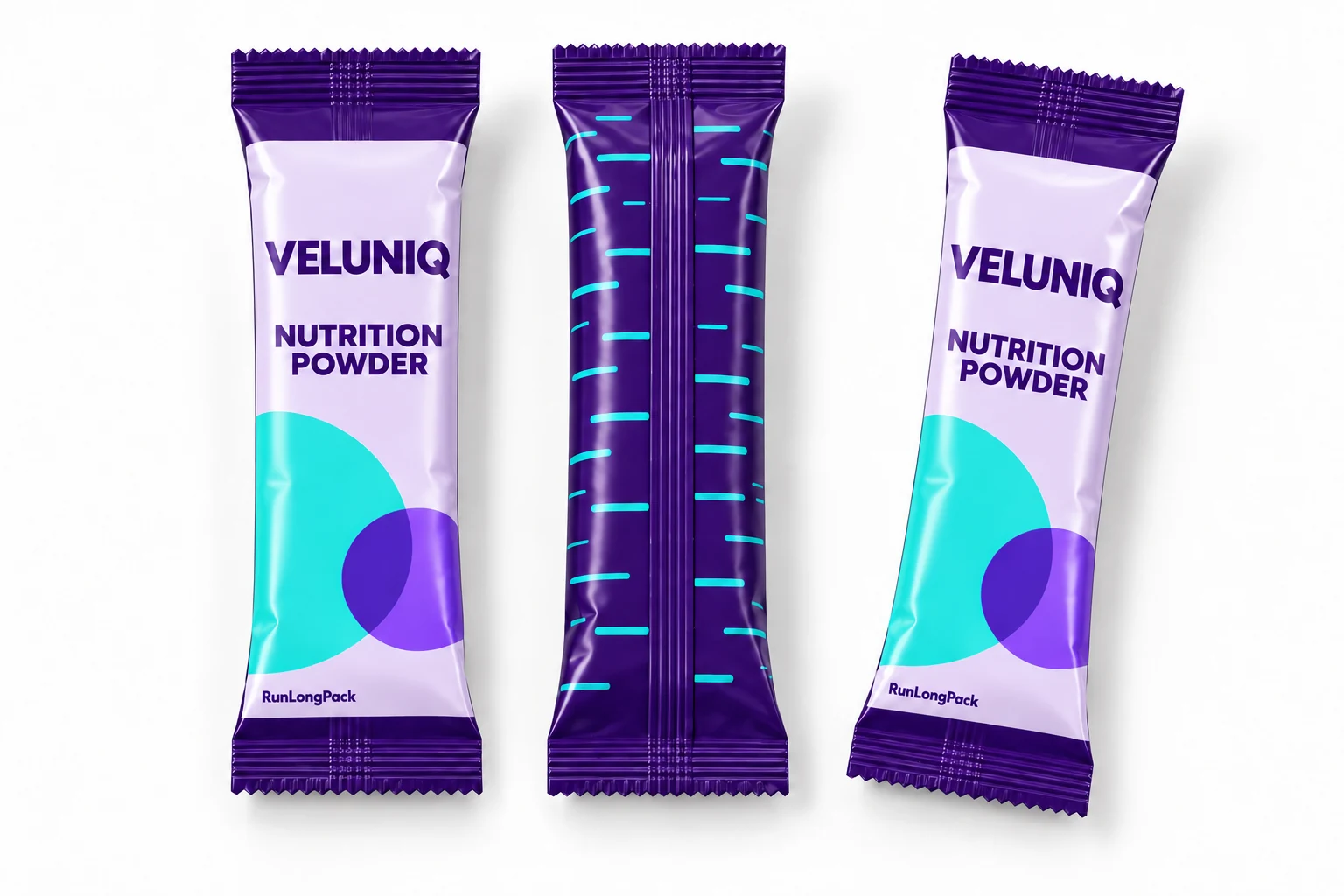
Keep one master design for the film repeat and the corresponding finished pack. Coordinate brand, product name, illustration, colors and text. The concept images demonstrate the chosen single-lane construction; they do not prove exact small-text registration or supply production-ready film dimensions.
Confirm spelling, net quantity, ingredients, allergens or warnings as applicable, barcode, coding area and all regulatory copy before production. Digital printing normally uses CMYK and does not guarantee exact Pantone matching. Define color priorities early and agree an appropriate proofing or sample route.
MOQ, Printing and Trial Planning
Some rollstock projects that suit the digital equipment, material, structure, web width and process can be evaluated around 10 kg, with a higher unit packaging cost. Normal commercial orders are generally recommended around 300 kg or more. These figures are conditional references, not a universal minimum for every film.
| Order question | How to plan it |
|---|---|
| Kilograms per design | Separate the requested commercial weight for each artwork and confirm whether the format is eligible for a short digital trial. |
| Digital printing | Useful for eligible trials or artwork variation. Equipment, structure, process and full web width must be checked; a finished-pouch width limit is not a universal reel-width specification. |
| Gravure printing | Compare for stable commercial quantities. Include cylinder layout, colors, designs and reel requirements in the quotation. |
| Film yield | Estimate from approved web width, repeat, lanes and laminate mass per area. Allow for setup, splicing, coding and rejects. |
| Samples and trials | Available reference samples are normally free with buyer-paid freight. Custom printed trial reels are separately quoted to the required specification. |
Compare the whole project cost: film weight, artwork versions, cylinders where applicable, trial reels, freight and line startup allowance. Do not compare the quoted price per kilogram alone when the structures or usable yield differ. A small trial may reduce uncertainty before a larger order, but it has a higher unit packaging cost and must still suit the equipment.
Digital Production
Typical production is approximately 8–10 working days for an approved, eligible project.
Gravure Production
Cylinder making is approximately 7–9 working days, then production approximately 15–20 days after cylinders are ready.
Delivery Planning
Timing starts after final artwork/specification approval and required payment. Shipping is additional. Tell us about deadlines, destination and trial requirements early.
Material availability, holidays, trial results and the production schedule can affect delivery. Retain the approved artwork, reel specification and trial findings for repeat orders. If you change the formula, machine or stick dimensions later, review the affected specification before treating the order as an unchanged repeat.
Work with Runlong Pack
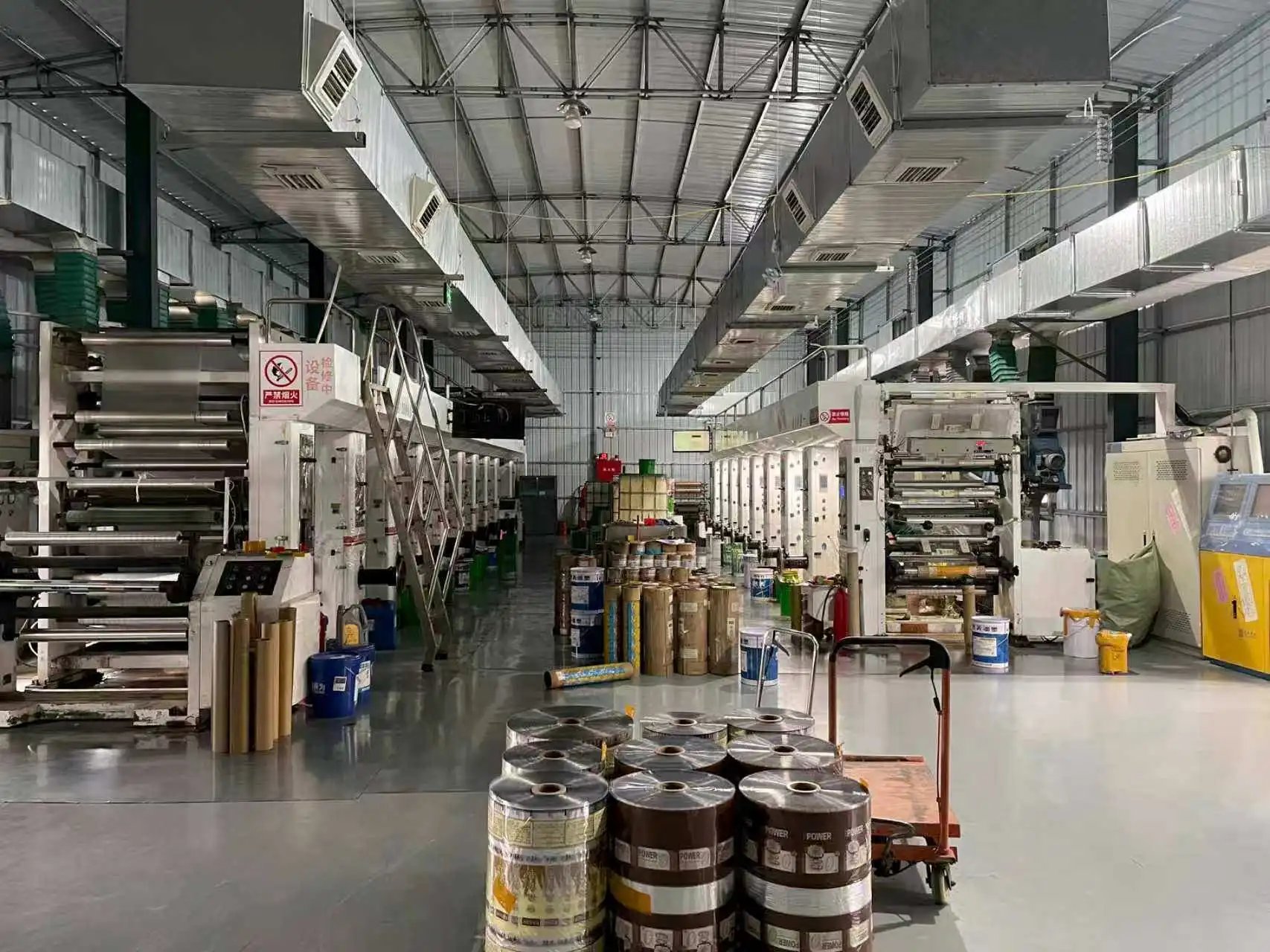
Runlong Pack is the brand of Shantou Runlong Packaging Co., Ltd., a custom flexible packaging manufacturer in Shantou, China. We supply printed pouches and rollstock for food producers, brands, importers and private-label projects.
Our project review connects the product, material, machine drawing, artwork and printing route before production approval. Send an existing film specification or a new project brief so we can identify what is ready and what still needs confirmation.
About Runlong PackCustom Supplement Stick Pack Film FAQ
The supply route, machine specification and ordering rules appear above; these answers address common purchasing questions.
Do you supply supplement powder or just printed film?
We supply empty printed flexible packaging and rollstock. The supplement brand or co-packer is responsible for the formula, filling, product claims and product compliance. Our scope is the agreed packaging specification and production.
Does supplement stick-pack film require an automatic machine?
Yes. The compatible machine forms, doses and seals the sticks from a reel. If you are filling by hand, discuss a suitable premade format with practical opening access. A small tabletop sealer alone does not convert a printed reel into filled sticks.
Do you make film for multi-lane stick-pack machines?
We assess projects against the actual machine drawing, lane count, lane widths, slit and cut positions, repeat, registration and reel limits. Each lane must map to its approved finished stick. A generic single-lane concept is not a production layout for your multi-lane machine.
Can I choose stick dimensions from the serving weight?
Serving weight is only a starting point. Powder bulk density, flow, headspace, dosing nozzle, seal clearance and machine limits determine the workable dimensions. Two formulas with the same gram weight can need different stick sizes.
What is the minimum order for supplement stick-pack film?
Some rollstock projects that suit the digital equipment, material, structure, web width and process can be evaluated around 10 kg, with a higher unit packaging cost. Normal commercial orders are generally recommended around 300 kg or more. These figures are conditional references, not a universal minimum for every film.
Which barrier structure should I choose?
Review the actual formula, moisture and oxygen sensitivity, light exposure, target shelf life and sealing conditions. Foil-containing, metallized or other suitable laminates may be evaluated. Packaging appearance and film type alone do not validate nutrient stability or shelf life.
Can you guarantee accurate supplement doses?
Dose accuracy depends on the filling equipment, calibration, powder and operating process. The film should be assessed with that process, but the reel does not establish dose accuracy. Agree the filling and inspection criteria with your machine supplier or co-packer.
What compliance documents can I request?
Request available food-contact documentation relevant to the proposed structure, intended use and destination. Ask which sample and conditions the document covers. Packaging documents do not approve a supplement formula, health claim or finished-product label.
Can I start with a mockup or trial reel?
A free static mockup is normally prepared within two days after we receive the necessary logo and design direction. Available reference samples are normally free with buyer-paid freight. Custom printed trial reels are separately quoted to the agreed material and machine specification.
What lead time should I plan?
Typical digital production is around 8–10 working days. Gravure cylinder making takes around 7–9 working days, followed by approximately 15–20 days of production after cylinders are ready. Final approval and required payment start the timing; trials, holidays and shipping also affect delivery.