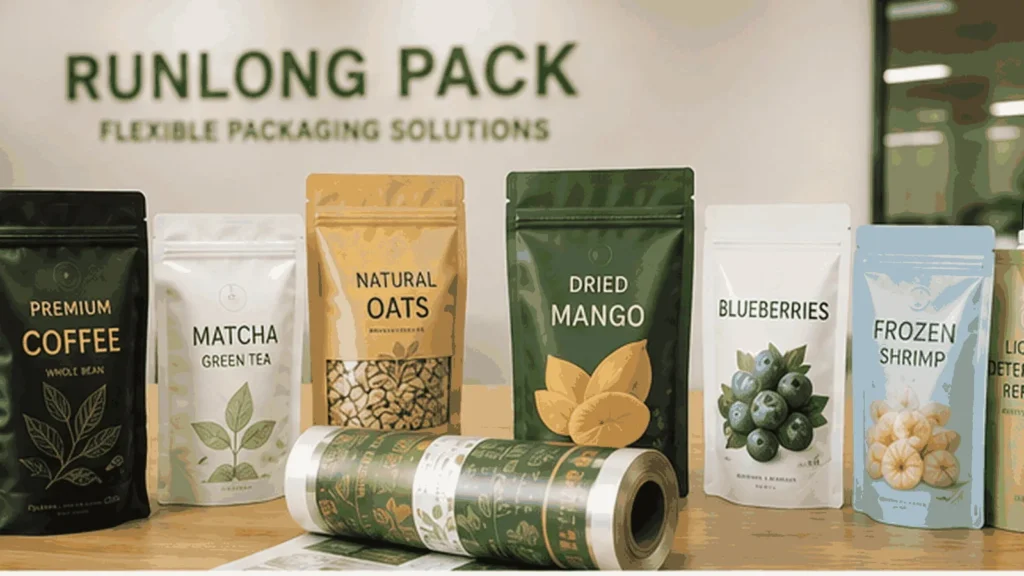




How to Match Rollstock Film with a VFFS Machine
Confirm the web, print repeat, eye mark, unwind direction, roll core, seal system and product conditions before printed film enters production.
What must match between rollstock film and a VFFS machine?
Rollstock must match the VFFS machine in web width, print repeat length, registration-mark position, unwind direction, roll-core dimensions, maximum roll diameter and weight, longitudinal-seal type, film structure, thickness, friction and heat-sealing behavior. The product, filling system and target line speed also affect whether the film can form, track and seal reliably.
Do not approve printed rollstock from finished bag width or fill weight alone. Use the machine supplier’s forming-set drawing, web specification and sensor requirements, then confirm the final film in a controlled machine trial when needed.
How a VFFS machine turns printed rollstock into finished bags
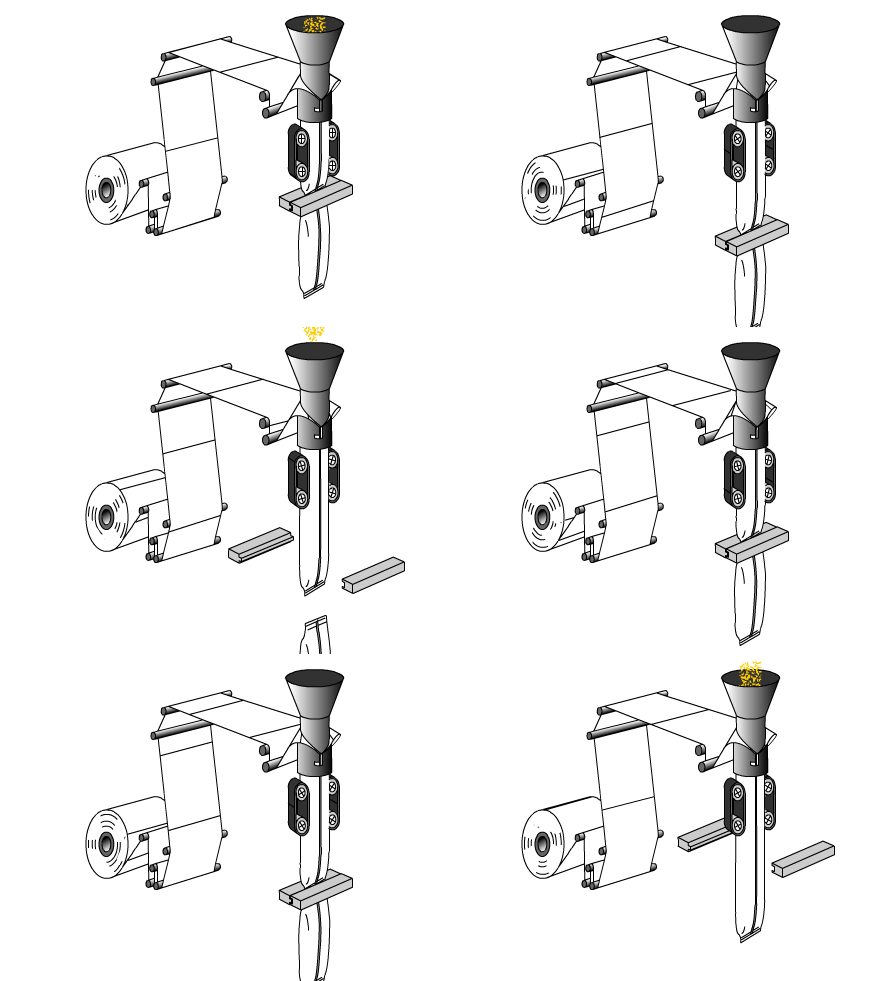
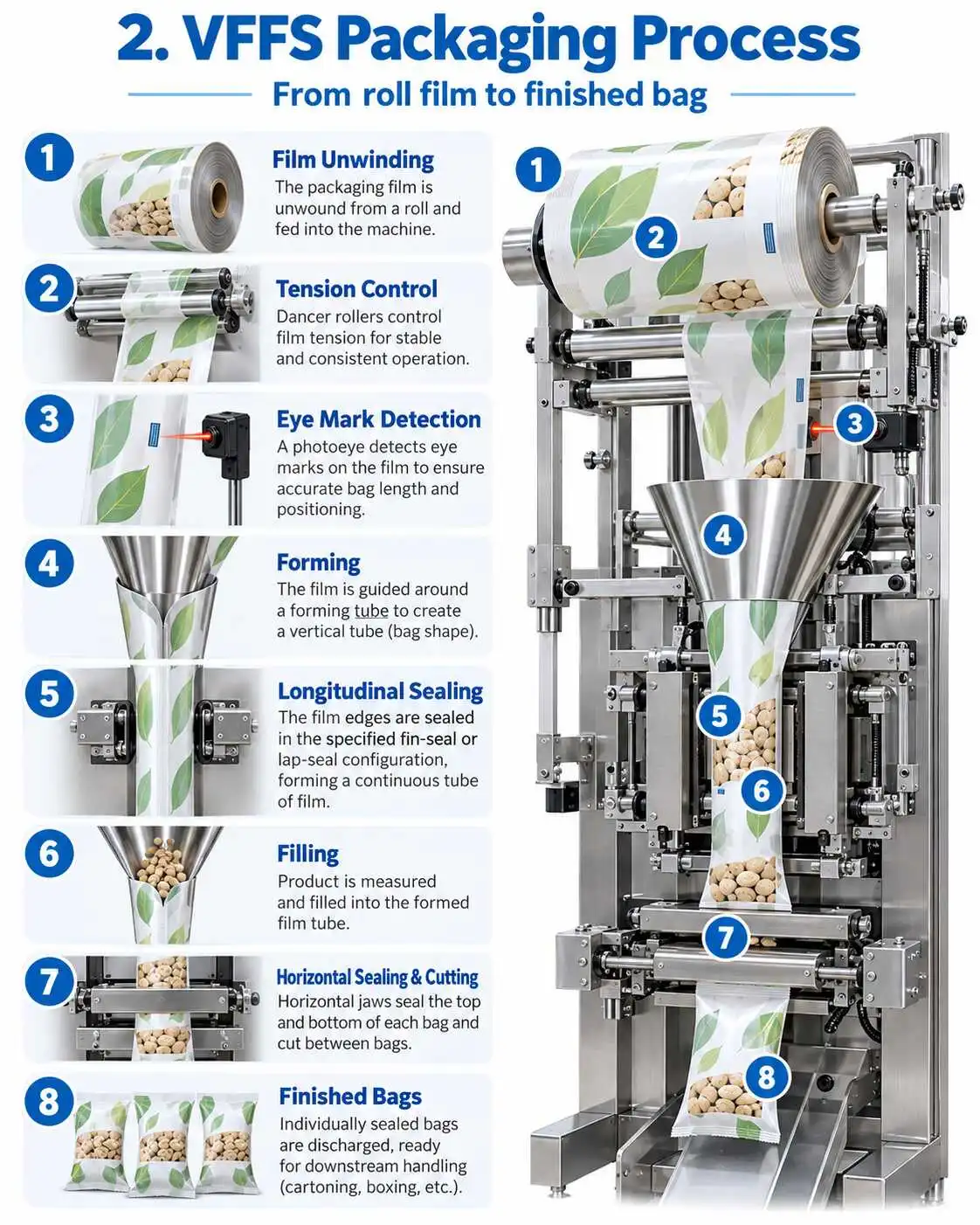
A vertical form-fill-seal machine unwinds flexible film, controls web tension, detects the registration mark, wraps the film around a forming collar and tube, makes the longitudinal seal, fills the product, and completes the horizontal seal and cut. A mismatch at any one of these stages can affect registration, bag shape, filling or seal integrity.
Collect machine, bag, film and product data before quotation
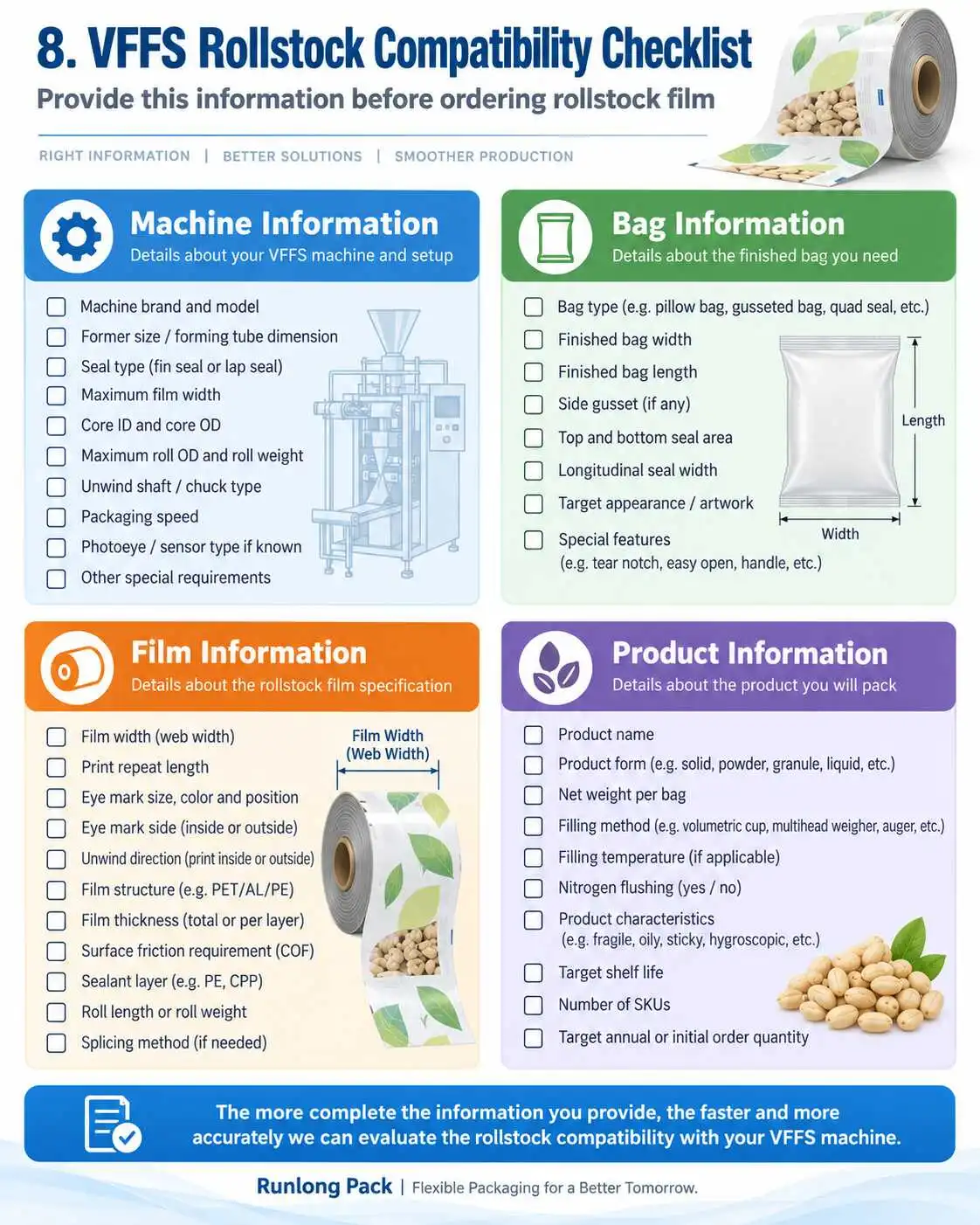
A reliable rollstock specification starts with four information groups. If the machine data is incomplete, ask the machine supplier for the forming-set drawing, recommended web specification and seal configuration before artwork is finalized.
Machine information
- Machine manufacturer and model
- Forming collar or forming-tube dimensions
- Maximum web width, roll OD and roll weight
- Core ID, shaft or chuck type
- Fin-seal or lap-seal configuration
- Photoeye or registration-sensor requirement
- Target operating speed
Package and product information
- Finished bag width, length and gusset
- Top, bottom and longitudinal seal areas
- Product form, fill weight and bulk volume
- Filling method and filling temperature
- Sharp, oily, dusty or hygroscopic characteristics
- Nitrogen flushing or other gas requirement
- Target shelf life and distribution conditions
Confirm web width, print repeat and seal allowances from the machine setup
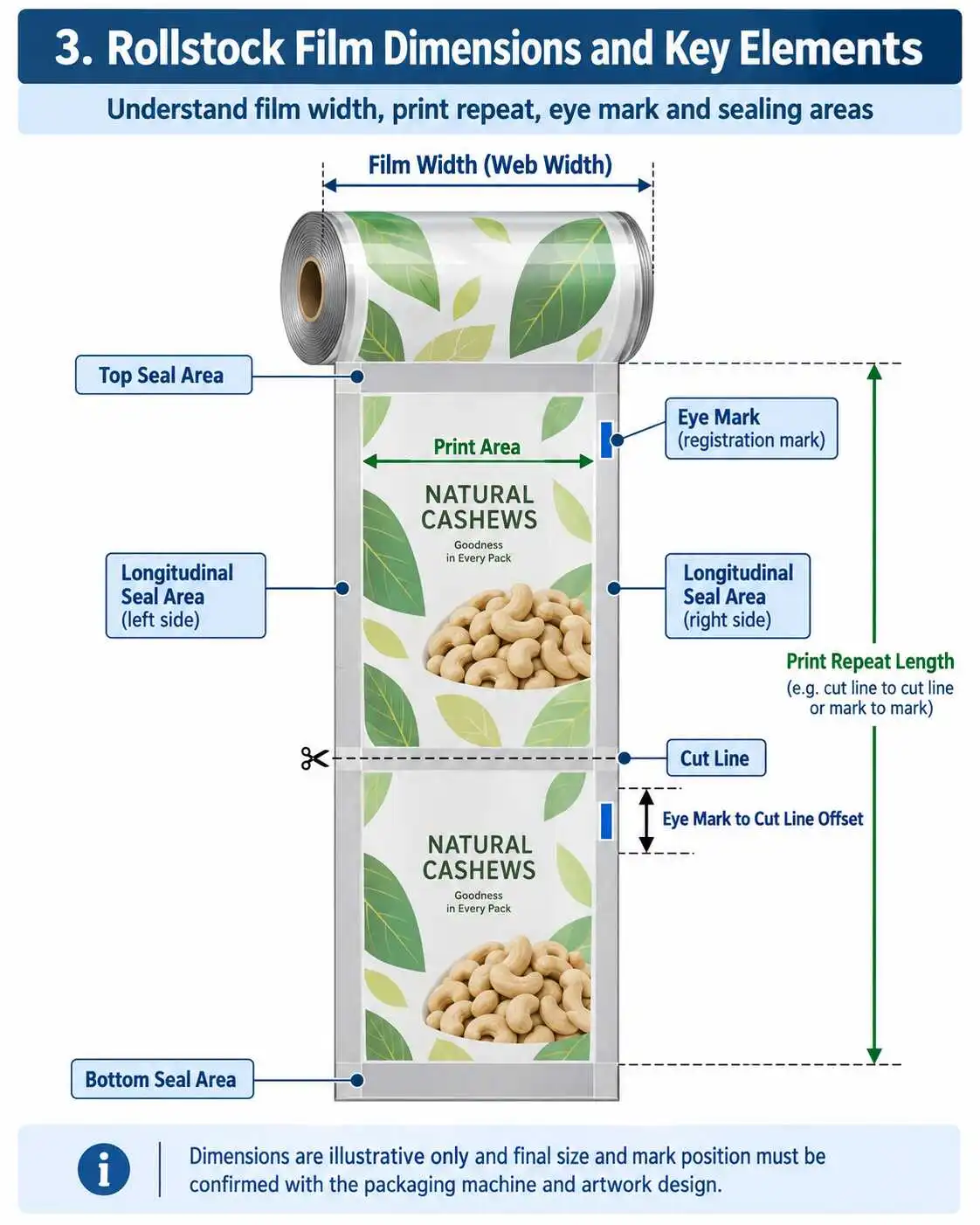
Web width is the total width of the flat film entering the machine. It is related to the forming collar, package circumference, gusset design and longitudinal-seal allowance. The finished bag width alone is not enough to calculate it safely because different forming sets and seal configurations can require different allowances.
Print repeat length controls the distance from one package image to the next. It must coordinate with the finished bag length, top and bottom seal areas, registration mark, cut line and the machine’s tracking logic. Artwork height and finished bag length are therefore not always the same value.
Preparing printed-film artwork?
Confirm the web layout, repeat, seal zones, mark and cut position before selecting and approving the print route.
Eye-mark position and unwind direction must match the sensor and film path
The registration mark helps the machine control package length and cutting position. Confirm its color, contrast, size, left or right position, distance from the cut line, and whether the sensor reads the printed surface or through another layer. Metallized backgrounds, low contrast, excessive line speed or an unsuitable sensor can make a visible mark difficult to detect.
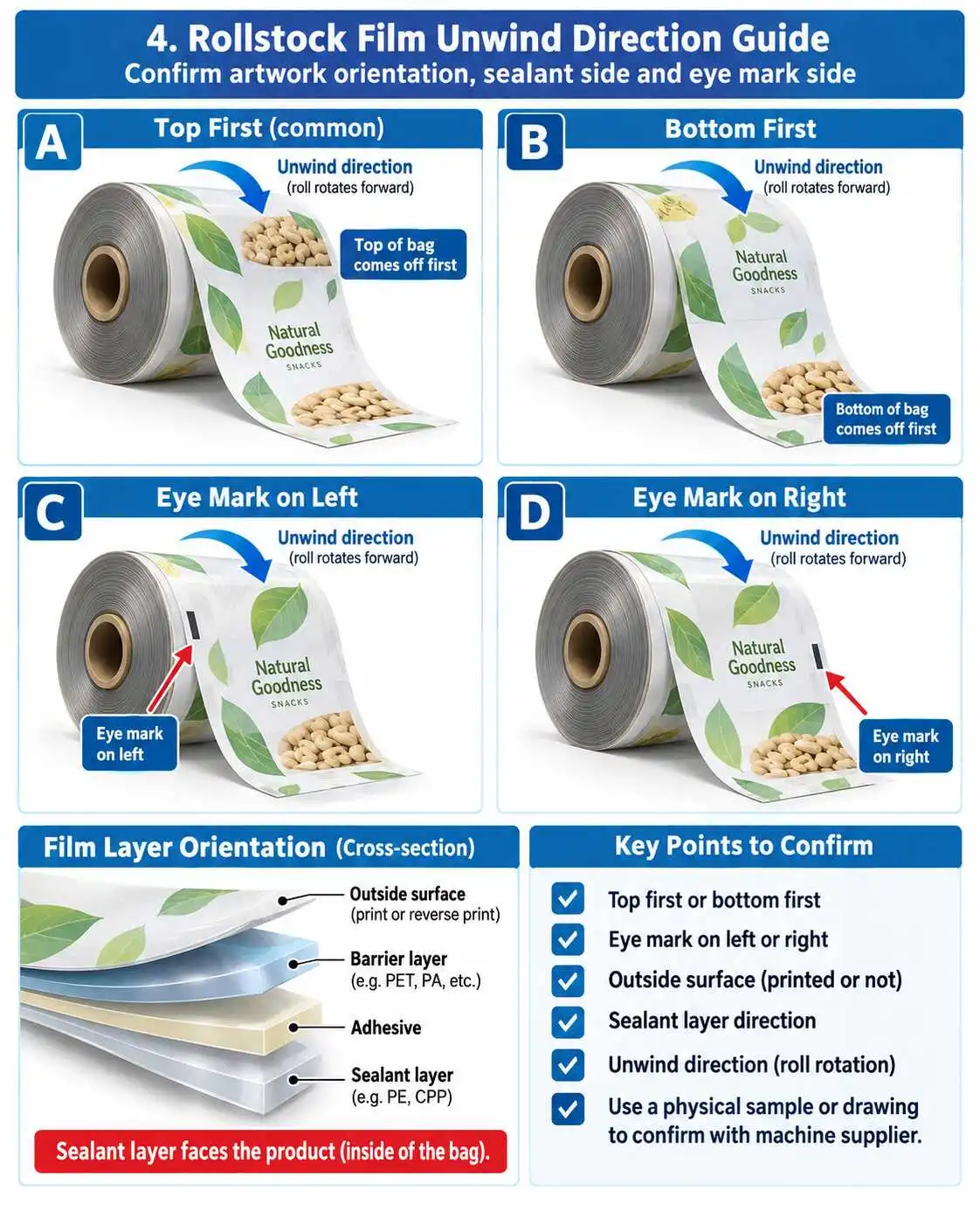
Unwind direction defines whether the top or bottom of the artwork enters first, which side carries the eye mark, whether the printed surface faces inward or outward, and which surface becomes the product-contact sealant side. A physical roll sample or signed unwind drawing is safer than descriptions such as “normal direction.”
Fin seal and lap seal require different film contact surfaces
Fin seal
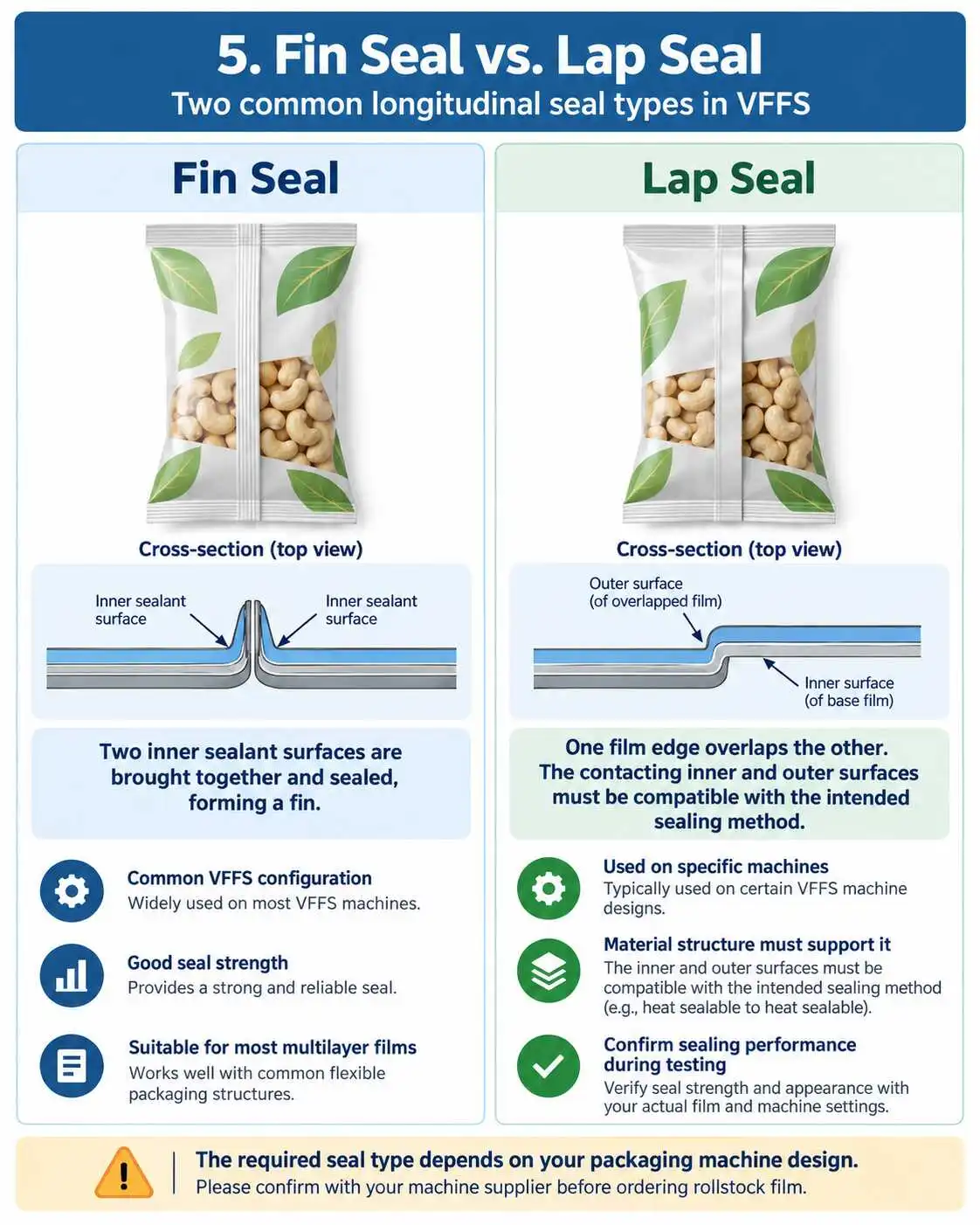
The two inner sealant surfaces are brought together to create a projecting fin. This is a common VFFS configuration and normally uses the package’s inner heat-seal layer on both contacting sides.
Lap seal
One web edge overlaps the other, so the intended inner and outer contact surfaces must support the machine’s sealing method. Do not assume a structure designed for a fin seal will automatically work as a lap seal.
Core dimensions, maximum roll size and winding affect loading and uptime
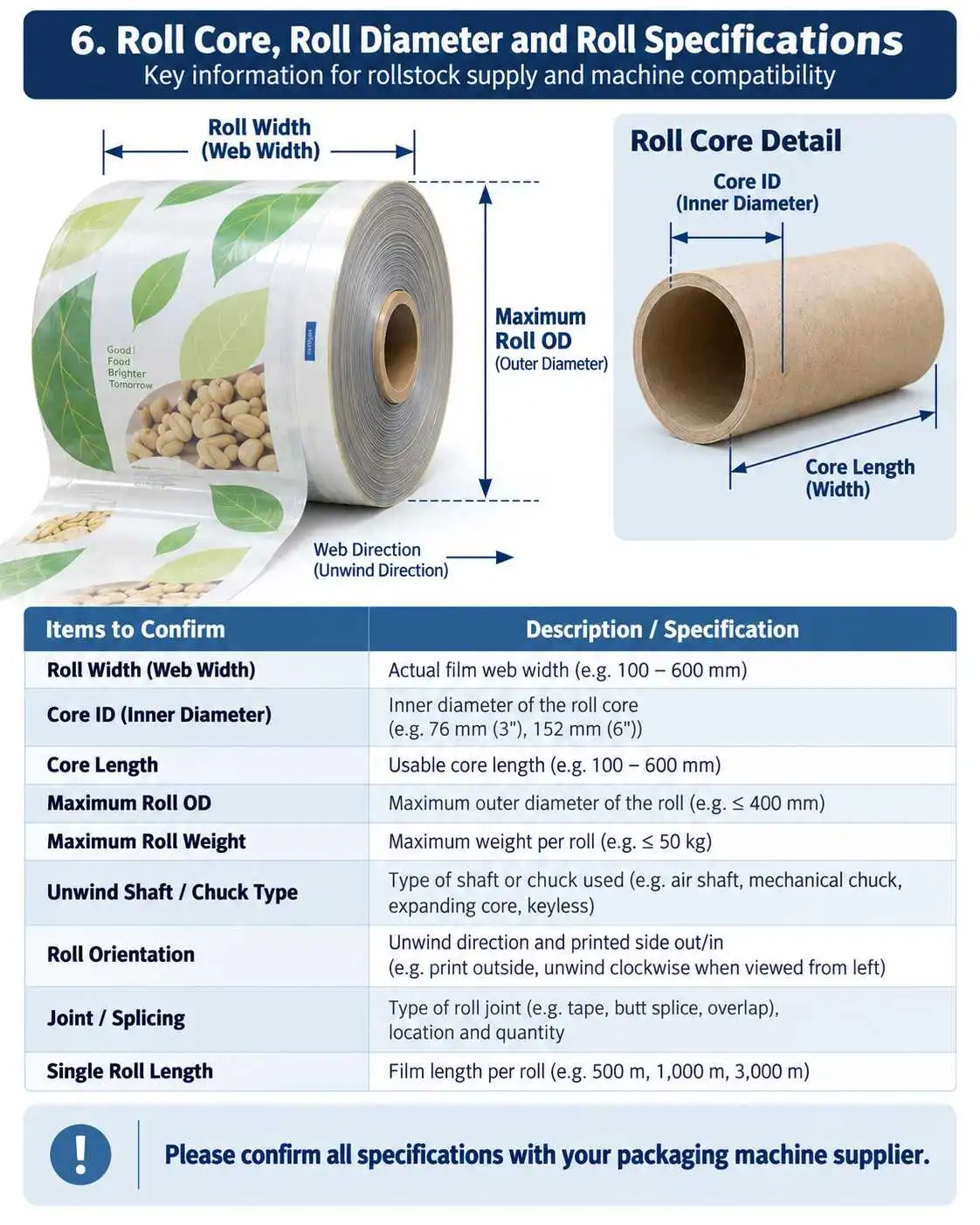
Confirm the core inner diameter, usable core length, maximum roll outer diameter, maximum roll weight, shaft or chuck type, roll orientation, acceptable splice method and target film length per roll. A roll that is technically correct in material and print can still be unusable if it does not fit the unwind station or exceeds the machine’s handling limit.
Single-roll length also affects changeover frequency and line efficiency. The most economical roll size must remain within the machine, operator-handling and film-quality limits.
Match barrier and mechanical performance to the packaging process
Product protection
Moisture, oxygen, light, aroma, oil and puncture requirements influence the laminate. The final structure depends on the actual product, shelf life, filling method, storage and market requirements.
Machine handling
Film thickness, stiffness, curl, static and surface friction affect unwinding, tracking, forming and pull-belt behavior. There is no universal COF target for every machine.
Heat sealing
Seal initiation, hot tack, temperature window, pressure, dwell time and contamination resistance must support the actual line speed and product behavior.
Temperature cannot be evaluated alone. A seal that works at low speed may fail when dwell time becomes shorter. Judge temperature together with jaw pressure, contact time, seal design, contamination and production speed.
Need to define moisture, oxygen, light or puncture protection?
Start with material functions, then validate the structure on the line.
The packed product changes the film and sealing priorities
| Product type | Typical line concern | Rollstock questions to confirm |
|---|---|---|
| Chips and fragile snacks | Breakage, nitrogen space and crumbs in the cross seal | Bag volume, drop height, gas flushing, barrier, seal window and jaw timing |
| Nuts and oily snacks | Oxidation, aroma and sharp product edges | Oxygen barrier, puncture resistance, fill control and seal cleanliness |
| Powders | Dust, static and powder contamination in the seal | Auger or dosing method, dust control, sealant behavior and line speed |
| Granules and candy | High-speed dosing and inconsistent shapes | Weigher or volumetric filling, registration stability, friction and seal timing |
| Liquid or sauce | Leakage, splash and seal contamination | Filling temperature, dosing, liquid-resistant sealing and machine design |
| Frozen product | Cold handling, puncture and condensation | Low-temperature performance, strength, filling conditions and storage |
These are selection questions, not universal material specifications. Product-specific trials and shelf-life validation may be required.
Define what the machine-test roll must prove
A test roll can be used to evaluate loading, tension, tracking, registration, forming, longitudinal sealing, cross sealing, cutting, filling and target speed. The required roll length or weight depends on the machine start-up loss, test duration, product trial, number of settings and whether the film is printed or unprinted.
Before ordering a test roll
- Agree on the exact test objectives
- Confirm the machine and forming set
- Decide whether real product will be filled
- Confirm whether registration marks are required
- Estimate setup waste and useful running time
Before bulk production
- Record the approved machine settings
- Confirm the final web and repeat
- Approve unwind and eye-mark position
- Review seals at the intended speed
- Confirm roll size, winding and splice rules
A small test roll is not priced as a simple fraction of a production roll. Material preparation, printing or registration requirements, slitting, winding and setup can still apply. Request a project-specific test plan and quotation.
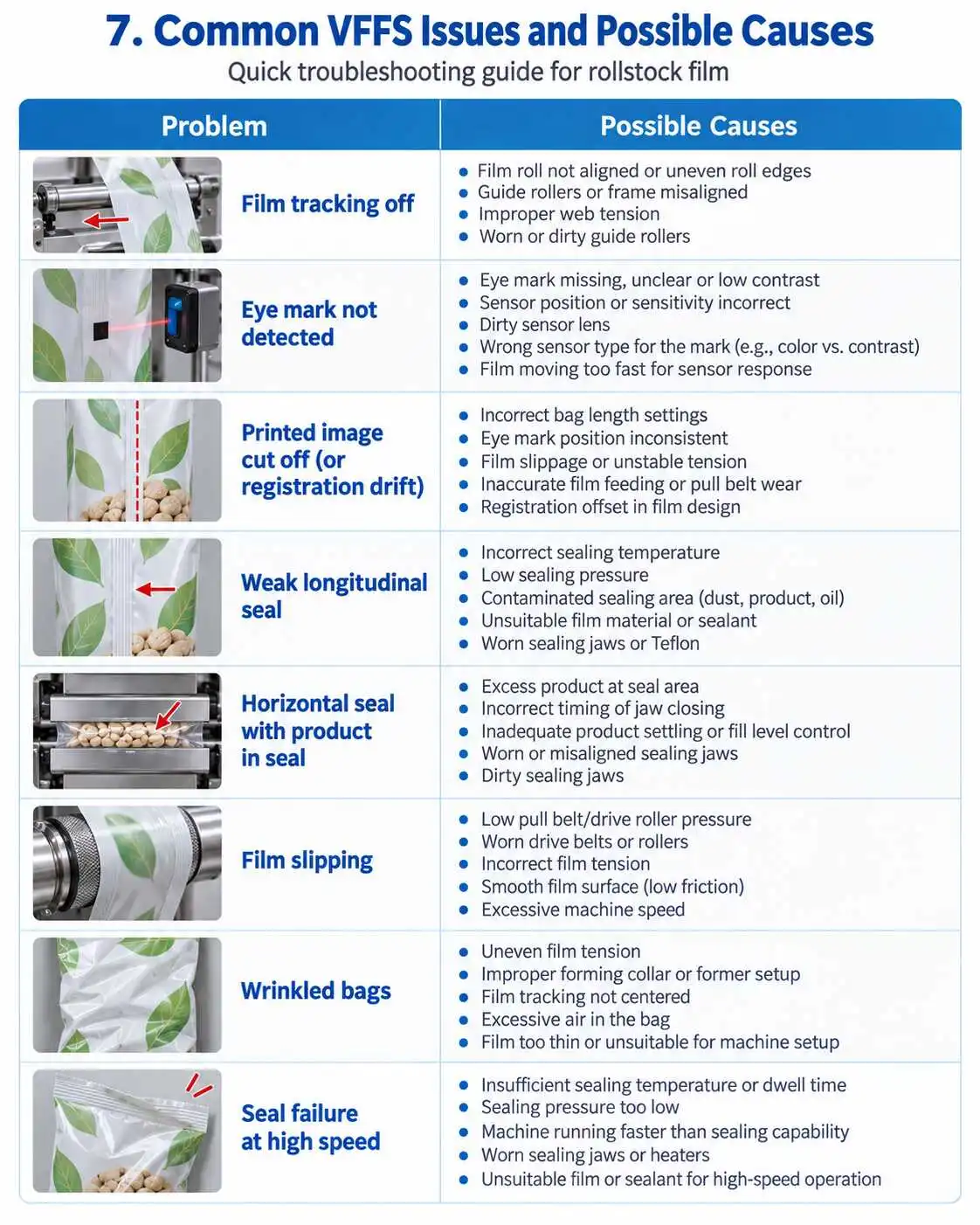
Common VFFS problems can involve film, setup, equipment or product
Film tracking, missed registration, print drift, weak seals, product in the seal, slipping and wrinkled bags should not be assigned to one cause without checking the complete line. Record when the fault begins, the actual machine speed, jaw settings, tension, sensor result and affected roll before changing the specification.
Investigating a running problem?
Send the roll label, film specification, machine model, settings, photos or video and a description of when the fault occurs.
VFFS rollstock compatibility questions
How do I determine the correct rollstock web width for a VFFS machine?
What is print repeat length on VFFS rollstock?
Where should the eye mark be placed?
How do I confirm rollstock unwind direction?
Can the same film work for both fin seals and lap seals?
What is Runlong Pack’s MOQ for printed rollstock?
Why can a film seal at low speed but fail at high speed?
Should I order a machine-test roll before bulk production?
Send the machine, bag, film and product information together
For a useful rollstock review, provide the packaged product, fill weight, finished bag dimensions, machine manufacturer and model, forming-set data, web width, repeat length, eye-mark requirement, unwind direction, core ID, maximum roll size, seal type, line speed, filling method, target quantity and artwork status.