


Spout refill pouches • Optional carry handles
Custom Liquid Laundry Detergent Packaging
Custom printed spout pouches and refill packaging for laundry detergent brands, manufacturers, importers and packaging buyers.
Runlong Pack reviews size, fill volume, artwork, spout position and cap configuration around the actual detergent formulation, viscosity and filling process. Larger refill packs can be evaluated with a carry handle where the dimensions and construction allow it.
Liquid Laundry Detergent Packaging at a Glance
Quick answer: A detergent refill pouch is a flexible package that can be configured with a spout and cap for filling and dispensing a suitable liquid. Choose the pouch around formulation, viscosity, filling method and filled weight—not capacity alone. Runlong’s spout-pouch guidance starts at approximately 1,000 pcs for suitable digital projects and approximately 15,000 pcs for gravure projects.
Packaging format
Custom spout refill pouches, with suitable stand-up and optional handle configurations.
Applications
Liquid laundry detergent and fabric softener refill projects, subject to compatibility review.
Digital spout pouches
~1,000 pcs
Recommended starting quantity; size, structure and fittings must be confirmed.
Gravure spout pouches
~15,000 pcs
Project-specific starting MOQ; artwork and pouch configuration affect the quotation.
Digital production
Approximately 8–10 working days after final specification / artwork approval and required payment.
Customization
Size, fill-volume target, artwork, spout position, cap and suitable carry-handle layout.
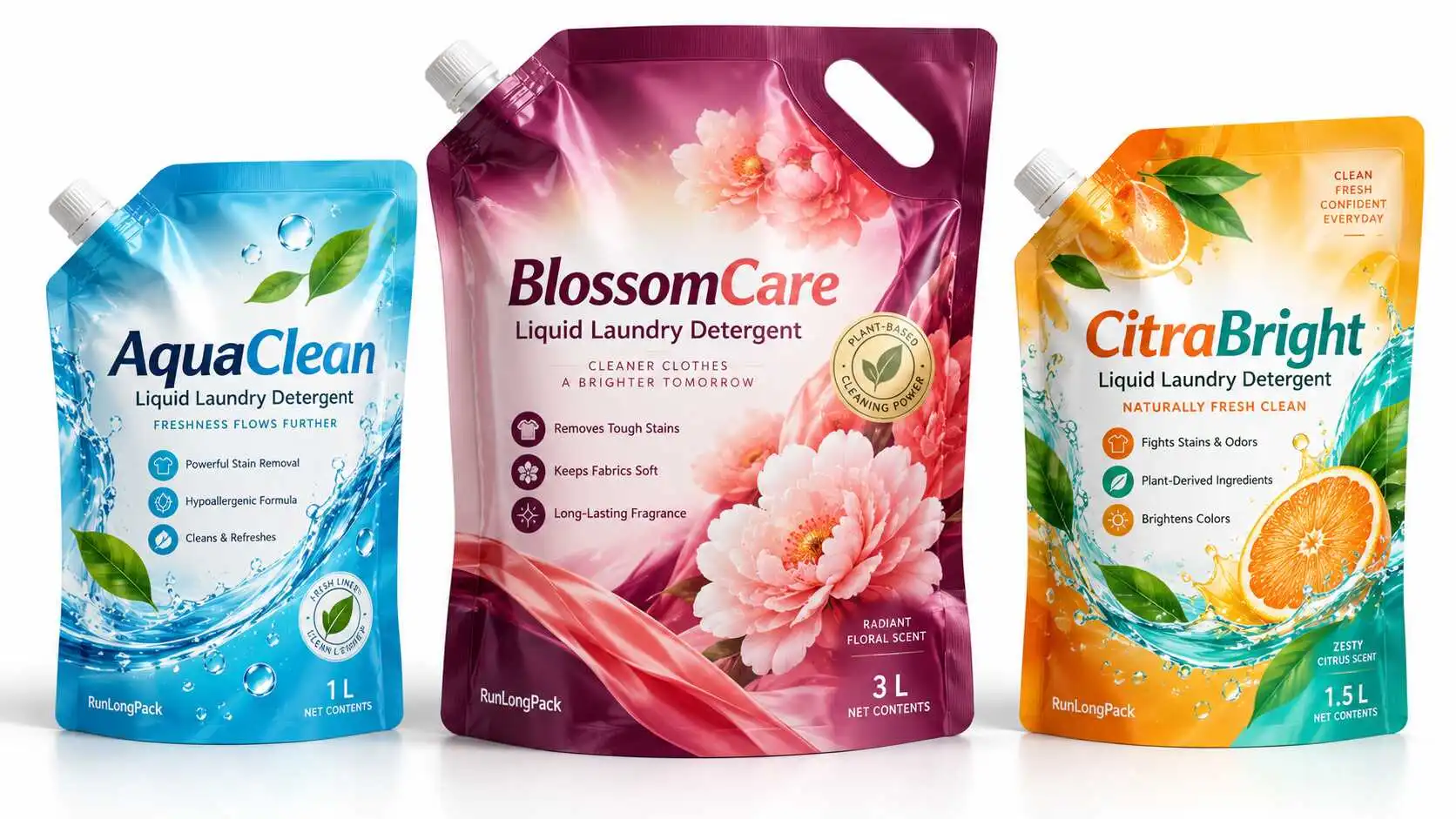
Final specifications depend on formulation, viscosity, fill volume, filling method, storage and transport. The volumes printed on the concept images are examples, not verified standard capacities.
Can Liquid Laundry Detergent Be Packed in a Spout Pouch?
Yes—spout pouches can be considered for liquid laundry detergent, fabric softener and refill products, subject to formulation and filling review. The material structure, spout, cap, dimensions and filling conditions need confirmation for the actual product. One pouch structure should not be assumed suitable for every detergent formulation.
A corner-spout pouch is not the same as a dry-powder bag or a water-soluble detergent pod. This page concerns liquid refill packaging supplied empty for your confirmed filling process.
For broader pouch construction and closure choices, explore custom spout pouches.
Packaging Formats for Liquid Laundry Detergent
Standard spout refill pouch
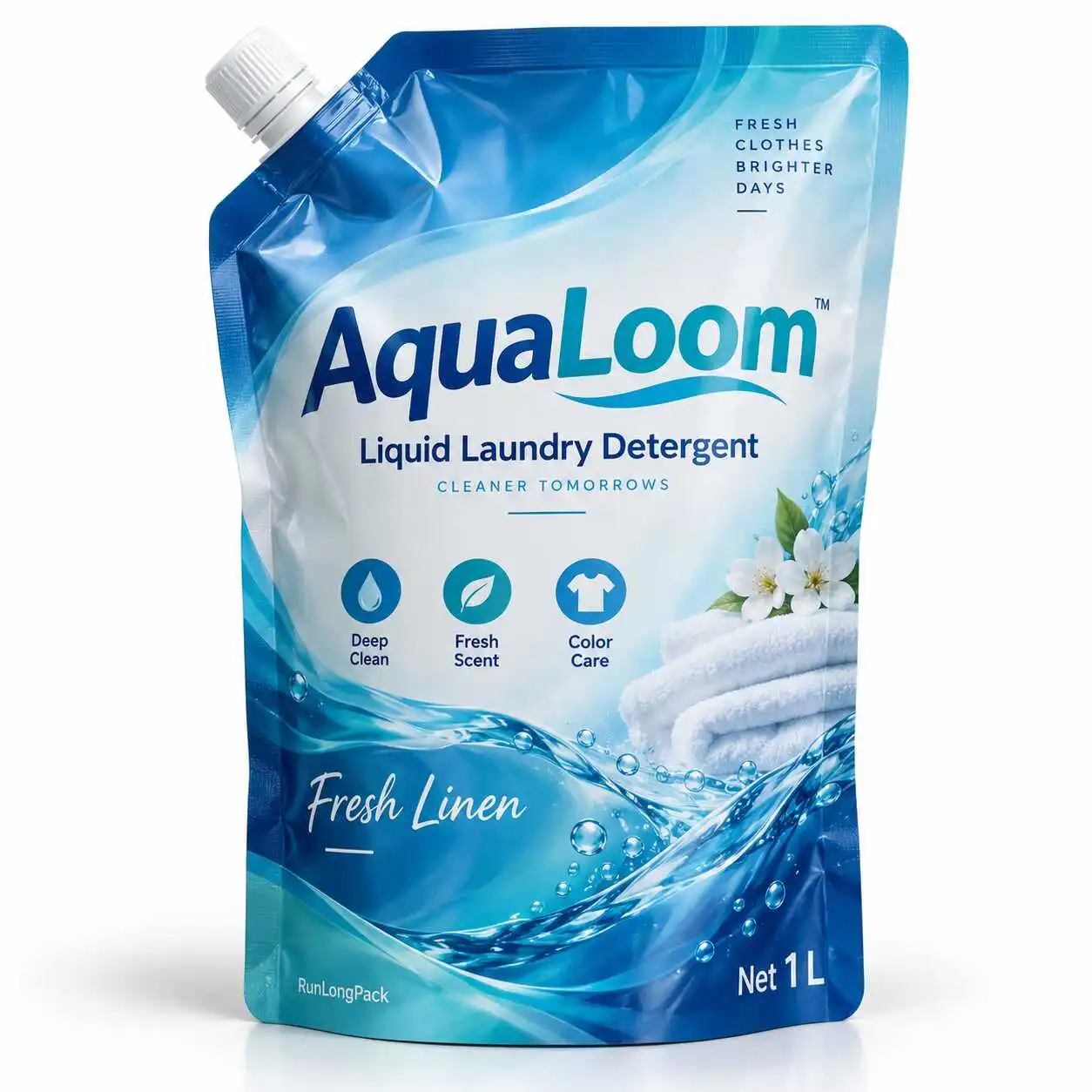
A corner spout and screw cap can be evaluated for suitable refill projects. Examples such as 500 mL, 1 L and 1.5 L are volume targets to review, not a list of fixed stock sizes.
- Confirm fill volume and viscosity.
- Review spout position, cap and pouch dimensions.
- Confirm filling through the spout or an open pouch edge.
- Trial the actual liquid and closure configuration.
Stand-up spout pouch
A bottom gusset supports the filled-pouch presentation for suitable retail and repeat-use projects. Check the filled shape and stability; spout placement and cap fit remain application-specific.
Large handled refill pouch
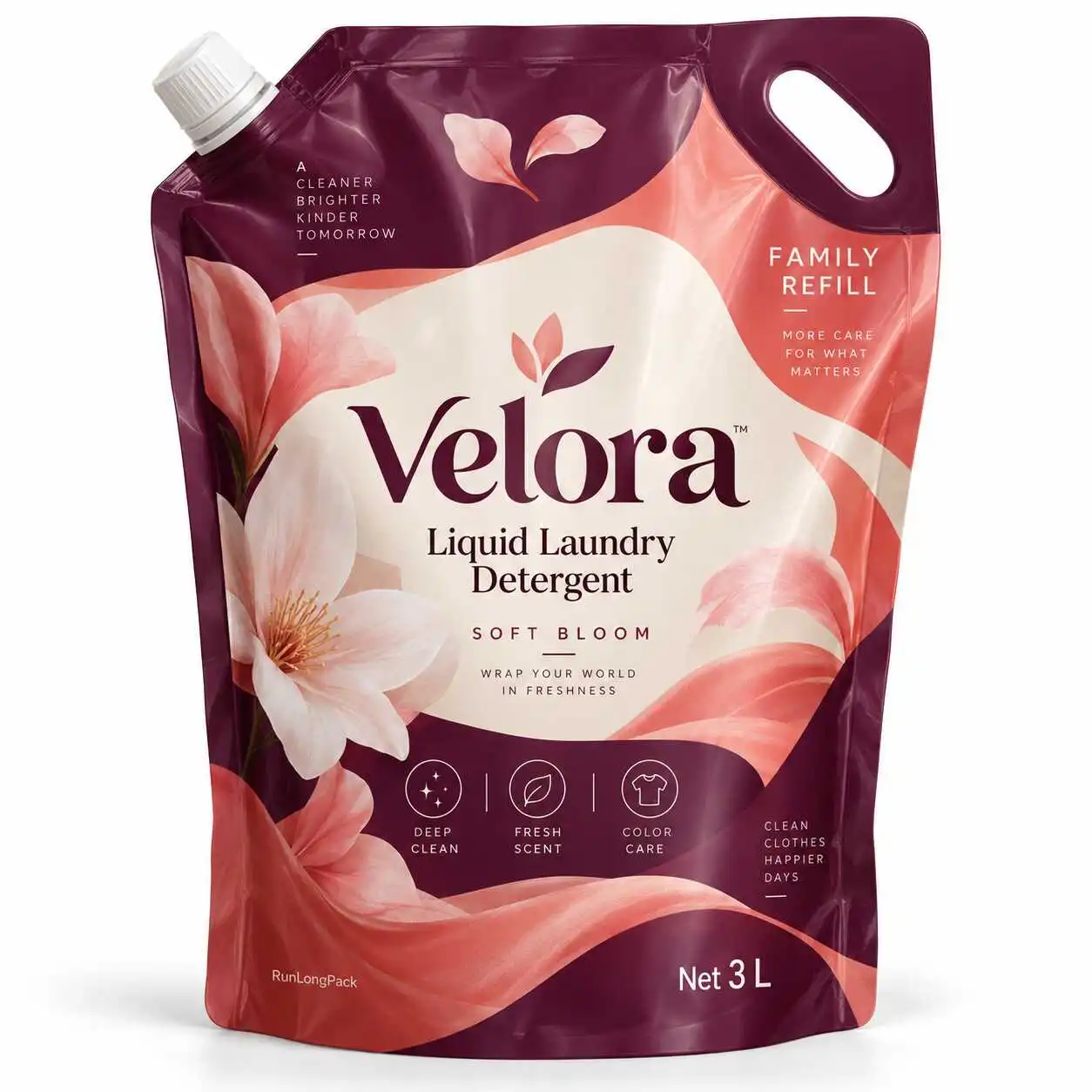
Evaluate for larger family-size refills. Filled weight, handle position, spout and seal layout are reviewed together. A carry handle is not automatically available on every configuration.
Small refill pouch
Consider for smaller refills, trial volumes or concentrated detergent projects. A smaller pouch is not automatically a single-dose pack; intended use must be specified.
Fabric softener refill pouch
Apply the same specification process to fabric softener: formulation, viscosity, filling temperature and storage conditions still require review.
Large Liquid Detergent Pouches with Spout and Carry Handle
The handle cannot be selected independently from the pouch structure. A larger-volume refill may be easier to handle with a die-cut opening, but feasibility must be confirmed with the actual filled weight and layout.
- Fill volume, density where relevant and filled weight
- Pouch width, height and bottom gusset
- Handle and spout position, including clearance
- Seal area and construction
- Filling, closure application and consumer dispensing
- Distribution, carrying and transport conditions
The 3 L marking on the illustration is a visual project example, not a tested load rating. Larger targets such as 5 L or 10 L require separate project evaluation; they are not automatically confirmed capabilities.
How Do You Choose the Spout and Cap?
Do not select spout diameter from pouch capacity alone. Viscosity, the required pouring rate, filling process, pouch dimensions and how the customer dispenses the product all matter.
| Decision | What the buyer should confirm | Why it matters |
|---|---|---|
| Spout configuration | Viscosity, dispensing method, desired flow and position | A visually similar opening does not establish equivalent flow performance. |
| Filling fit | Spout drawing and filling nozzle / equipment interface | Fit must be checked with the actual line rather than inferred from a photograph. |
| Cap | Style, opening method and required closure configuration | Cap and spout need to be reviewed as a matched system. |
| Filled-pouch use | Volume, dimensions, handle, pouring grip and reuse pattern | These affect access and handling during filling and consumer use. |
| Trial | Actual detergent, filling conditions and closure application | Confirms the selected combination before production commitment. |
No universal spout diameter is specified here. Request a relevant drawing and trial plan rather than approving a fitting by appearance.
Read the spout pouch packaging guide for the broader specification process.
Why Does the Detergent Formulation Matter?
Liquid detergents can contain different surfactants, fragrances and additives. Packaging should be reviewed against relevant formulation information and actual filling conditions, rather than selected only from the product name.
Product information
Describe detergent or softener type, viscosity and packaging-relevant ingredients or characteristics. Provide pH if available.
Use conditions
Confirm filling temperature, storage conditions, shelf-life target, fill volume and intended transport.
Practical evaluation
Identify the compatibility and filled-pack tests needed for the project. Visual design and an appearance sample do not validate the formulation.
You do not need to publish your full proprietary formulation. Relevant information can be discussed confidentially as needed for packaging selection. Agree the information-sharing arrangements before sending sensitive formulation details.
How Does Viscosity Affect a Detergent Spout Pouch?
Viscosity influences filling, pouring and consumer handling. Tell us whether the product is a thin liquid, medium-viscosity formulation or thick / concentrated detergent; provide measured data if available, including its measurement conditions.
Filling
Review how product passes through the nozzle or opening, along with the actual filling method and temperature. Do not assume a machine speed.
Pouring
Evaluate desired flow rate and dispensing control with the selected spout. A larger diameter is not a universal solution.
Handling
Assess the filled shape, consumer grip and any handle arrangement during dispensing.
The page does not assign unverified viscosity ranges or claim one spout works with every formulation.
What Filling Information Should Be Confirmed?
Through-spout filling
Provide the spout and nozzle interface, filling temperature, fill volume and cap-application method. Confirm the closure process and trial conditions with the equipment supplier.
Through-pouch-opening filling
Confirm the supplied opening, filling access and final heat-sealing process. Review how liquid contamination at the seal area is controlled.
- Actual filling temperature and method
- Filled volume and equipment interface
- Whether filling occurs through the spout or pouch opening
- Cooling conditions, if relevant
- Cap application and final seal / closure checks
Elevated-temperature filling requires material and process confirmation. It is not automatically supported by the pouch pictured on this page.
Material Structure Is Selected for the Actual Detergent
Runlong Pack does not apply one fixed laminate or thickness to every liquid detergent pouch. Review formulation, viscosity, fill volume, filling temperature, storage, transport, dimensions, spout configuration and the required protection together.
Product compatibility
Select the contact layer and complete structure for evaluation with the actual liquid and expected storage conditions.
Closure & seal system
Consider pouch seals, fitting attachment and cap configuration as part of the finished package—not just the film.
Distribution
Confirm filled-pack handling, stacking, carrying and transport conditions, and define the relevant tests.
Runlong uses food-grade raw materials for its flexible packaging production and does not use recycled, secondary or scrap materials. This also applies to detergent packaging; it does not by itself establish compatibility with a particular formulation or regulatory approval in every market.
Final structure should be confirmed for the product, shelf-life target, filling process and market requirements. No fixed material stack, micron thickness or environmental certification is claimed here.
Printing Options and Order Quantities
Digital printing
Recommended from ~1,000 pcs
For suitable spout-pouch projects, including smaller custom runs, launches and multiple artwork designs. No gravure cylinder fee.
Typical production: 8–10 working days after final specifications / artwork approval and required payment.
Maximum finished pouch width is approximately 37 cm. Larger handled pouches and special fittings need feasibility review; exceeding that width is not suitable for digital production.
Gravure printing
Typical MOQ from ~15,000 pcs
Consider for larger repeat orders with stable artwork. Final MOQ depends on size, structure, spout, cap, artwork and production requirements.
Cylinders: approximately 7–9 working days. Production: approximately 15–20 days after cylinders are ready, subject to specification / artwork approval and required payment.
Historical cylinder reference: USD 30–80 per color; current costs must be quoted. Delivered quantity variation: ±10% according to the contract.
These are spout-pouch rules, not generic plain-bag minimums. Confirm quantity per design, fittings and production route before comparing quotations. Production estimates do not guarantee arrival dates; shipping is separate.
Compare digital and gravure printing, review the MOQ guide and the packaging cost factors.
Can I Get a Custom Printed Sample?
Stock / historical samples
Normally free; the customer pays shipping. Availability varies, and reference samples do not define your final specification.
Customer-design samples
Ordinary digital printed samples: approximately USD 50–70 per piece, subject to format, size and production feasibility.
Special finishes
Approximately USD 100–150 per piece for suitable UV or hot-stamping samples; confirm the project quotation.
For qualified gravure bulk orders over 20,000 pcs per design, the sample fee may be fully refunded, subject to confirmation. Confirm eligibility before placing the sample order.
Large handled pouches or special spout configurations may require a different sampling method. An artwork proof is not a substitute for trials with the actual formulation, filling process and closure system.
Front and Back Printing for Detergent Refill Pouches
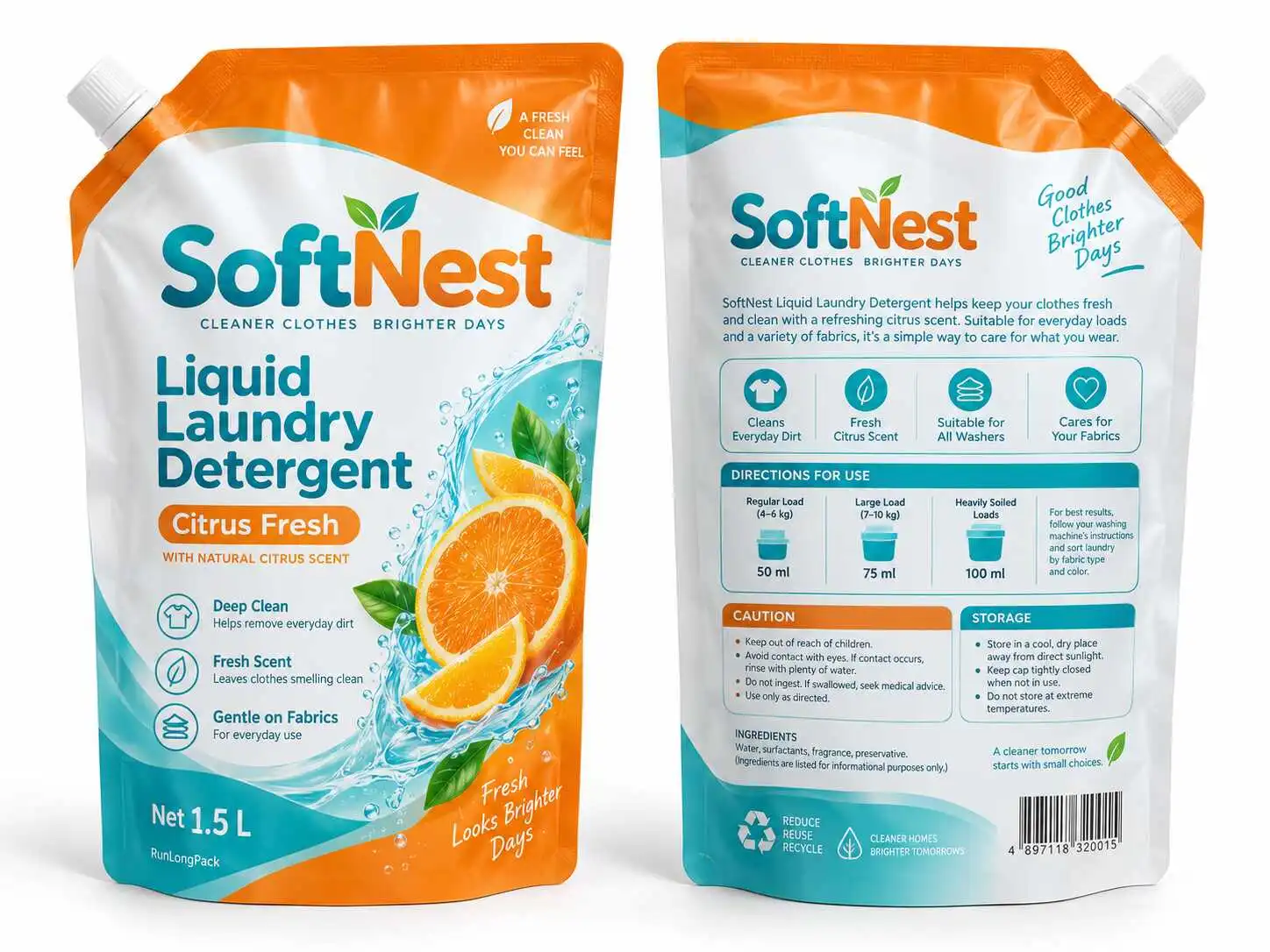
Plan both panels around the dieline, spout, gusset, handle where applicable and seal areas. Keep critical label text and barcode zones away from folds or distorted areas in the filled pack.
Front panel
Brand, product name, scent or variant, declared contents and main artwork.
Back panel
Required product information, instructions, cautions, barcode zone and company information.
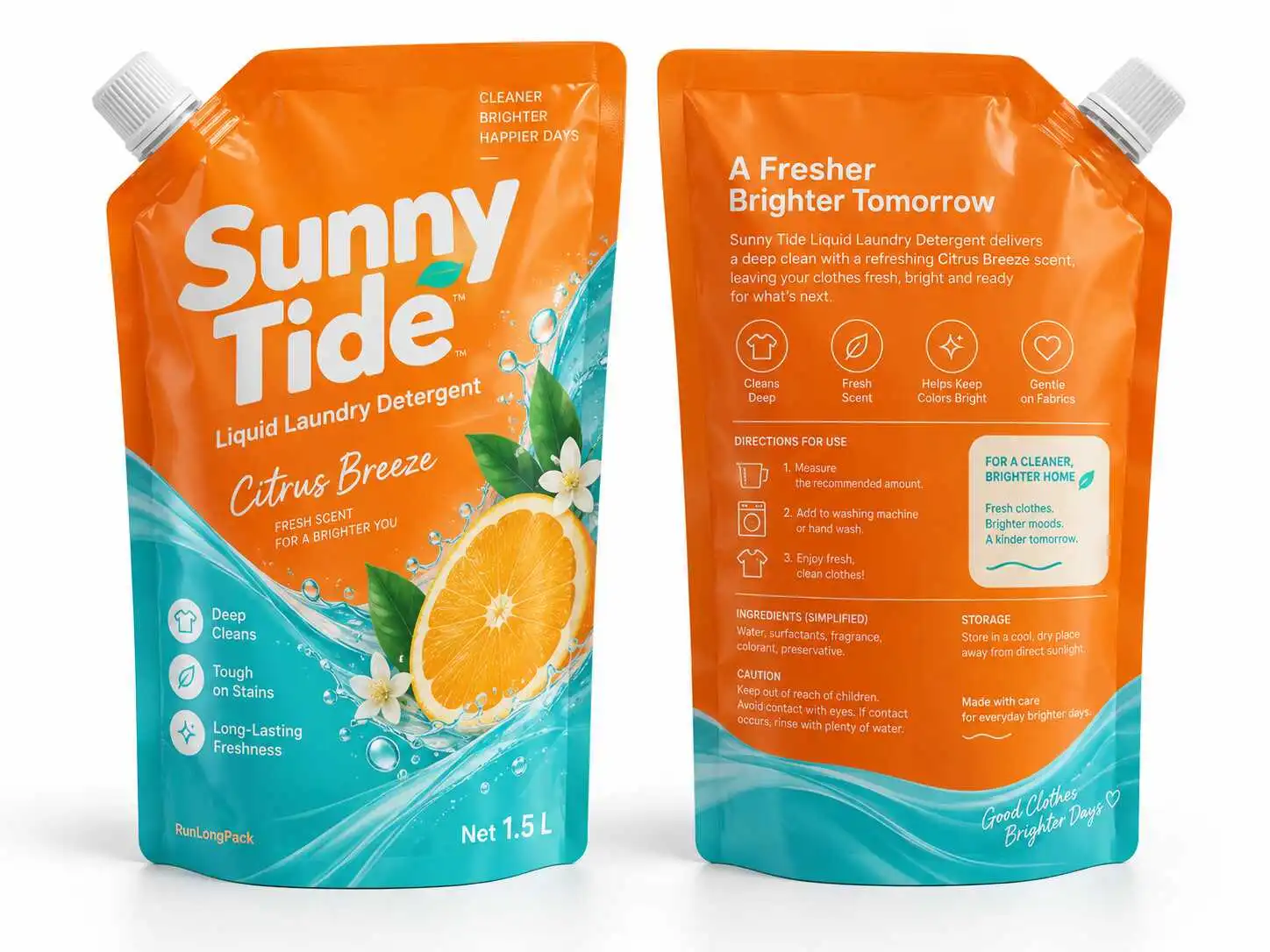
Buyer artwork and required labeling remain the customer’s responsibility and should meet destination-market requirements. The illustrations’ ingredients, dosage, symbols and promotional wording are not approved instructions or verified claims.
What Capacity Can a Detergent Spout Pouch Hold?
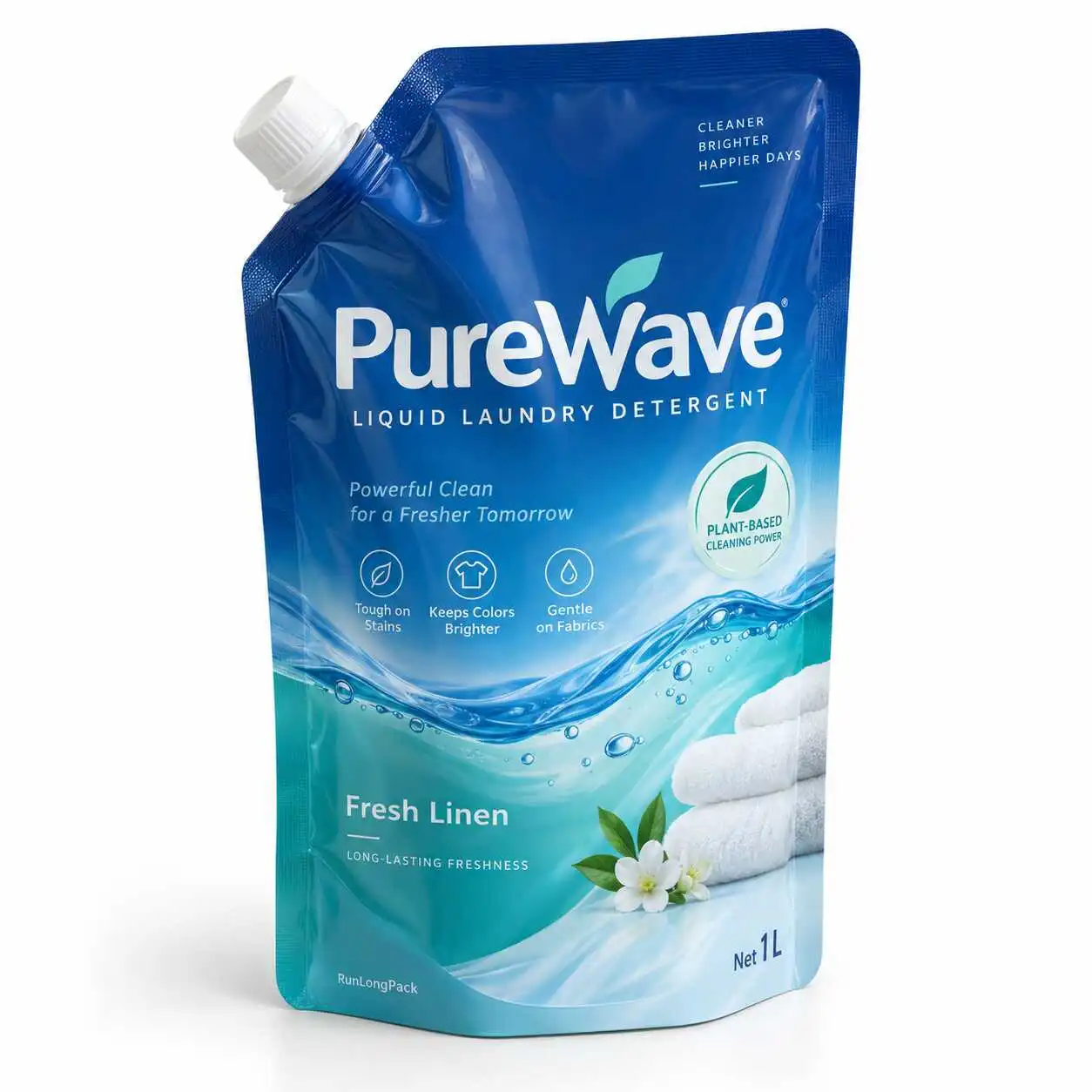
The pictured 1 L, 1.5 L and 3 L markings are visual examples, not fixed standard pouch sizes or automatic production guarantees. Final dimensions depend on actual liquid volume, shape, spout position, handle, filled weight and filling process.
| Buyer input | What to confirm |
|---|---|
| Target fill volume | Actual required volume and relevant filling tolerances |
| Existing package | Current dimensions or filled sample, if available |
| Filled shape | Gusset, presentation, headspace and access to the closure |
| Spout & handle | Position, seal clearance, filling fit and carrying conditions |
| Validation | Actual fill trial and final dimensions approval before production |
Artwork & SKU presentation examples
Different designs can be evaluated without assuming every SKU shares the same formulation or pouch specification. Confirm quantities per design and which specifications are common.
What to Send for a Liquid Laundry Detergent Packaging Quote
Send what you know and flag unknown items for review. Do not guess a material structure or spout specification to complete the checklist.
- Product: liquid laundry detergent / fabric softener
- Fill volume
- Viscosity, with measured information if available
- Filling temperature
- Existing pouch dimensions, if available
- Preferred pouch format
- Spout position
- Cap requirements
- Carry-handle requirement
- Order quantity
- Artwork designs / SKU count
- Filling method and equipment interface
- Storage requirements and intended shelf life
- Delivery country and city
Add formulation information relevant to compatibility, including pH if available, and any project-specific validation requirements.
Why Runlong Pack: From Specification to Manufacturing
Runlong Pack is Shantou Runlong Packaging Co., Ltd., in Shantou, Guangdong, China. The available routes include digital and gravure printing, lamination and pouch conversion, with suitable spout-pouch configurations reviewed by project.
Application review
Start with formulation, fill volume, viscosity and equipment—not a one-size-fits-all laminate.
Printing route
Compare smaller digital projects and repeat gravure orders using the specific spout-pouch quantity rules.
Approval before production
Confirm dimensions, fittings, artwork and suitable samples / trials before committing to the final production specification.
Project workflow
Requirements → Formulation & filling review → Size / spout / cap / handle → Material & sampling plan → Artwork approval → Printing & lamination → Pouch conversion & fitting confirmation → Inspection & shipment.
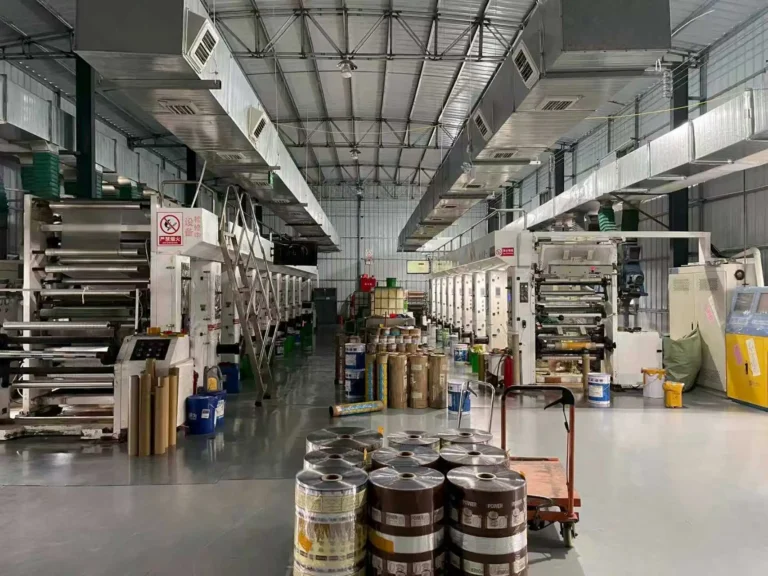
Product images on this page are packaging concepts. Their brands, capacity markings and marketing wording are illustrative, not customer case evidence or validated performance statements.
Real Spout Pouch Case Study: Sampling Before Mass Production
The published South Africa case describes a 200,000-piece custom-shaped spout pouch order for a beverage project, not a laundry detergent project. It involved approximately two sample rounds, sealing adjustments, functional evaluation and customer confirmation before mass-production preparation continued.
The relevant lesson is the project-development process: identify functional issues through sampling and confirm the specification before scaling production.
This case study represents one specific project and does not define the material structure or spout specification for every detergent pouch. Its internal mixing feature and beverage application are not presented as detergent-packaging capabilities.
Liquid Laundry Detergent Packaging FAQ
Can liquid laundry detergent be packed in a spout pouch?
What is the MOQ for custom detergent spout pouches?
Can a large detergent refill pouch have a carry handle?
What spout size should I use?
Can you make 1 L, 1.5 L or 3 L detergent pouches?
Do you use one material structure for all detergents?
Can I get a custom printed sample?
How long does production take?
What information do you need for a quote?
Working with washing powder instead? Explore our custom laundry detergent powder packaging for premade bags, printed rollstock and dry-powder filling requirements.
Start Your Custom Detergent Refill Pouch Project
Send your product, fill volume, viscosity, filling temperature, dimensions or existing sample, quantity / SKUs, spout / cap / handle requirements and destination.
We can review a suitable packaging and sampling route before you approve mass production.