



How Many Packs Can You Make from a Roll of Packaging Film?
A practical buying guide with a checklist you can use in your next packaging discussion.
Discuss Your Packaging ProjectQuick Answer
Theoretical packs per roll equal net film weight in grams divided by the film area used for one pack times the total laminate grammage. For a confirmed single-lane layout: packs = net kg × 1,000 ÷ (GSM × web width in metres × cut repeat in metres). Subtract documented startup and running losses separately to estimate usable output. Gross roll weight and pouch fill weight cannot replace these inputs.
Quick Facts
| Decision point | What to confirm |
|---|---|
| Required inputs | Net film kg, total laminate g/m², slit web width and cut repeat |
| Single-lane formula | N = M × 1,000 / (G × W × R) |
| Result type | Theoretical complete packs, before line losses |
| Example status | All example figures below are hypothetical—not a film recommendation |
Collect four compatible measurements
| Symbol | Meaning and unit | Check before calculating |
|---|---|---|
| M | Net film weight, kg | Exclude core, wrap, pallet and other non-film weight. |
| G | Total finished laminate grammage, g/m² | Use the supplied or measured total GSM, including the finished construction. |
| W | Actual slit web width, metres | Use the roll being fed to the machine, not an unrelated master-roll width. |
| R | Machine-direction cut repeat, metres | Confirm one repeat produces one pack for this single-lane example. |
GSM means grams per square metre. Thickness alone does not reliably provide total laminate GSM because different layers, adhesives, coatings and inks contribute mass differently. Obtain the agreed value from the packaging supplier or a suitable measurement method. Do not use a single plastic density for an unknown multilayer laminate.
Convert units first: 400 mm is 0.400 m, not 400 m. Use the complete web width consumed by the process, including the sealing allowances already in the approved drawing. Do not add those allowances again if they are already included.
Calculate area, length and theoretical pack count
The same calculation can be broken into three steps so that purchasing and production can check each other’s numbers:
- Film area (m²) = net kg × 1,000 ÷ GSM.
- Film length (m) = area ÷ web width in metres.
- Single-lane theoretical packs = film length ÷ cut repeat in metres.
If a roll has a reliable supplied length, you can calculate packs from length and repeat directly, then use the weight calculation as a consistency check. Round down when reporting complete theoretical packs. Keep intermediate values unrounded so repeated rounding does not distort the estimate.
For a confirmed equal-repeat multi-lane layout, multiply the length-based result by the number of usable lanes. The width in the mass calculation must be the total web width represented by that net weight. Do not use the mass of a master roll with the width of one narrow slit roll and then multiply by lanes again.
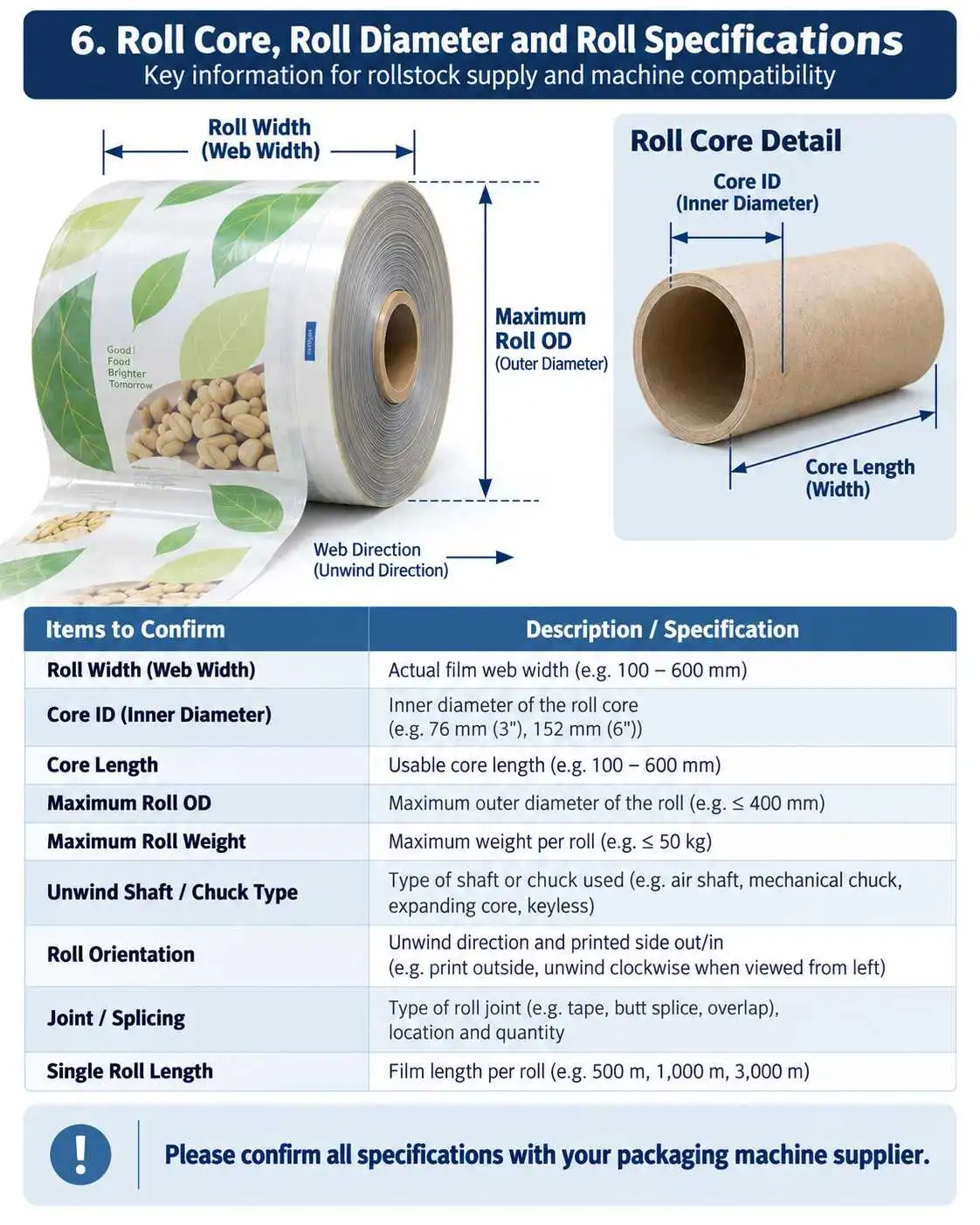
Worked example: a hypothetical 50 kg roll
| Input / step | Calculation | Result |
|---|---|---|
| Net film mass | 50 kg × 1,000 | 50,000 g |
| Total laminate grammage | Assumed for this example | 75 g/m² |
| Web width | 400 mm ÷ 1,000 | 0.400 m |
| Cut repeat | 250 mm ÷ 1,000 | 0.250 m |
| Film area | 50,000 ÷ 75 | 666.6667 m² |
| Film length | 666.6667 ÷ 0.400 | 1,666.6667 m |
| Theoretical packs | 1,666.6667 ÷ 0.250 | 6,666 complete packs, rounded down |
These dimensions and grammage are assumptions for arithmetic only. They are not a recommendation for potato chips, coffee, frozen products or any particular line. The concept film image shows repeated artwork; its printed fill weight is not an input in the film-yield formula.
If only grammage changes from 75 to 90 g/m² while net weight, width and repeat stay the same, theoretical yield falls to 5,555 complete packs. That is why kilograms alone cannot compare the output of two different film structures. Do not reduce grammage solely to increase yield without validating the packaging requirements.
Separate fixed startup loss from running loss
For the same hypothetical roll, assume 50 metres are consumed in startup and the remaining production has a 3% pack reject rate. The usable-output estimate is: (1,666.6667 − 50) ÷ 0.250 × 0.97 = 6,272.6667, or approximately 6,272 complete usable packs after rounding down. These loss values are assumptions, not Runlong or machine performance guarantees.
Use the 3% rate only if it applies to the remaining production. If your historical overall loss rate already includes startup waste, do not subtract startup again. Likewise, splice rejects, roll-end waste and rejected filled packs should not be counted twice. Ask production how its loss records are defined.
| Loss category | Record your value | Included elsewhere? |
|---|---|---|
| Startup and registration | _____ metres per roll / changeover | Yes / No |
| Splices and roll-end waste | _____ metres or packs | Yes / No |
| Running rejects | _____ % of defined remaining output | Yes / No |
| Other documented loss | _____ and measurement basis | Yes / No |
Many short runs may produce more startup loss than one long run with the same total film mass. This matters when dividing an order among flavours or pack sizes.
Reverse the calculation for a purchasing estimate
Suppose the target is 10,000 usable packs, with the same hypothetical 75 GSM, 0.400 m web, 0.250 m repeat, one 50 m startup allowance and 3% running rejects. Required film length = 10,000 × 0.250 ÷ 0.97 + 50 = 2,627.3196 m. Required net film mass = 2,627.3196 × 0.400 × 75 ÷ 1,000 = about 78.82 kg.
That is a planning estimate, not a purchase instruction. Confirm roll splits, number of startups, supplier quantity tolerances, trial stock and any separate contingency before ordering. If the job needs several rolls or repeated SKU changes, one startup allowance may be inadequate. Use actual line records to improve the estimate over time.
See printed rollstock options and machine compatibility requirements before converting the estimate into an order.
Copy the roll-yield worksheet
| Worksheet entry | Your project |
|---|---|
| Net film mass / verified roll length | ________________ |
| Total laminate GSM and source | ________________ |
| Slit web width and cut repeat | ________________ |
| Usable lanes and drawing revision | ________________ |
| Theoretical packs, rounded down | ________________ |
| Fixed loss basis and number of startups | ________________ |
| Running loss rate and definition | ________________ |
| Estimated usable packs | ________________ |
| Actual output after trial / production | ________________ |
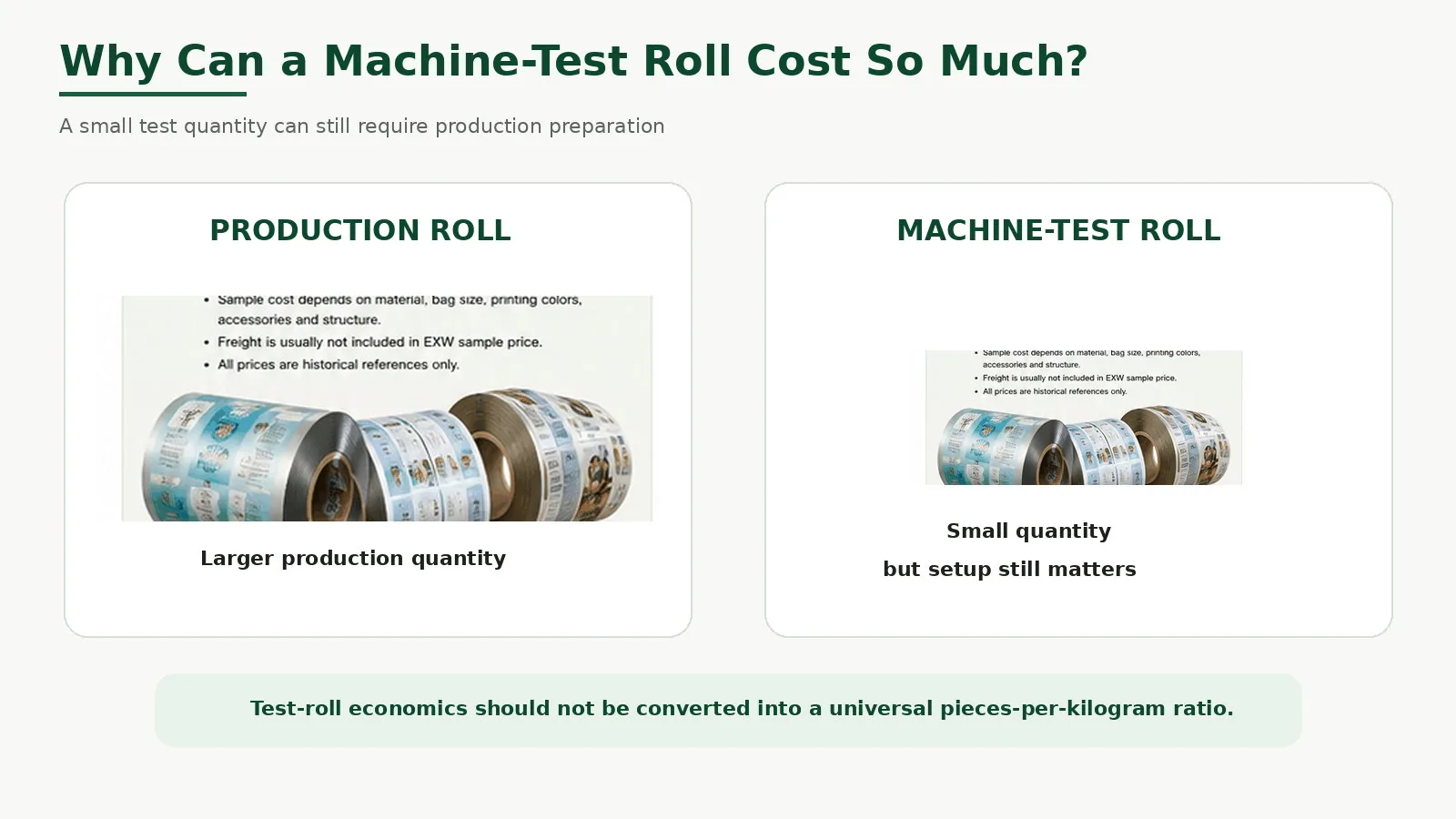
Use the actual result to update the next forecast. For suitable compatible projects, Runlong may assess digital rollstock trials around 10 kg; commercial orders are generally recommended around 300 kg or more. Neither reference provides a universal packs-per-kilogram ratio. See trial-roll and sample planning for why a small test run has different economics.
Frequently Asked Questions
Can I calculate packs from gross roll weight?
Not accurately without subtracting the core and other non-film weight. Use net film mass or a verified film length.
Can I use thickness instead of GSM?
Not reliably for an unknown multilayer film. Obtain total laminate grammage or a validated conversion for the actual construction.
Does one printed repeat always equal one pack?
No. Confirm the cutting and lane layout. The simple formula assumes one pack per repeat in a single lane.
Is the result guaranteed production output?
No. The theoretical number excludes losses. Usable output depends on actual startup, splicing, running rejects and other documented losses.
Start With a Clear Packaging Brief
Net film kg or length + total laminate GSM + slit width + cut repeat + lane layout + actual loss records + target usable quantity
Get a Quote