

China or the USA for Flexible Packaging?
Compare the package, delivered cost, replenishment plan and supplier controls against your factory’s real demand.
Should a U.S. food factory buy flexible packaging from China or the USA?
There is no universal winner. China may fit forecastable custom programs when production scale, format choice or a supplier’s specific capabilities justify planning ahead. A U.S. supplier may fit orders where domestic replenishment, nearby technical coordination or a shorter import route matters more. The right choice depends on the quoted package, order pattern, total landed cost, verified production window and supply risk.
Compare suppliers using the same approved structure, dimensions, print, seal requirements, order volume, delivery point and acceptance criteria. Consider a qualified second source when a packaging shortage could interrupt production, but validate that source before relying on it.
These are Runlong project references, not averages for all suppliers in China or the United States. Final MOQ and schedule depend on pouch type, size, material, artwork, quantity and production conditions.
Define the buying problem before comparing countries
A procurement decision should begin with the plant’s consumption and operating constraints. List each pouch or rollstock format, annual usage, monthly demand, SKU count, forecast accuracy, packaging inventory, line compatibility, shelf-life requirements and the cost of a line stoppage. Separate routine demand from launches, promotions and emergency replenishment.
Then identify what cannot change: the approved material structure, package dimensions, artwork, seal performance, filling-machine fit, food-contact documentation and delivery date required at the factory. If suppliers quote different specifications, their prices are not directly comparable.
Ask the plant
- How many days or weeks of packaging are on hand?
- How variable is consumption by SKU?
- Which line or package failure would stop production?
- Can the plant hold planned inventory safely?
- How quickly can artwork and specifications be approved?
Ask procurement
- Are quotes based on the same pack and quantity?
- Which setup, freight, customs and delivery charges are included?
- What production milestones and shipping assumptions apply?
- Which records, tests and change controls are required?
- What is the approved response if the primary source is delayed?
Compare the actual supplier offer, not a country stereotype
| Decision factor | What to test for a China supplier | What to test for a U.S. supplier |
|---|---|---|
| Price | Convert quote, freight, import charges, inventory and risk to the same delivered basis | Confirm material, conversion, setup, delivery and any minimum or surcharge |
| MOQ and SKUs | Check print method, format, material use and whether each design is counted separately | Ask how tooling, run size, stock availability and SKU changes affect the minimum |
| Time to usable stock | Include production, export handling, international freight, customs and inland delivery | Include production queue, local freight, stock status and the supplier’s confirmed ship date |
| Technical fit | Verify line trials, specification control, communication and documentation for your application | Verify the same technical criteria, plus the support actually included in the offer |
| Risk and recovery | Plan buffer inventory, shipment visibility and escalation for delays | Check available capacity, backup stock and recovery options for urgent demand |
A nearby supplier does not automatically have stock or spare capacity. An overseas supplier does not automatically mean low quality or poor service. Ask both candidates for written evidence tied to your package and production plan.
When China sourcing may make sense for a U.S. food manufacturer
Overseas production is easier to evaluate when demand is forecastable and the plant can plan artwork, purchase orders, production and freight together. It may be worth comparing China when the specific supplier offers a pouch format, customization route or production option that fits the package, or when the expected scale makes the full delivered economics attractive.
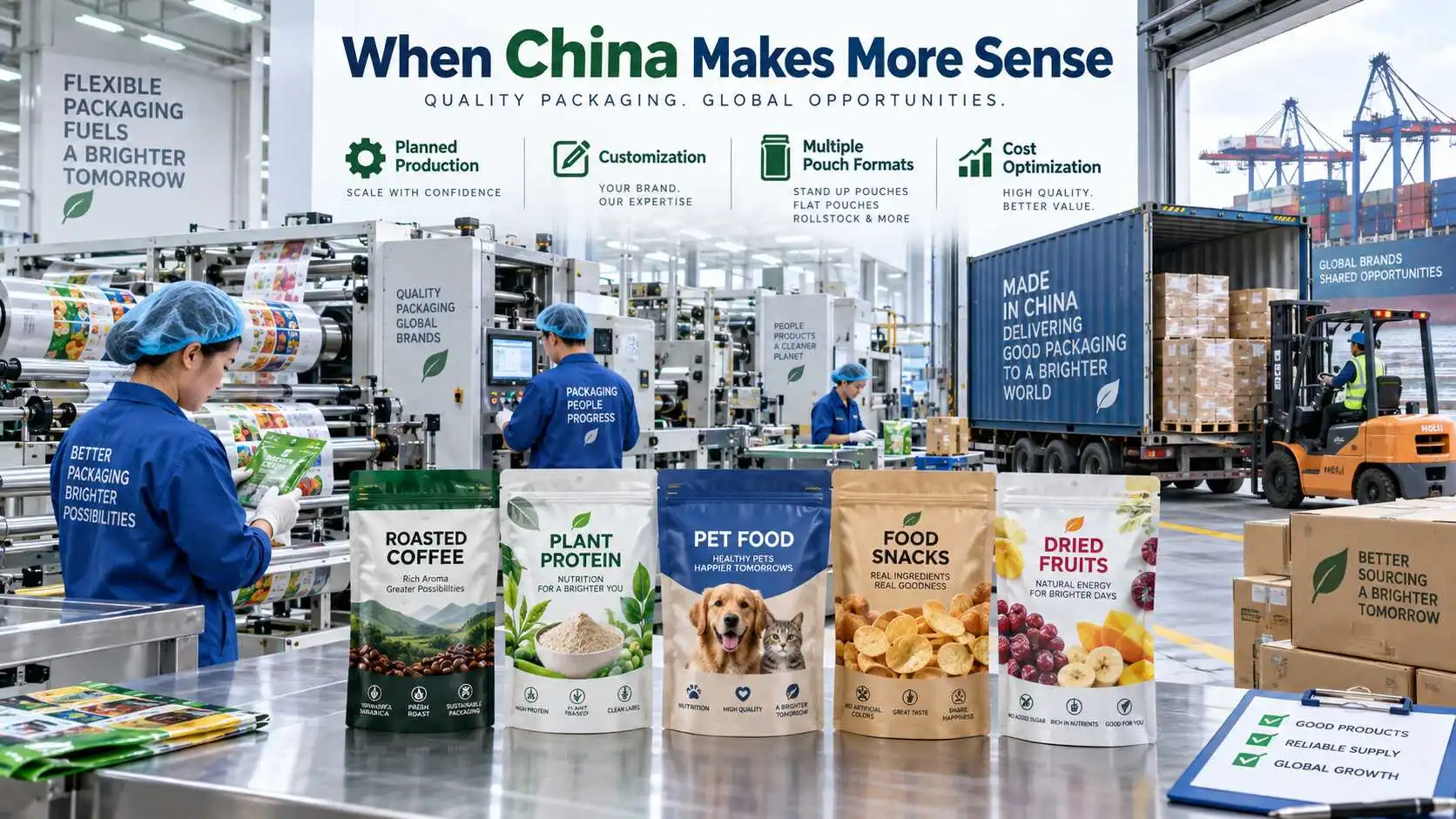
Forecasted repeat demand
Known consumption and reorder triggers make it easier to plan production and shipping instead of paying to solve every order as an emergency.
Custom package requirements
Compare the supplier’s real pouch, laminate, print and finishing capabilities against your approved design and food application.
Scale that supports the run
Review whether your quantity fits digital, gravure or rollstock production. Runlong’s MOQ guidance can help assess its offer, but it is not a market-wide China benchmark.
For Runlong, standard custom pouch digital printing may be evaluated from around 100 pieces for some projects, with roughly 1,000–3,000 pieces often offering a more practical value range; normal gravure pouch orders generally start around 10,000 pieces. Commercial printed rollstock orders are generally recommended around 300 kg or more; selected compatible digital trials around 10 kg may be evaluated separately. Neither is a universal MOQ. Specific pouch, size, material, SKU and structure can change the assessment.
Checking a supplier’s minimum?
Compare the MOQ with the package format, printing method, size and number of designs.
When U.S. sourcing may make sense for the factory
A domestic supplier may be a better fit when the production plan depends on local replenishment, frequent coordination with plant teams, a short recovery window or inventory held near the factory. These advantages are specific to the supplier’s location, stock position, schedule and service terms. Confirm them rather than assuming every U.S. supplier can ship immediately.
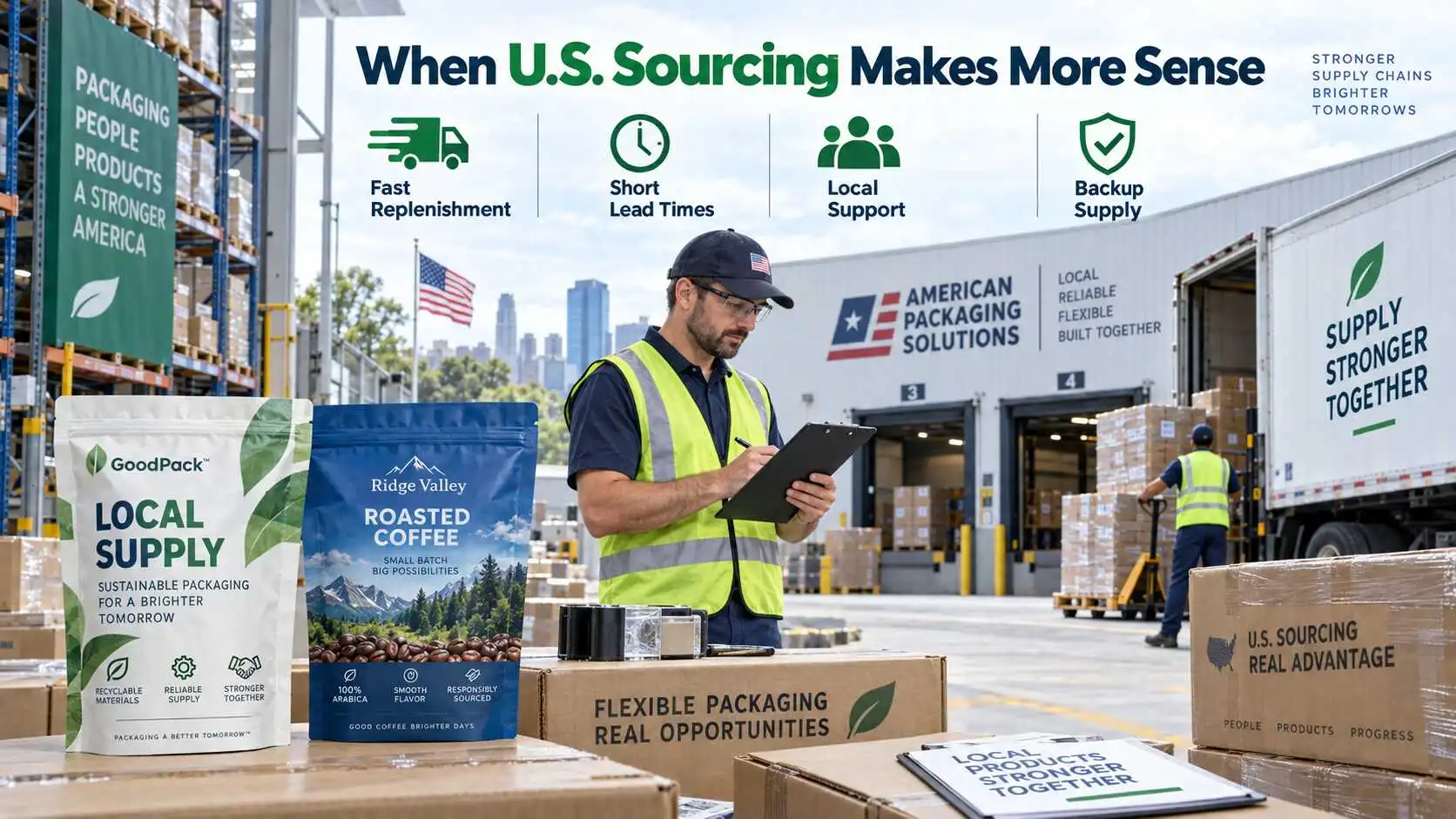
- Emergency replenishment is more important than the lowest planned-order quote.
- Plant engineers need frequent in-person or same-time-zone coordination, and the vendor confirms that service.
- Demand changes quickly enough that imported buffer inventory would be costly or risky.
- The supplier can provide the required food-contact package, structure and line performance.
- The domestic offer remains competitive after setup, minimums, rejects and downtime exposure are included.
U.S. sourcing is not automatically lower risk: the buyer should still qualify the converter, approve materials and artwork, validate seals and confirm capacity. It is an operating choice whose value depends on what the plant needs.
Compare minimums by format, print process and SKU mix
MOQ is a supplier- and package-specific production threshold. It is affected by pouch style, finished dimensions, material, film usage, print process, number of designs and whether the item is custom or stocked. A single China-versus-USA number can be misleading.
Digital printing
It may suit pilot launches, several SKUs or smaller custom runs when the pouch and size fit the equipment. Compare per-SKU quantities and the total delivered cost. A small MOQ does not necessarily mean the lowest unit cost.
Gravure printing
It may suit larger, stable designs where setup and cylinder costs can be spread over production. Ask how many designs need separate cylinders and use the same order profile for each supplier quote.
Runlong’s normal custom pouch references are around 100 pieces for some digital projects, around 1,000–3,000 pieces as a more practical value range, and generally around 10,000 pieces for gravure. These are not universal supplier comparisons; the actual package and project determine feasibility.
Choosing between print processes?
Compare setup, design count, quantity and expected repeat orders together.
Measure time from approved artwork to usable inventory at the plant
Ask suppliers to separate specification approval, material preparation, printing, converting, inspection, export handling, international transport, customs clearance and final delivery. A production estimate is not the same as an arrival date at a U.S. factory.
For Runlong, typical digital production is around 8–10 working days. For gravure, cylinder making is around 7–9 working days, followed by about 15–20 days of production after the cylinders are completed. The production clock normally begins after final artwork/specification approval and required payment; international freight, customs and U.S. delivery are additional and must be confirmed for the order.
For sea, air or other transport, actual transit and clearance vary with route, service, season, shipment size and customs processing. Use a current freight quote and a qualified customs broker for the specific shipment; do not substitute a supplier’s factory lead time for a landed delivery plan.
Compare the cost of packaging that is delivered and usable
The lowest quoted bag price may not produce the lowest cost for the plant. Build a like-for-like comparison using the same specification, annual demand, SKU mix, delivery location, currency date and accepted-quality basis.
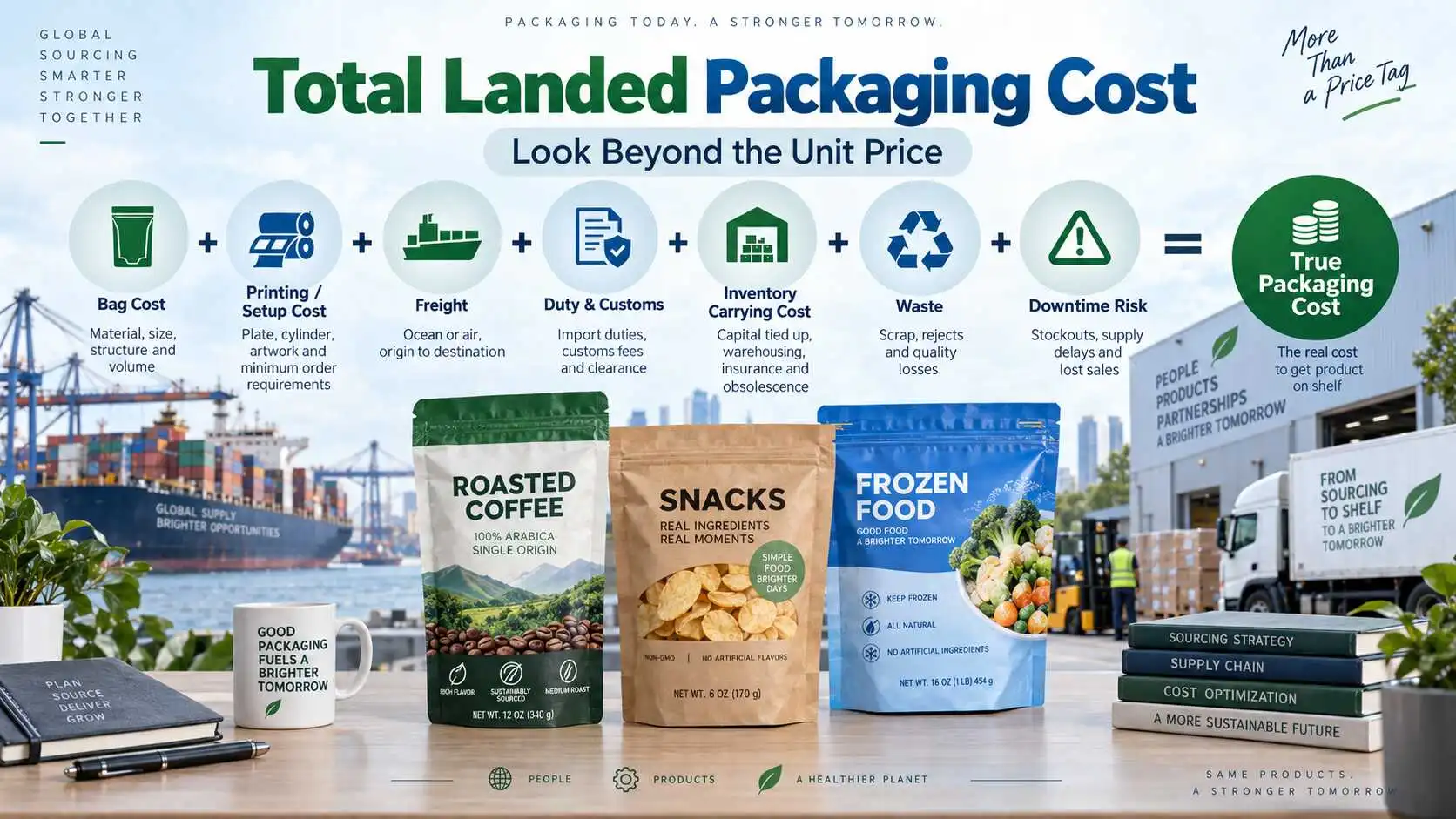
Direct purchase and import costs
Include film or pouch price, cylinders or setup, freight, insurance if applicable, brokerage, customs entry, duties and delivery to the plant. Confirm the Incoterm, named destination and what charges remain outside the quote.
Operating and inventory costs
Estimate inventory carrying and storage, expiry or obsolescence exposure, trial and changeover waste, quality rejects, line-fit risk, stockout recovery and any expedite cost using your own plant data.
U.S. import duty depends on the correct tariff classification, origin and current rules for the particular shipment. Do not use a generic percentage: confirm classification and current charges with your customs broker and review the official U.S. Harmonized Tariff Schedule search as part of that process.
Want a quote compared on the same basis?
Share the package specification, quantity by SKU, delivery ZIP code and requested delivery window.
Qualify supplier controls and documentation for the exact food package
Country of manufacture alone cannot establish package safety or line performance. Ask each supplier to identify the material structure and intended use, provide applicable food-contact declarations or test documentation, define thickness and dimensional controls, agree on print and color acceptance, document seal requirements, retain approved samples and explain lot traceability and change notification.
For U.S.-market food packaging, the buyer’s regulatory and quality teams should review documentation against the actual food, conditions of use and applicable requirements. The FDA’s food ingredients and packaging resource area is a starting point; a generic report or the phrase “food grade” alone should not be treated as approval for every structure and application.
Runlong confirms that it uses food-grade raw materials throughout its flexible-packaging production and does not use secondary, recycled or scrap material. Relevant material compliance documents and test reports may be available for applicable projects; the exact package and intended use still require review.
Before a large commitment, approve the final specification, evaluate representative samples, run a line trial where needed and set written acceptance criteria. Confirm who approves material or process changes and how affected lots will be identified.
Dual sourcing can combine planned production and local recovery
A food factory does not always need to choose one country for every bag. A dual-source plan may assign forecasted production to one qualified supplier and keep another approved supplier available for defined formats, demand spikes or recovery needs. This can reduce dependence on one production or logistics route when the packaging is critical to the line.
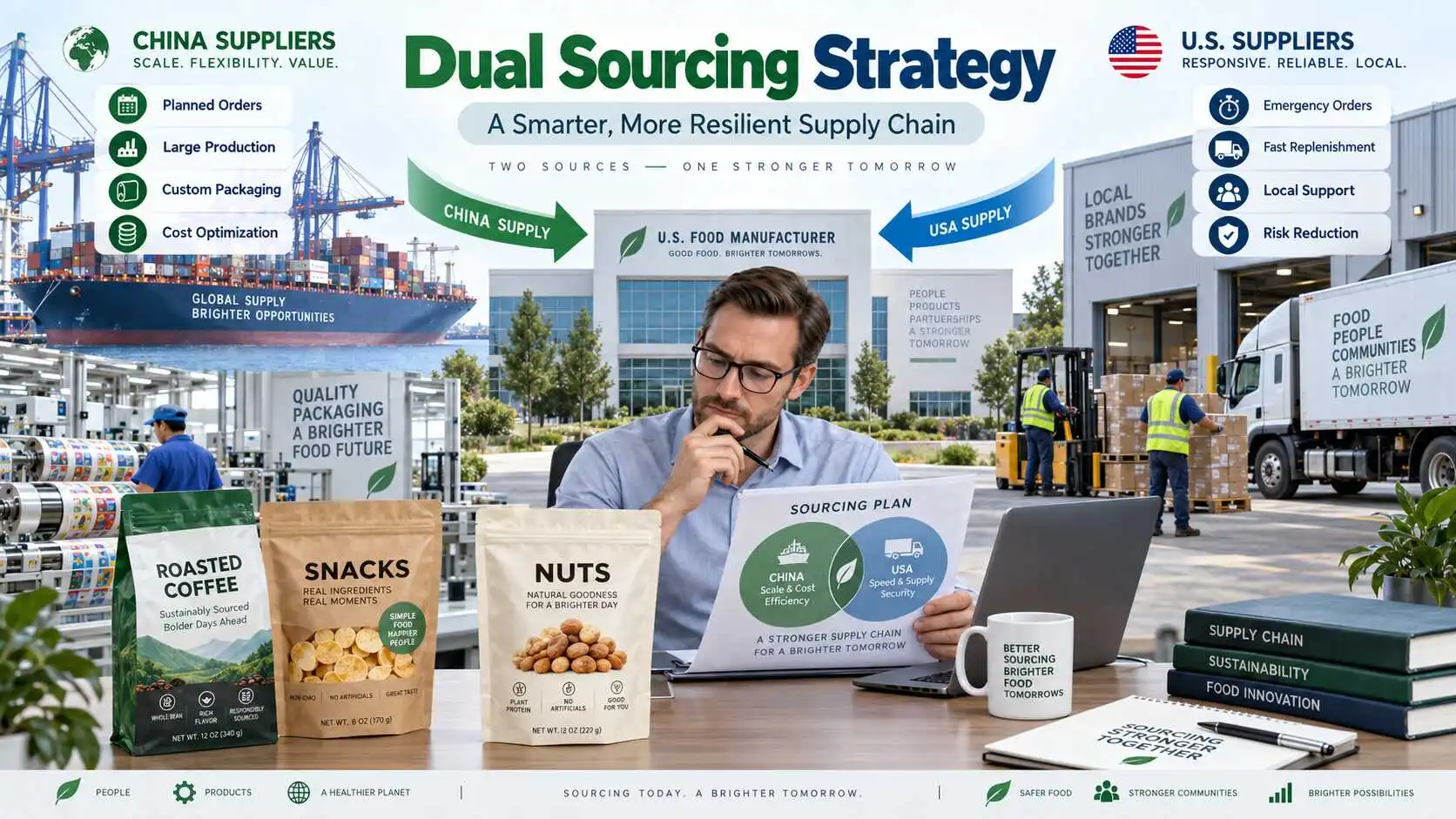
Dual sourcing adds work. Two suppliers may require separate artwork adaptation, tool ownership, validation, safety stock, purchase planning and change control. Materials that appear similar may run differently on the filling line. The food factory should decide which packaging specifications must be identical, what differences are allowed and what tests are needed before switching.
Choose the primary source
Use a documented scorecard for total delivered cost, stable quality, capacity, schedule visibility, communication and technical support.
Make the backup real
Keep approved artwork and specifications current, agree on qualification samples, confirm commercial readiness and periodically verify that the backup can still produce the package.
Request comparable quotes from both sourcing routes
Package and demand
- Product and food-contact application
- Pouch style or rollstock machine requirements
- Approved dimensions, material functions and thickness
- Print files, number of SKUs and quantity per SKU
- Annual demand, forecast variation and reorder pattern
- Line trial needs and acceptance criteria
Quote and supply plan
- Unit price, MOQ, setup and tooling by SKU
- Production schedule and clock-start conditions
- Incoterm, named destination and quote validity
- Freight, customs, duty and broker assumptions
- Delivery estimate to the plant and buffer inventory
- Quality documents, traceability and change control
- Delay escalation and backup-source readiness
Normalize the quote: compare the same package, accepted quantity, delivery point, currency basis, timeframe and scope. Record exclusions beside the quoted price.
China vs. USA flexible packaging sourcing FAQ
Is flexible packaging always cheaper when sourced from China?
Is packaging made in the United States automatically better quality?
Are U.S. packaging supplier MOQs always lower?
How should I compare lead times from China and the USA?
What is the right way to compare China and U.S. packaging quotes?
What MOQ does Runlong offer for custom pouches?
What should a U.S. food factory check for food-contact compliance?
Does dual sourcing reduce packaging supply risk?
Compare your U.S. packaging plan using the same specification
Send the product, pouch or rollstock format, dimensions, material needs, quantity by SKU, annual demand, artwork status, filling or VFFS machine details, delivery ZIP code and required delivery window. We can review Runlong’s production route and identify the information needed for a meaningful total-cost comparison.
Continue your supplier and cost review
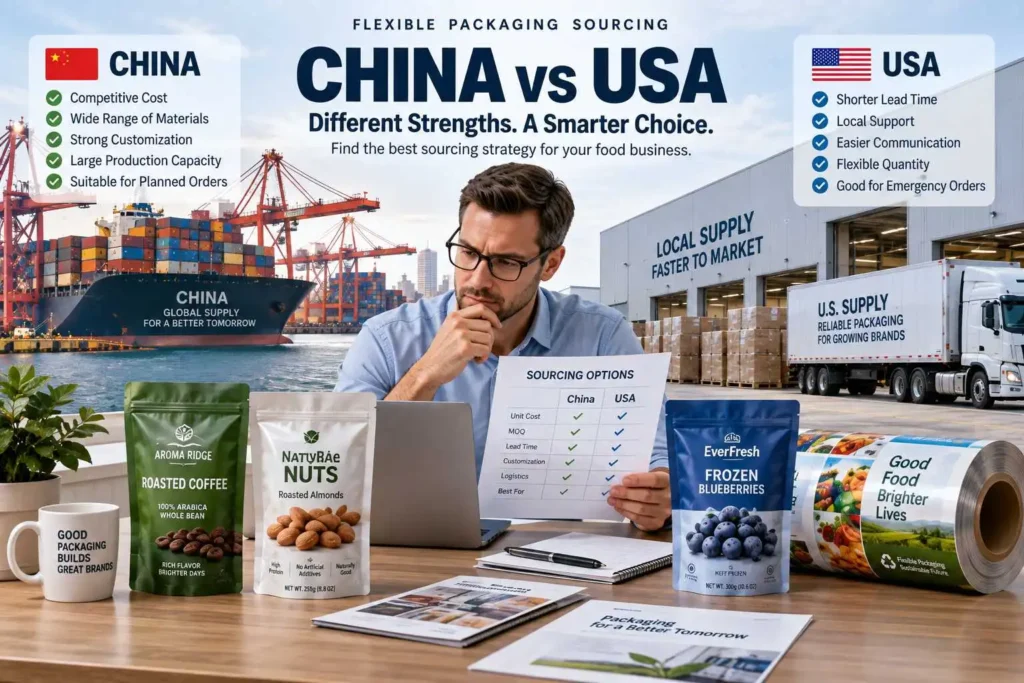
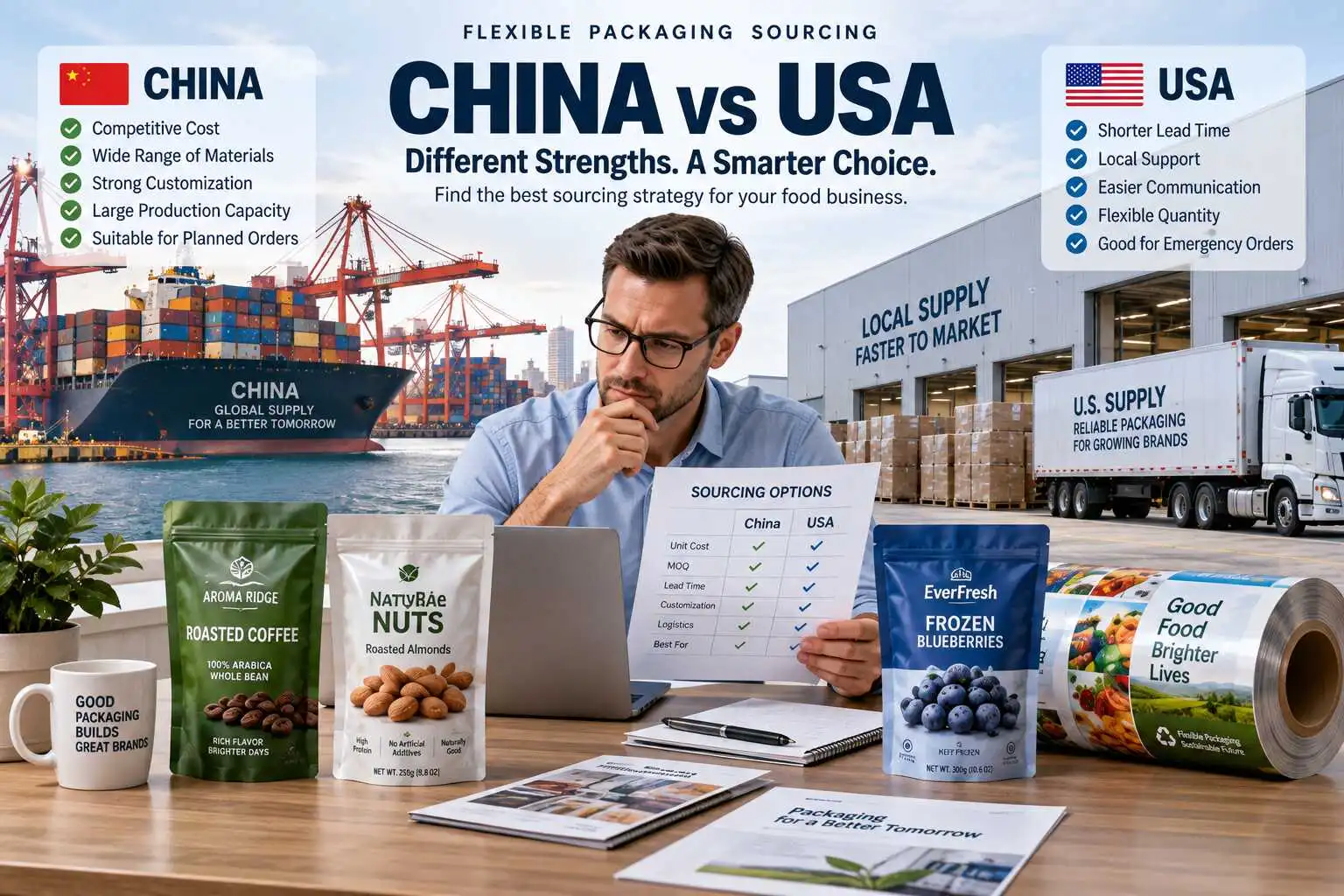
Country comparison images are illustrative AI-generated concepts. Any package brands, people, supplier facilities, logos or text shown are fictional mockups and do not represent customers, endorsements, verified supplier performance or approved Runlong specifications.