

Ice Cream Packaging: Premade Bags vs. Printed Rollstock
A practical buying guide with a checklist you can use in your next packaging discussion.
Discuss Your Packaging ProjectQuick Answer
Choose premade bags when your process fills and seals an already formed pouch; choose printed rollstock when a compatible machine forms the wrapper from film. For individual ice cream bars, a horizontal flow wrapper is a different route from placing wrapped products into a premade multipack. Decide around the actual product, machine and frozen handling conditions—not the appearance of a finished bag.
Quick Facts
| Decision point | What to confirm |
|---|---|
| First decision | Primary food-contact wrapper or secondary multipack? |
| Equipment evidence | Machine model, film specification or premade-pouch drawing |
| Quantity basis | Order by SKU; compare delivered bags with usable packs from film |
| Approval gate | Actual product, packing-line trial and frozen handling assessment |
Start with what goes inside the packaging
An ice cream bar, an irregular mochi piece and a family multipack do not present the same packaging problem. Record the product’s maximum dimensions, whether a stick or tray projects beyond the food, and its condition at the point of packing. An attractive wrapper mockup cannot show whether the product will feed correctly or whether the seal area stays clean.
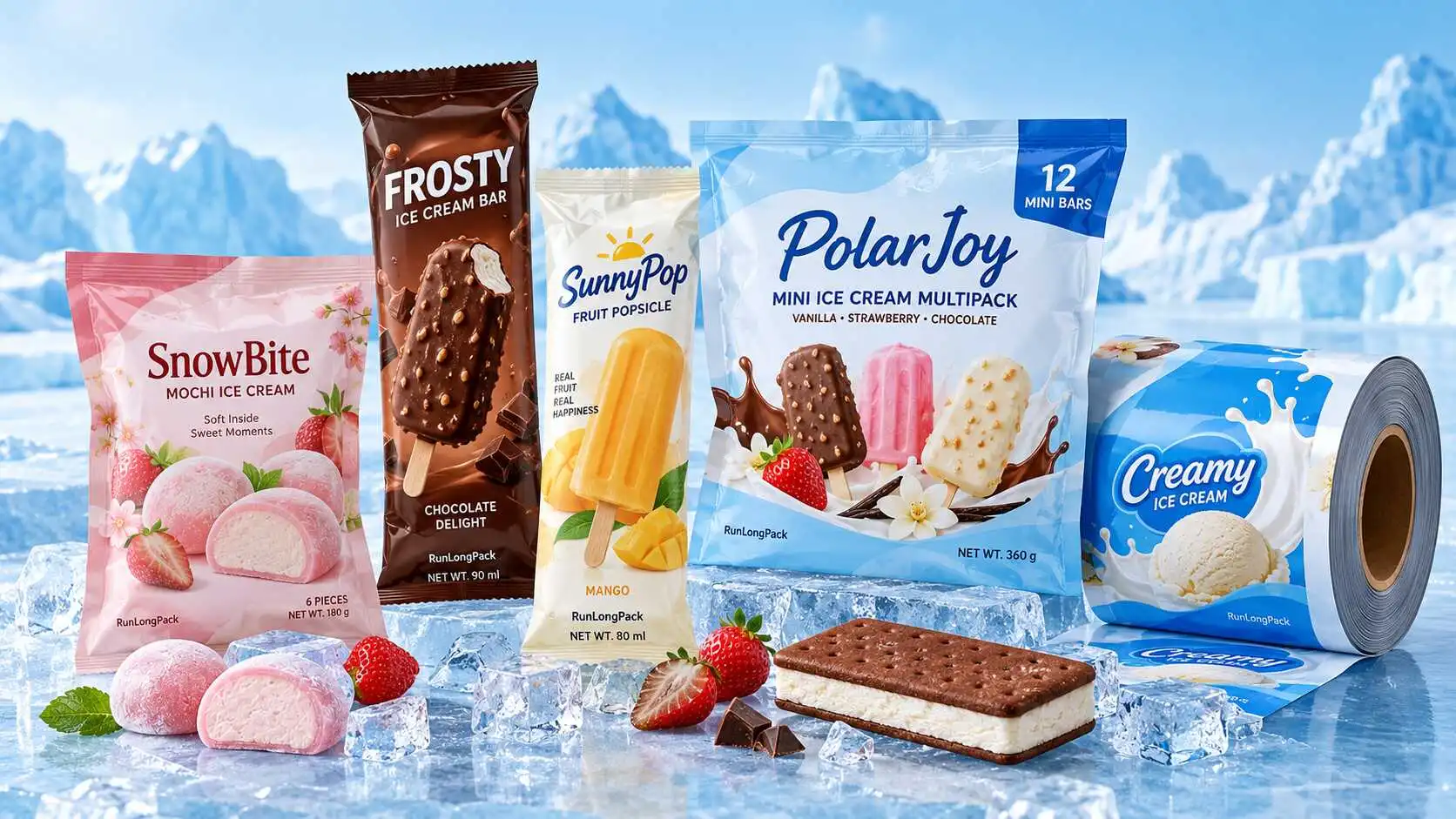
Separate direct food contact from secondary packaging. A carry bag or insulated delivery bag does not replace the individual sealed wrapper. A premade multipack may contain already wrapped bars; it should not automatically be specified as the primary wrapper for exposed ice cream. Start with the ice cream packaging formats and mark which layer you are buying.
Premade bags vs. rollstock: the selection table
| Decision | Premade-bag route | Printed-rollstock route |
|---|---|---|
| Existing equipment | Confirm pouch opening, loading, gripping and sealing capability. | Confirm a compatible form-fill-seal or horizontal flow-wrap machine. |
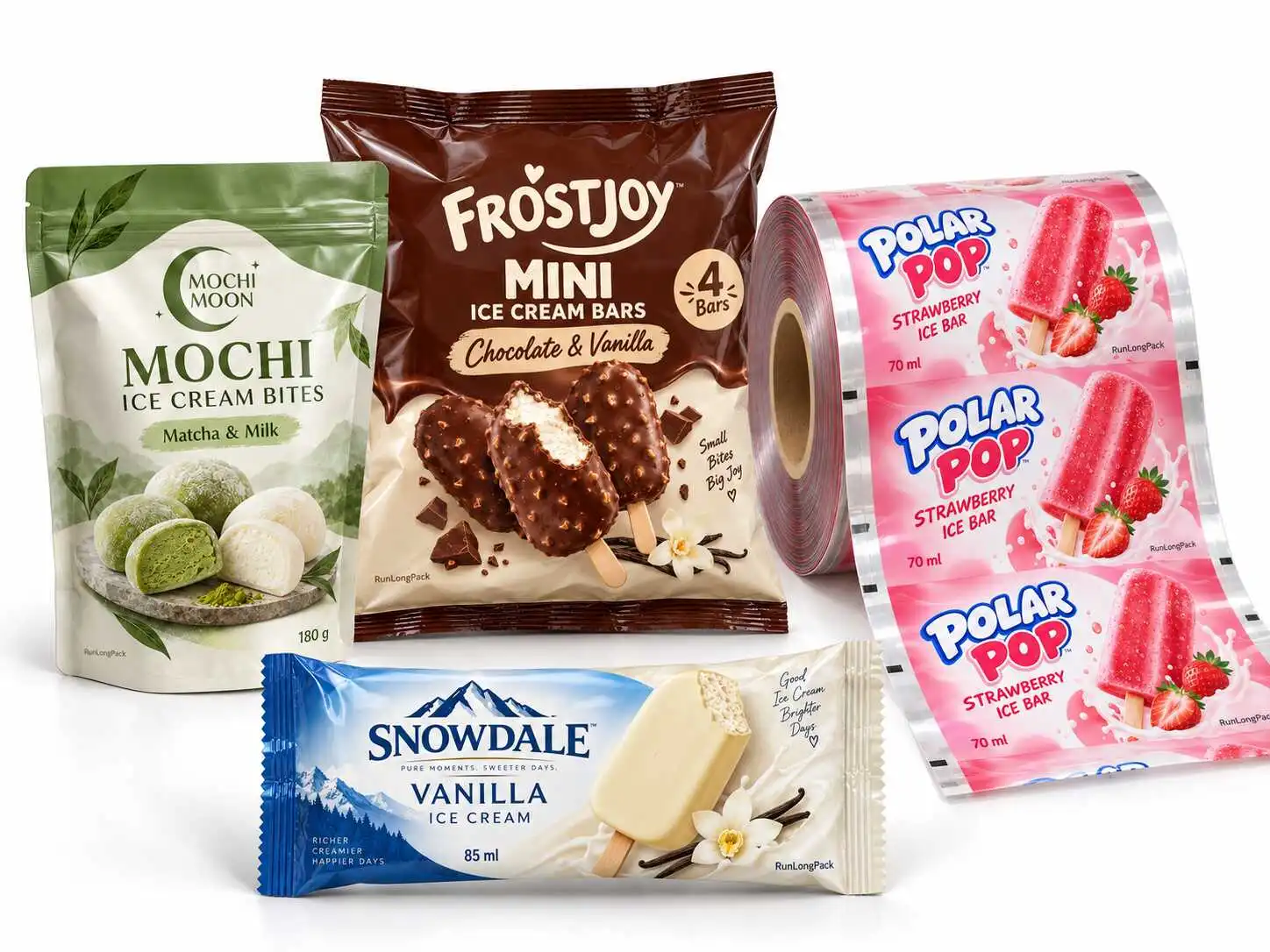
| Packaging format | Useful to assess for suitable mochi pouches or multipacks; verify loading clearance. | Useful to assess for individual bar wraps and other machine-formed packs. |
| Order quantity | List finished pieces per size and artwork. | List kilograms or metres per artwork, then calculate usable pack yield. |
| Frequent SKU changes | Assess changeover handling, stock storage and artwork quantities. | Assess roll changes, registration setup and startup waste per SKU. |
| Trial method | Fill the actual product; check closure, seal area and frozen handling. | Run a trial roll on the intended machine at agreed conditions. |
| Approval document | Signed bag drawing and filled sample record. | Signed web drawing, unwind reference and machine trial record. |
This table selects a route to investigate, not a guarantee that either format will run on your equipment. If you have no line yet, ask the equipment supplier to define acceptable packaging before ordering commercial printed stock.
Do not confuse horizontal flow wrapping with VFFS
In horizontal flow wrapping, the product is generally conveyed into a film tube and the machine creates longitudinal and end seals. A VFFS line forms a vertical tube and fills through it. The two routes have different product-feeding arrangements and film requirements. A roll described merely as “automatic packaging film” is not a complete purchase specification.
Ask who owns the final film drawing: your factory, the machine manufacturer or the contract packer. Obtain web width, cut repeat, seal layout, eye-mark location, unwind direction, core size and roll limits from that approved source. Use the broader premade-pouch versus rollstock guide for a general comparison; do not substitute a VFFS drawing for a horizontal wrapper.
Test frozen handling, not just the printed appearance
Specify product temperature at packing, storage conditions, expected transport exposure and the intended shelf life. The laminate and seal system must be assessed for that use. “Food grade” alone does not prove resistance to your freezing, flexing, handling or distribution conditions.
- Check whether frost, moisture or product residue can enter the seal area.
- Inspect seals and the package after the agreed frozen storage and handling sequence.
- Record tears, pinholes, seal opening and abrasion separately; retain a control sample.
- Confirm opening convenience without sacrificing the required seal integrity.
The final material should be confirmed against the product, shelf life, packing method and destination-market requirements. Runlong uses food-grade raw materials and does not use recycled, secondary or scrap materials in its flexible packaging production; the actual food-contact documentation still needs to match the intended application.
Compare the cost of usable packs
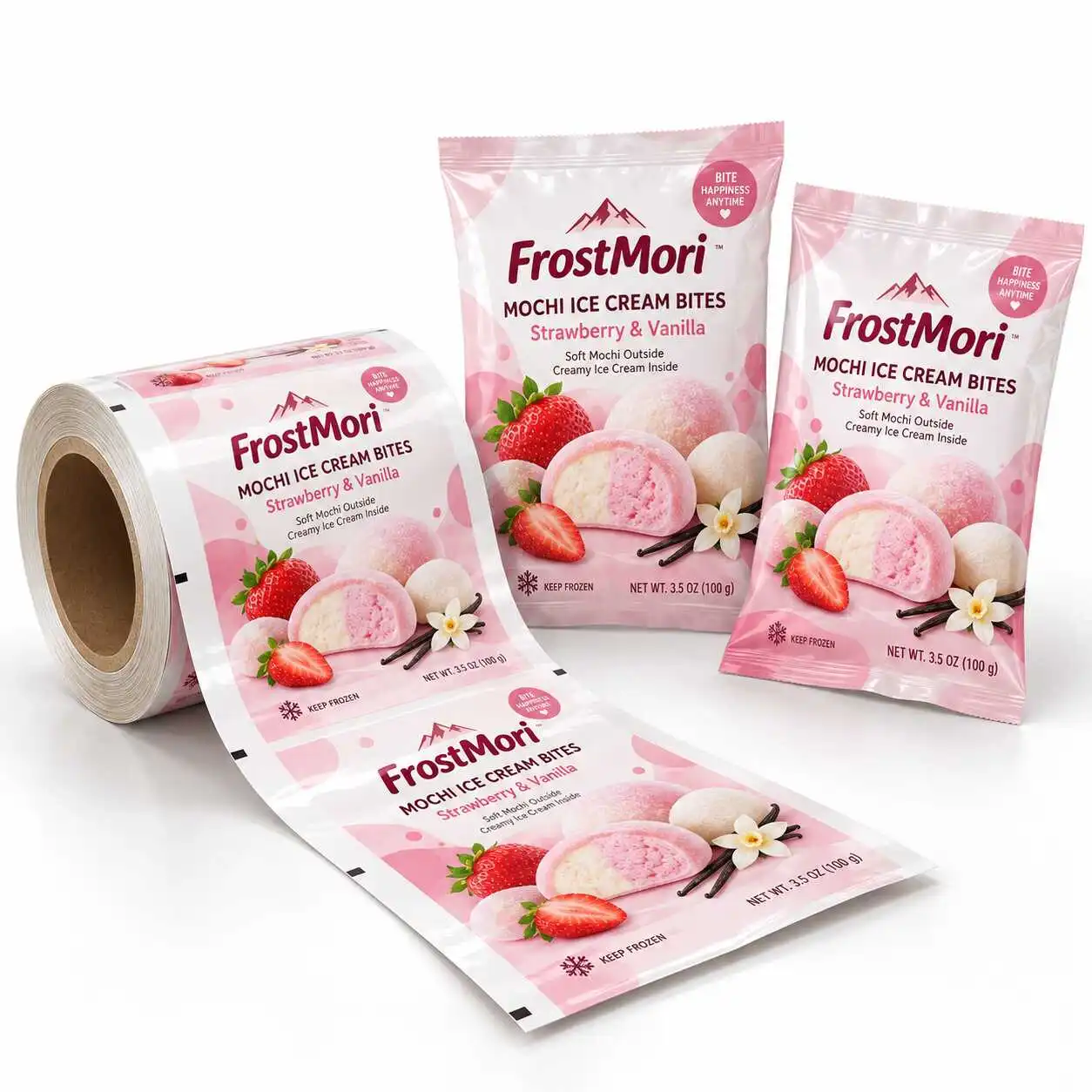
A cheaper kilogram price is not necessarily a cheaper wrapped product. Film yield changes with laminate grammage, web width and cut repeat. Startup waste, roll changes and rejected seals reduce saleable output. Premade bags also incur loading, sealing and rejected-pack costs. Compare both routes at the same practical output and specification.
For suitable rollstock projects, Runlong can assess selected digital trial orders around 10 kg, subject to material, structure, width and process compatibility. Commercial orders are generally recommended around 300 kg or more. These are not universal ice cream film minimums. Premade-pouch quantities must be reviewed by format and artwork; do not apply a generic small-pouch MOQ to every frozen product.
Ask for a trial proposal before committing to a large printed run. A print proof confirms artwork more than machine performance; a reference pouch confirms shape more than your final frozen-product performance. See what different packaging samples can establish.
Use this approval record before placing the order
| Record | Buyer’s entry | Confirmed by |
|---|---|---|
| Product and primary/secondary role | ________________ | Product / QA team |
| Maximum product dimensions and stick or tray | ________________ | Production team |
| Packing equipment and approved drawing revision | ________________ | Machine supplier |
| Quantity by size and artwork | ________________ | Purchasing |
| Frozen storage and transport conditions | ________________ | QA / logistics |
| Trial results and remaining exceptions | ________________ | Production / QA |
Keep the approved artwork, technical drawing and trial outcome together. When changing flavour, check whether only the print changes or whether dimensions, ingredients, fat content, product shape or packing behaviour also change. A previous successful wrapper is useful evidence, but it is not automatic approval for a different project.
Frequently Asked Questions
Can an individual bar use a premade bag?
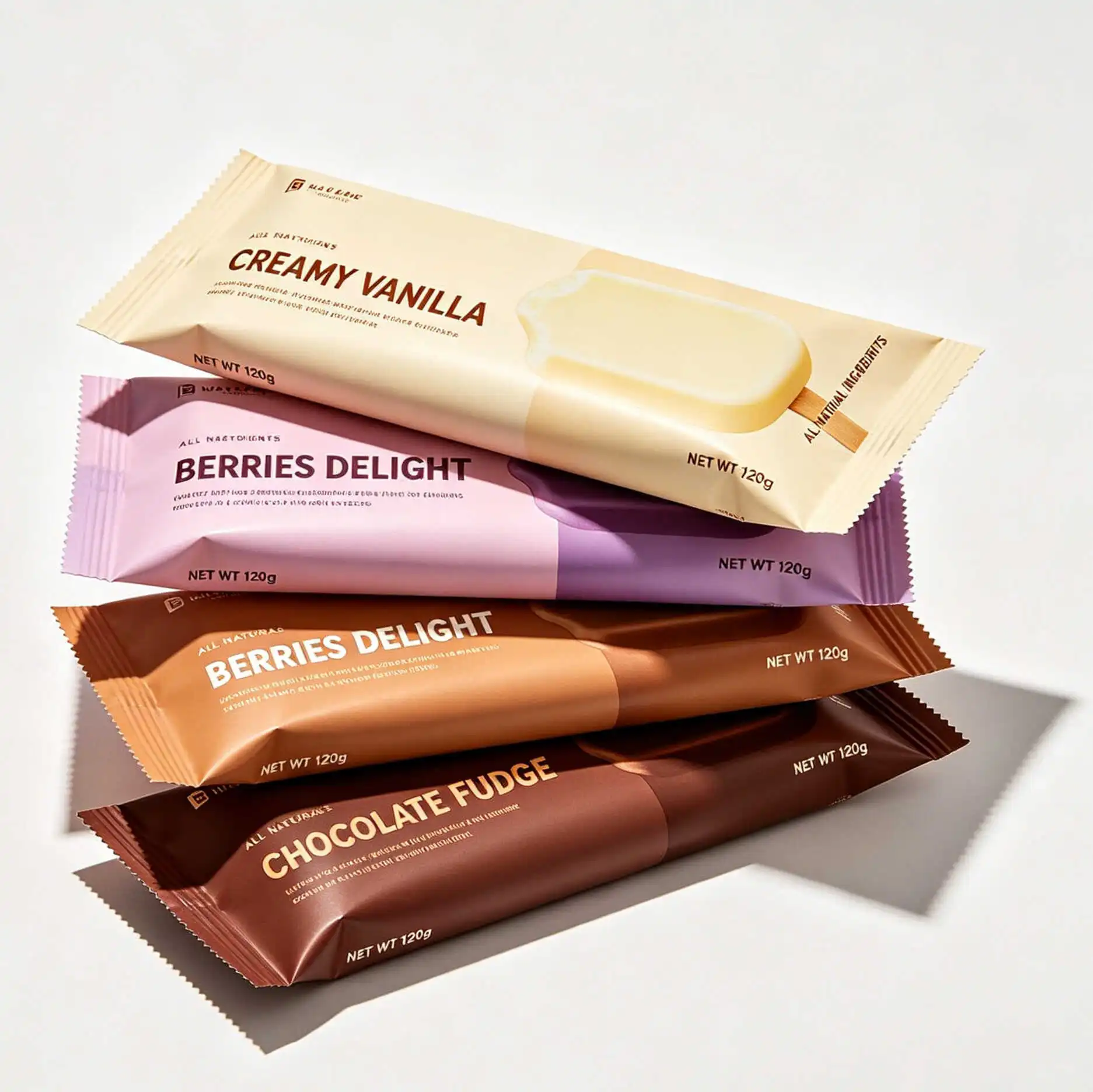
Only if the intended loading and sealing process supports that format and the project has been assessed. A printed bar-wrap illustration does not establish that a matching premade bag is available.
Is rollstock always cheaper?
No. Compare film yield, machine setup, waste, labour, order size and stock exposure against the premade route at the same usable output.
Can one material cover every frozen dessert?
No. Product contact, storage, handling, sealing and shelf-life requirements must be reviewed for the actual product.
What should I send first?
Send the product dimensions, primary or secondary packaging role, machine details, quantity per SKU and intended frozen storage conditions.
Start With a Clear Packaging Brief
Product + maximum dimensions + primary/secondary role + machine model + quantity per SKU + storage conditions + target delivery date
Get a Quote