

Ice Cream Flow-Wrap Film: A Specification Checklist for Buyers
A practical buying guide with a checklist you can use in your next packaging discussion.
Discuss Your Packaging ProjectQuick Answer
To order ice cream flow-wrap film, provide the machine-approved web width, cut repeat, seal configuration, registration mark, unwind drawing and roll limits, together with the product and frozen-use conditions. Package capacity or a photograph alone is not enough. Confirm the specification with the horizontal flow-wrapper supplier and validate a representative trial roll before the commercial run.
Quick Facts
| Decision point | What to confirm |
|---|---|
| Machine route | Horizontal flow wrapping; do not substitute a VFFS specification |
| Main dimensions | W = flat web width; R = machine-direction cut repeat |
| Roll information | Core, outer diameter, weight, winding and splice rules |
| Practical output | Copy-and-fill specification table plus orientation diagram |
Identify the line and the product first
Record the machine manufacturer, model and serial or configuration reference. Machines of the same model can have different forming hardware, sealing systems or product-feed arrangements. Include whether the film feeds above or below the product and whether a tray is used. The supplier needs the actual setup, not simply the phrase “popsicle packaging machine”.
Measure the largest product in normal production, including the stick and any tray. Record width, height, total length, dimensional variation and orientation on the conveyor. For irregular bars or toppings, note protrusions that may affect feeding, clearance or puncture risk. Packing temperature and frost conditions belong on the same specification sheet.
Understand web width, repeat and product direction
Web width is measured across the flat film before it is formed. Repeat is measured along film travel between corresponding cut positions for the intended pack. Neither is automatically equal to the finished pack’s visible face width or the edible bar length. Forming allowance, the longitudinal seal and end-seal zones have to be included in the machine-approved drawing.
Flat film before forming — single bar, schematic only
← W: cross-web width →
Cut line / end-seal zone
Cut line / end-seal zone
↓ Film travel and product length direction
R: cut-to-cut repeat along this direction
Longitudinal seal allowances lie at the web edges. Final geometry comes from the machine drawing; not to scale.
For this illustrated format, the bar and stick point along the machine direction. Other machine configurations must be drawn separately. Do not calculate a purchase dimension from this schematic. Send a dimensioned sketch or the existing approved film drawing to establish W and R.
Copy this flow-wrap film specification checklist
| Field | Enter value / attach reference | Who confirms it |
|---|---|---|
| Machine make, model and configuration | ________________ | Machine supplier / factory |
| Product length including stick, width and height | ________________ mm | Product team |
| Tray, feed orientation and pack style | ________________ | Production |
| Flat web width W and tolerance | ________________ mm | Machine-approved drawing |
| Cut repeat R and tolerance | ________________ mm | Machine-approved drawing |
| Longitudinal and end-seal layout | Drawing revision: __________ | Machine supplier |
| Eye mark size, colour, position and clear zone | Drawing revision: __________ | Machine / print supplier |
| Unwind direction and printed side in/out | Signed picture: __________ | Production |
| Core ID, core length, maximum roll OD and weight | ________________ | Machine supplier |
| Laminate, total thickness and total GSM | ________________ | Packaging / QA |
| Splice method, maximum count and identification | ________________ | Production |
| Packing, storage and distribution conditions | ________________ | Factory QA |
| Artwork revision and quantity by flavour | ________________ | Buyer |
| Trial acceptance criteria and sign-off | ________________ | Production / QA |
A blank cell means an unresolved requirement, not permission for either supplier to guess. Keep units visible, especially when converting millimetres to inches or kilograms to pounds.
Confirm unwind direction with a picture
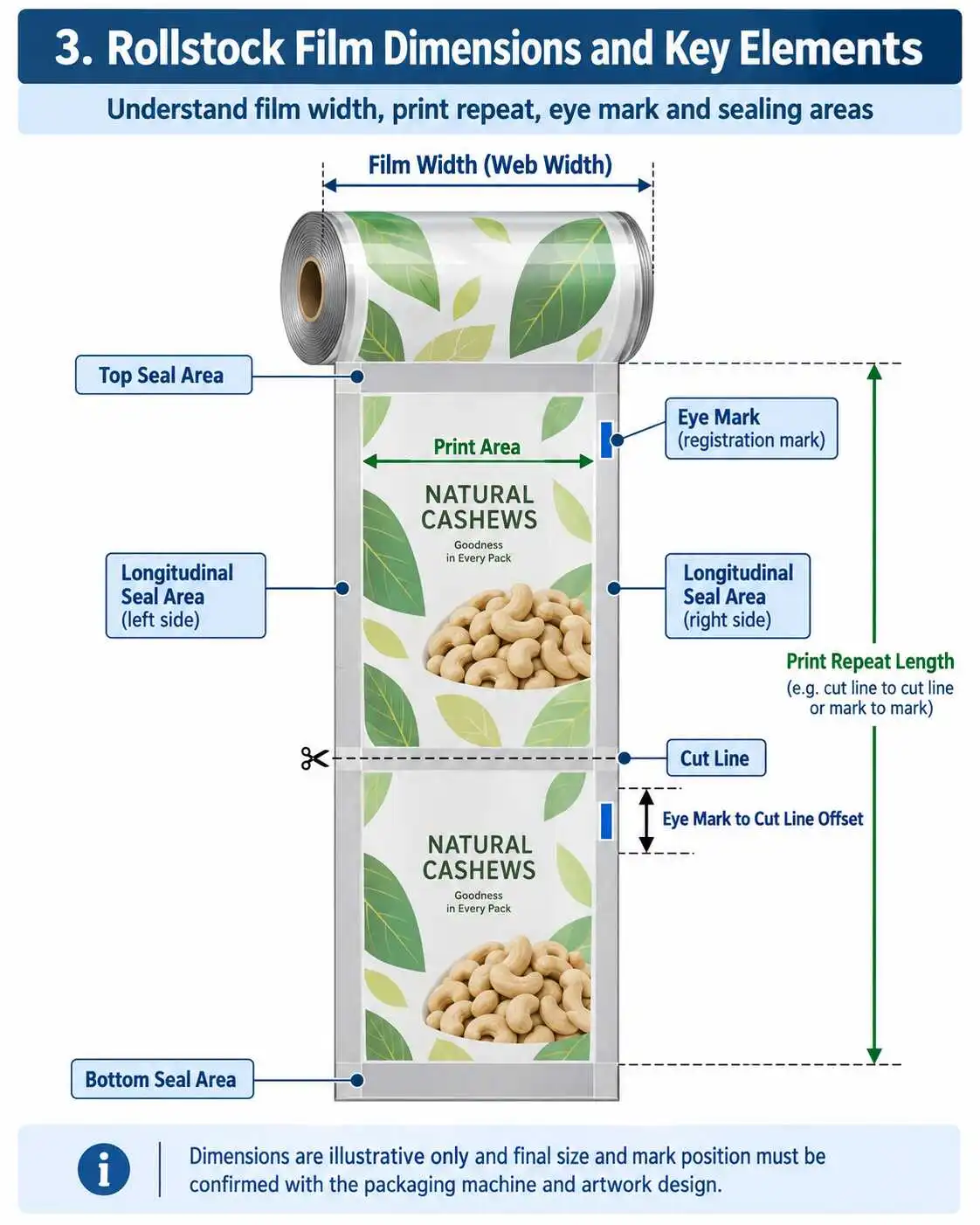
Terms such as “top first”, “clockwise” or “print outside” can be misunderstood if the viewing side is not stated. Send a roll-end photograph or diagram that shows which end you are looking at, the film travel direction, the artwork orientation, the seal side and the sensor side. Ask the film supplier and line operator to approve the same annotated reference.
Use artwork with a clearly identifiable top and bottom for approval. A repeated symmetrical pattern can hide a reversed orientation until the first production run. Eye-mark contrast and placement must match the actual sensor and artwork; avoid adding other graphics in its required clear zone.
Specify the sealing system without guessing temperatures
Identify the machine’s sealing method and the film system it requires. For a heat-seal laminate, temperature, pressure, dwell time and speed work together. Do not copy settings from an unrelated film, and do not assume a heat-seal specification is interchangeable with another sealing system.
The film review should consider sealing behaviour, slip, stiffness, tracking, resistance to handling damage and the intended frozen conditions. Barrier selection depends on the product and target shelf life. Runlong’s food-grade raw-material policy is not a substitute for validating the final laminate in the intended food-contact and processing conditions.
Run a trial with a defined pass record
- Confirm the trial roll uses the agreed construction, width, repeat and winding. Document any differences from planned bulk film.
- Record roll tracking, registration, feeding, seal appearance and rejected packs at the tested operating conditions.
- Inspect the actual filled package after the agreed frozen handling and storage assessment.
- Retain the approved film sample, finished pack, drawing and test record under one revision.
A trial that only runs at a low speed does not establish performance at the target production speed. Agree the test range with the equipment supplier and do not treat an attractive printed sample as line qualification. Selected compatible digital rollstock trials around 10 kg may be assessed; normal commercial orders are generally recommended around 300 kg or more, subject to the specific project.
If your equipment is actually vertical, use the VFFS film compatibility guide instead. For the full frozen-product range, see custom ice cream packaging.
Frequently Asked Questions
Is web width the same as finished bag width?
No. Web width is the flat-film dimension across the roll and includes the geometry needed for forming and sealing. Use the machine-approved drawing.
Can I specify unwind direction in words only?
Use an annotated picture or drawing as well. It should identify the viewing side, film travel, artwork orientation, seal side and registration-mark side.
Can I copy a sealing temperature from another supplier?
No. Settings depend on the actual film and machine. Validate the sealing window with the equipment supplier and the intended product.
Does a print proof replace a trial roll?
No. A print proof can help approve artwork; a representative trial roll is needed to assess machine compatibility.
Start With a Clear Packaging Brief
Machine model + product dimensions including stick/tray + W and R + unwind reference + roll limits + packing/storage conditions + quantity per artwork
Get a Quote