

Choosing Spout Size for Sauces and Jam: Flow, Fruit Pieces and Filling Fit
A practical buying guide with a checklist you can use in your next packaging discussion.
Discuss Your Packaging ProjectQuick Answer
Choose a spout by checking the product’s flow at filling and use temperatures, the largest particles, the entire dispensing path and the filling interface. Nominal opening diameter and pouch capacity alone cannot prove compatibility. Obtain the exact fitment and cap drawings, confirm how the pouch will be filled, then test the real product in representative pouches.
Quick Facts
| Decision point | What to confirm |
|---|---|
| No universal bore | Ketchup, jam and dressings do not each have one fixed spout size |
| Product data | Flow behaviour, particle distribution, oil content and temperature |
| Interface data | Bore, neck, thread, cap, weld profile and filling equipment |
| Approval evidence | Filling, dispensing, closure and process trial records |
Capacity does not select the spout
Two pouches with the same declared fill volume can need different fitments. One might hold a smooth, pourable dressing; another might contain jam with fruit pieces. The desired dispensing action may also differ: controlled squeezing onto food, pouring into a kitchen container, or dispensing through a foodservice system. Specify the use case before comparing cap colours or pouch silhouettes.
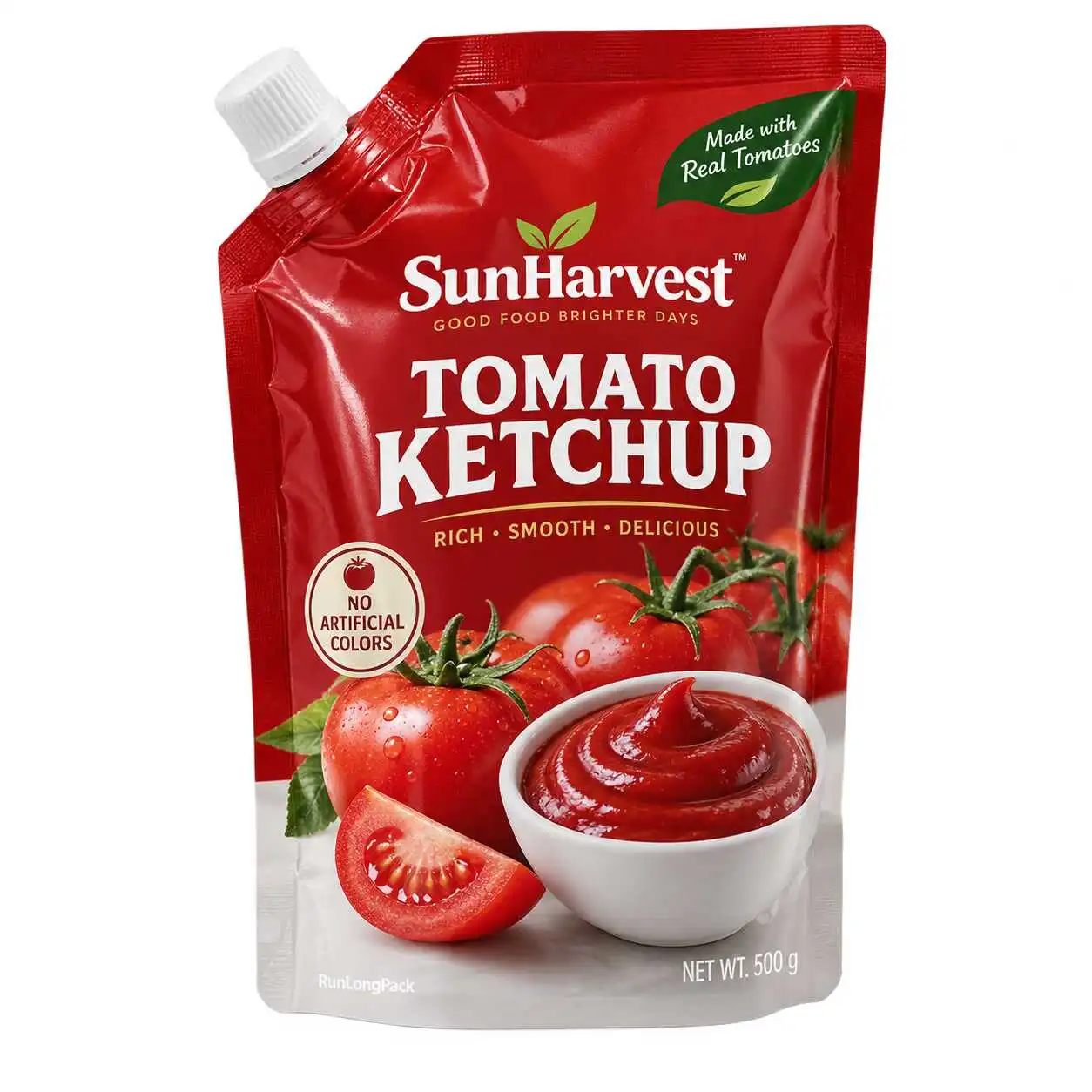
A larger opening may change flow, portion control, cap handling and equipment compatibility. A smaller opening may restrict flow or trap particles. Neither choice is automatically better. View sauce and condiment pouch formats first if a spout is not yet confirmed as the right format.
Describe the real sauce, not just its name
| Product detail | Information to supply | Why it matters |
|---|---|---|
| Flow behaviour | Measured viscosity with method and temperature if available; otherwise product sample and conditions. | A single number without a test method can be misleading for sauces whose flow changes under shear. |
| Fruit, seeds, herbs or solids | Largest expected pieces, distribution, concentration, shape and tendency to clump. | The limiting passage may be inside the valve, nozzle or fitment rather than at the visible mouth. |
| Temperature | Actual filling, processing, storage and dispensing conditions. | Flow and package requirements may change across the process. |
| Oil, acidity and formulation | Relevant formulation and compatibility requirements. | Review contact materials, seals and the intended shelf life. |
| Serving behaviour | Pour, squeeze, portion control or foodservice connection. | A fast emptying rate is not the only user requirement. |
Avoid a rule such as “jam needs one standard diameter”. Fruit size, recipe, temperature and the filling path vary. Physical product samples and controlled trials are more useful than assigning a bore from the food name.
Ask for the complete fitment drawing
Nominal spout size can refer to different dimensions. Identify the internal passage, neck dimensions, thread or closure interface, flange or weld profile, overall height and any internal restrictions. The cap and spout should be treated as a matched system, not two independently interchangeable components.
Record the supplier’s part number and drawing revision. Ask how the pouch is supported during filling and whether the line handles the fitment using a rail, gripper or other fixture. If a cap includes tamper evidence or another feature, confirm its actual design and required compliance. Do not infer child safety or tamper performance from appearance.
Use custom spout pouches to discuss formats, but put the exact component drawing in the purchase approval. A catalogue photograph is not a dimensioned manufacturing reference.
Check the filling route and the narrowest passage
Is the pouch filled through the spout or through an open edge that is sealed afterwards? Through-spout filling requires the filling interface, flow path and cap process to work together. Open-edge filling has different sealing and contamination controls. Confirm the route before asking the supplier to set the fitment position.
- Ask the equipment supplier to confirm nozzle dimensions, alignment, support and the intended filling conditions.
- Review the narrowest flow restriction throughout the product path, including valves and connectors—not just the spout mouth.
- Check splash, drips and residue around the neck or seal zone using the actual sauce.
- Confirm cap application and verification requirements with the closure and machine suppliers.
Do not compensate for a poorly matched passage by casually increasing pressure or changing operating settings. Changes must remain within the equipment and packaging limits and be evaluated by the responsible technical team.
Copy the spout selection and trial checklist
| Approval item | Record / result | Owner |
|---|---|---|
| Product formulation and sample reference | ________________ | Product / QA |
| Particle data and filling/use temperatures | ________________ | Factory |
| Spout and cap part numbers / drawing revisions | ________________ | Packaging supplier |
| Filling route and machine interface approval | ________________ | Machine supplier |
| Filling trial: flow, blockage, residue and fill consistency | ________________ | Production |
| Dispensing trial: portioning, emptying and resealing | ________________ | Product team |
| Leak / closure assessment under agreed conditions | ________________ | QA |
| Thermal and transport requirements, where relevant | ________________ | QA / process specialist |
| Approved sample and outstanding exceptions | ________________ | Buyer |
Test representative product variation, not just the easiest batch. Record what was observed separately from the suspected explanation. For example, “pieces accumulated at the nozzle” is an observation; “the spout is too small” is a hypothesis until the complete restriction and operating conditions have been checked.
Treat hot fill and heat treatment as a separate approval
Cold fill, hot fill, pasteurization and retort are not interchangeable terms. The film, fitment, cap and seals must all suit the intended process. A pouch that pours well at room temperature has not thereby passed thermal validation. Send the actual process requirements to the packaging supplier and have the food process approved by the responsible specialist.
Runlong spout-pouch projects generally start discussion around 1,000 pieces for digital printing and around 15,000 pieces for gravure, subject to the final project. These quantity references do not establish compatibility for special thermal applications. Runlong uses food-grade raw materials without recycled, secondary or scrap inputs; application-specific documentation and trials are still required.
For process planning, review pasteurization pouch selection and sauce filling-line coordination.
Frequently Asked Questions
What spout diameter should I use for jam?
There is no universal diameter. Review particle size and distribution, flow at the intended temperatures, the full filling path and the dispensing requirements, then trial the actual product.
Does a larger pouch need a larger spout?
Not necessarily. Capacity is only one input; flow, dispensing behaviour and equipment fit may be more important.
Are caps with the same nominal diameter interchangeable?
Do not assume so. Confirm matched part numbers, thread or closure geometry, sealing design and the approved drawing.
Does successful cold filling prove retort compatibility?
No. Thermal suitability requires separate assessment of the complete package and the actual approved process.
Start With a Clear Packaging Brief
Sauce sample/data + particle details + fill volume + filling and use temperatures + filling route + machine interface + quantity + process requirements
Get a Quote