

How should you choose a flexible packaging material structure?
Start with the actual product, target shelf life, filling and sealing process, storage, transport and market requirements. Then select the print, barrier, strength and sealant functions needed for that application. A familiar laminate code should not be copied to a new product without confirming the real performance requirements.
Choosing the right flexible packaging material structure is one of the most important decisions in a custom packaging project. The structure affects barrier performance, sealing, puncture resistance, appearance, filling compatibility and how well the package protects the product during storage and distribution.
There is no single material structure that is best for every product. A coffee pouch, frozen seafood bag, snack package, vacuum bag and retort pouch can require very different combinations of films. The right choice depends on what the product needs the package to do.
At Runlong Pack, material selection is evaluated together with the product, bag format, storage conditions, filling process, target market and other packaging requirements. Runlong Pack can also produce EVOH/PE high-barrier packaging for suitable projects where a transparent oxygen-barrier solution is preferred.
What Is a Flexible Packaging Material Structure?
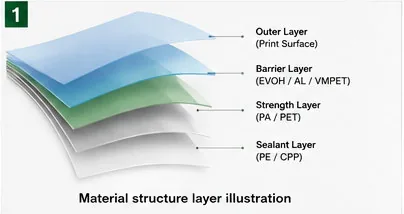
A flexible packaging material structure is the combination of one or more film layers used to create a pouch, bag, sachet or rollstock film. Each layer can perform a different function.
- Print layer: provides a stable surface for printed artwork and helps protect the design.
- Barrier layer: helps limit oxygen, moisture, aroma or light transmission depending on the material selected.
- Strength layer: can improve puncture resistance, toughness, stiffness or dimensional stability.
- Sealant layer: provides the heat-sealing surface that forms the final package.
- Functional layer: may add a specific property such as high oxygen barrier, heat resistance or improved mechanical performance.
This is why material selection should not be reduced to simply choosing “plastic” or “foil.” Buyers should understand what each layer is expected to contribute to the finished package.
Common Flexible Packaging Material Structures
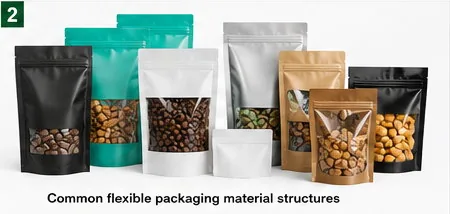
The following structures are common examples used across the flexible packaging industry. They are not universal specifications. Actual construction, film grade and thickness should be confirmed according to the product and production requirements.
PET/PE
PET/PE is a widely used laminated structure. PET can provide printability, stiffness and dimensional stability, while PE is commonly used as the inner sealant layer. This combination can be suitable for many dry-food and general flexible packaging applications when extremely high barrier performance is not required.
PET/CPP
PET/CPP combines a PET outer layer with cast polypropylene as the sealant side. It can be selected when the project requires the print and mechanical characteristics of PET together with CPP sealing and temperature-related performance. The final suitability depends on the filling and sealing process.
BOPP/CPP
BOPP/CPP is commonly associated with snack, confectionery and other lightweight food-packaging applications. It can provide good clarity, print presentation and practical sealing performance for suitable products.
PET/VMPET/PE
PET/VMPET/PE adds a metallized PET barrier layer between the outer PET and inner PE. Compared with a simple transparent laminate, the metallized layer can significantly improve barrier performance and provide a metallic appearance. It is frequently considered for products such as coffee, snacks, powders and pet treats that need stronger protection from oxygen, moisture or light.
PET/AL/PE
PET/AL/PE uses an aluminum foil layer as the primary barrier. Aluminum foil can provide very strong protection from light and gases when the package is properly converted and sealed. The trade-off is that the structure is opaque and may be less suitable for projects that require product visibility or a transparent window.
PA/PE
PA/PE, often referred to as nylon/PE, is commonly chosen where toughness and puncture resistance are important. It is frequently considered for vacuum packaging, meat, seafood, frozen food and products with sharper edges or demanding handling conditions.
PET/PA/PE
PET/PA/PE combines PET for print and dimensional stability, PA for mechanical strength and puncture resistance, and PE for sealing. It can be useful where both presentation and physical durability are important.
EVOH/PE
EVOH/PE is an important option for buyers who want a transparent package with enhanced oxygen-barrier performance. In practice, EVOH is typically used as a thin functional barrier layer within a multi-layer PE-based film rather than as a simple two-layer sheet. PE contributes sealing and moisture-related protection, while EVOH provides the oxygen-barrier function.
Runlong Pack can produce EVOH/PE high-barrier packaging for suitable applications. The exact coextruded or laminated construction, thickness and processing requirements should be confirmed for the specific product.
What Each Packaging Material Does
PET: Printability, Stiffness and Dimensional Stability
PET is often used as an outer layer because it provides a good printing surface and helps the package maintain its shape. It is frequently combined with PE, CPP, metallized film, aluminum foil or PA depending on the required performance.
PE: Sealing and Flexible Inner-Layer Performance
PE is widely used as a sealant layer in flexible packaging. It offers practical heat-sealing performance and can be engineered in different grades for different packaging applications. PE is also central to many mono-material PE packaging developments.
PA: Toughness and Puncture Resistance
PA, commonly called nylon in packaging discussions, is valued for toughness and puncture resistance. It is useful for vacuum products, frozen foods and packages that must tolerate more demanding physical handling.
VMPET: Metallized Barrier and Appearance
VMPET is metallized PET film. The thin metallic layer improves barrier performance compared with ordinary clear PET and gives the package a metallic or opaque appearance. It can be used when stronger barrier is required without moving to a full aluminum foil structure.
AL: Aluminum Foil for Strong Barrier and Light Protection
Aluminum foil is used when very strong protection against oxygen, moisture and light is required. It creates an opaque barrier and is often selected for products that are highly sensitive to light or oxidation.
CPP and RCPP: Sealant Layers for Specific Applications
CPP is used in a variety of laminated packaging structures as a sealant film. RCPP is a retort-grade cast polypropylene used in suitable high-temperature retort structures. Retort packaging requires the complete structure, adhesive system, sealing conditions and processing requirements to be evaluated together.
EVOH: Transparent Oxygen Barrier
EVOH is a high oxygen-barrier polymer commonly incorporated as a thin layer in coextruded or multilayer packaging. It is especially useful when the buyer wants stronger oxygen protection while retaining a transparent package. Because EVOH performance and the surrounding layers must work together, the full film structure should be selected according to the actual product and storage environment.
How Barrier Requirements Change the Structure
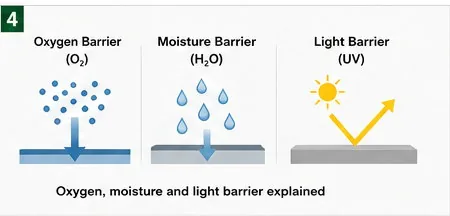
Barrier requirements are one of the main reasons two similar-looking pouches may use completely different materials.
Oxygen Barrier
Products that oxidize easily, lose aroma or are sensitive to oxygen may require a stronger oxygen barrier. Metallized film, aluminum foil and EVOH-based structures are among the options that can be evaluated depending on whether the package also needs transparency, light protection or recyclability considerations.
Moisture Barrier
Dry powders, snacks, coffee and other moisture-sensitive products may need a structure that helps limit moisture transmission. The required level depends on the product, expected storage period, climate and distribution conditions.
Light Barrier
For light-sensitive products, an opaque structure may be useful. Aluminum foil and metallized layers can help reduce light exposure, while transparent structures naturally provide less light blocking unless other design measures are used.
Puncture and Mechanical Resistance
Frozen products, vacuum-packed foods and products with bones, shells or sharp edges may require more attention to toughness and puncture resistance. PA-containing structures are commonly considered for this reason.
Heat and Processing Conditions
The structure must also match the filling, sealing, pasteurization or retort process. A material that works well for a room-temperature snack pouch may not be suitable for a high-temperature cooking pouch.
Material Structure by Packaging Application
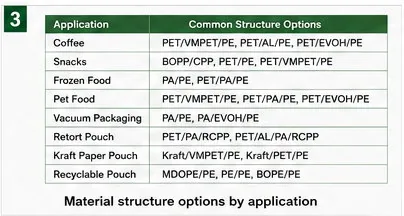
The following examples show how buyers can think about structure selection by application. They are starting points for discussion rather than fixed specifications.
Coffee Packaging
Coffee packaging often needs protection from oxygen, moisture and aroma loss. Depending on the desired appearance and barrier level, buyers may evaluate structures such as PET/VMPET/PE, PET/AL/PE or other high-barrier constructions. Transparent high-barrier concepts may also be considered when product visibility is important.
Snack Packaging
Snack products vary widely. Simple dry snacks may use structures such as BOPP/CPP or PET/PE, while products with higher barrier needs may require metallized or other barrier layers.
Frozen Food Packaging
Frozen food packaging needs to remain flexible and durable at low temperatures while resisting puncture, sealing failure and distribution damage. PA/PE and PET/PA/PE are examples commonly evaluated for demanding frozen applications, although the final structure depends on the product and packing process.
Pet Food and Pet Treat Packaging
Pet food packaging may need aroma retention, moisture control, puncture resistance and strong seals. The correct structure depends on whether the product is dry kibble, treats, powder, wet food or another format.
Vacuum Packaging
Vacuum packaging often requires toughness, seal reliability and puncture resistance. PA/PE-based structures are common candidates for meat, seafood and other vacuum-packed products.
Retort and Cooking Pouches
Retort packaging is a special category. Industry structures may use combinations such as PET/PA/RCPP or PET/AL/PA/RCPP, but the exact structure must match the required thermal process. Runlong Pack’s Moi Moi cooking pouch projects use special retort-grade materials, which is one reason their material requirements and production planning differ from ordinary food pouches.
EVOH/PE: Transparent High-Barrier Packaging
EVOH/PE deserves separate consideration because it addresses a common buyer question: how can a package provide stronger oxygen protection without using an opaque aluminum or metallized barrier?
In an EVOH/PE structure, EVOH provides the oxygen-barrier function while PE-based layers can provide sealing, protection and processing properties. The EVOH layer is normally thin and incorporated inside a multilayer structure.
This can be useful for packaging projects that want:
- Transparent product visibility
- Improved oxygen-barrier performance compared with ordinary PE-only film
- A PE-based sealing surface
- A high-barrier alternative to consider when a metallic appearance is not desired
However, EVOH/PE should not automatically replace aluminum foil or VMPET. Different barrier systems solve different problems. The buyer should first define oxygen sensitivity, moisture sensitivity, light sensitivity, storage conditions and required shelf-life targets before choosing the structure.
Aluminum Foil vs Metallized Film vs EVOH/PE
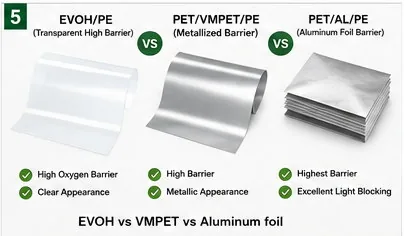
Choose Aluminum Foil When Strong Light Blocking Is a Priority
An aluminum foil laminate can be appropriate when the product needs very strong gas and light protection and transparency is not required. It is often selected for sensitive products where barrier performance has priority over product visibility.
Choose VMPET When You Want Metallized Barrier Performance
VMPET can provide a useful balance between barrier improvement, metallic appearance and material efficiency. It is widely used in flexible packaging, but its barrier level and flex-crack performance should not simply be assumed to equal an aluminum foil laminate.
Choose EVOH/PE When Transparency and Oxygen Barrier Both Matter
EVOH/PE can be attractive when the package should remain transparent while providing enhanced oxygen protection. It is particularly useful when a metallic layer would interfere with the desired visual presentation.
The correct choice is therefore not simply “which material has the highest barrier?” It is “which structure provides the required protection while meeting appearance, sealing, processing, cost and end-market requirements?”
What About Recyclable and Mono-Material Structures?
Recyclability-focused projects are increasingly evaluating mono-material PE or PP structures where the required packaging performance can still be achieved. Examples can include PE-based structures using oriented PE or functional barrier layers designed to remain compatible with the intended recycling stream.
This does not mean every product should immediately move from a conventional laminate to a mono-material structure. Product protection comes first. A failed package that causes product loss can create a larger overall problem than the material saving intended by the redesign.
For buyers developing packaging for a specific market, recyclability claims should be checked against the relevant local collection, sorting and recycling requirements rather than assumed from the material name alone.
How to Choose the Right Structure for Your Product
A useful material-selection process begins with the product rather than with a pre-selected film.
- Define the product: dry food, coffee, frozen product, liquid, powder, pet food, vacuum product or retort food.
- Define the main protection requirement: oxygen, moisture, light, aroma, puncture resistance or heat resistance.
- Define the packaging format: stand-up pouch, flat-bottom pouch, side-gusset bag, vacuum bag, spout pouch, sachet or rollstock film.
- Define the filling and sealing process: manual filling, automatic form-fill-seal, vacuum packing, hot filling or retort processing.
- Define the appearance requirement: transparent, windowed, metallized, foil, kraft-style, matte or glossy.
- Define the target market: different markets can have different packaging, recycling and food-contact expectations.
- Then confirm thickness and final structure: the laminate should be engineered around the complete project rather than selected from a generic list.
Common Material-Selection Mistakes
Choosing the Highest Barrier Without Understanding the Product
A stronger barrier is not automatically better if the added layer is unnecessary. It may increase complexity without improving the real performance of the package.
Choosing a Structure Only Because a Competitor Uses It
Two visually similar products can have different shelf-life requirements, filling processes, distribution environments and target markets. Copying a competitor’s apparent structure does not guarantee the same result.
Ignoring the Sealing Process
The sealant layer and sealing conditions are critical. Even a high-barrier laminate cannot protect the product if the package does not seal reliably.
Focusing Only on the Outer Film
Buyers sometimes identify a pouch as “PET” or “PE” based only on one visible layer. Flexible packaging is often a multilayer system, so the complete construction matters.
Information to Provide for a Material Recommendation
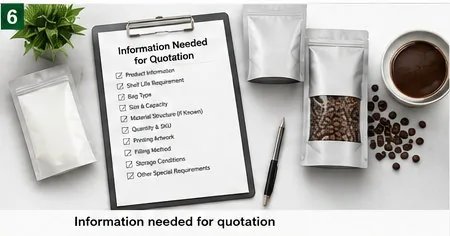
To recommend a suitable material structure and prepare a more accurate quotation, provide as much of the following information as possible:
- Product being packed
- Bag type or rollstock format
- Bag dimensions or filling capacity
- Required order quantity
- Number of SKUs or artworks
- Expected storage conditions
- Target shelf-life requirement, if known
- Filling and sealing method
- Vacuum, frozen, hot-fill or retort requirements
- Need for transparency or a product window
- Required protection from oxygen, moisture, light or puncture
- Target country or market
- Any existing material specification you are already using
If you do not know the current film structure, that is not a problem. Providing the product and process information is usually more useful than guessing a laminate.
Flexible Packaging Material Structure FAQ
What is the most common flexible packaging material structure?
There is no single universal structure. PET/PE, BOPP/CPP, PET/VMPET/PE, PET/AL/PE and PA/PE are common examples, but the correct choice depends on the product and required packaging performance.
What is the difference between VMPET and aluminum foil?
VMPET is a PET film with a thin metallized layer, while aluminum foil is a separate metal foil layer. Both can improve barrier performance, but aluminum foil generally provides stronger light blocking and very high barrier, while VMPET is thinner and provides a metallized appearance.
What is EVOH/PE packaging?
EVOH/PE is a PE-based multilayer packaging concept that uses EVOH as a high oxygen-barrier layer. It can provide a transparent high-barrier option when a metallic or aluminum foil layer is not desired.
Can EVOH/PE be used for transparent high-barrier packaging?
Yes. Runlong Pack can produce EVOH/PE high-barrier packaging for suitable projects. The final multilayer structure and thickness should be confirmed according to the product, required barrier, storage conditions and filling process.
Is PA/PE suitable for frozen or vacuum packaging?
PA/PE is commonly considered for frozen and vacuum applications because PA can improve toughness and puncture resistance while PE provides the sealing layer. The final specification still needs to match the actual product.
Should I choose the material structure before requesting a quotation?
No. If you already have a proven specification, provide it. If you do not, send your product, bag size, quantity, application, filling process and protection requirements so the structure can be evaluated as part of the quotation.
Get a Material Recommendation for Your Packaging Project
The right material structure should protect the product without adding unnecessary complexity. Instead of selecting a laminate only from a standard list, start with your product, barrier needs, filling process, storage conditions and target market.
Send Runlong Pack your product information, bag format, dimensions, quantity and performance requirements through the Runlong Pack contact page. We can review the project and recommend a suitable flexible packaging material structure for quotation and sampling.