

How to Choose Pasteurization Pouch Packaging
Match the pouch to the food, heat-treatment route, holding time, sealing conditions and storage target—not just to the words “heat resistant.”
Choose for the complete heat cycle
Pasteurization pouch packaging should be selected from the actual food and thermal process. Tell your packaging supplier the maximum temperature, holding time, whether the food is hot-filled before sealing or treated after the pouch is sealed, the heating and cooling method, product composition, storage condition and target shelf life. The laminate, sealant, adhesive, print system and pouch format all need to suit that exposure.
A packaging supplier can assess packaging compatibility and recommend samples for evaluation. The food processor and its qualified process authority must validate the food-safety process. If the scheduled process is retort or commercial sterilization, specify a retort-grade pouch project rather than assuming an ordinary hot-fill pouch is sufficient.
Quick Facts for Buyers
What Does Pasteurization Pouch Packaging Mean?
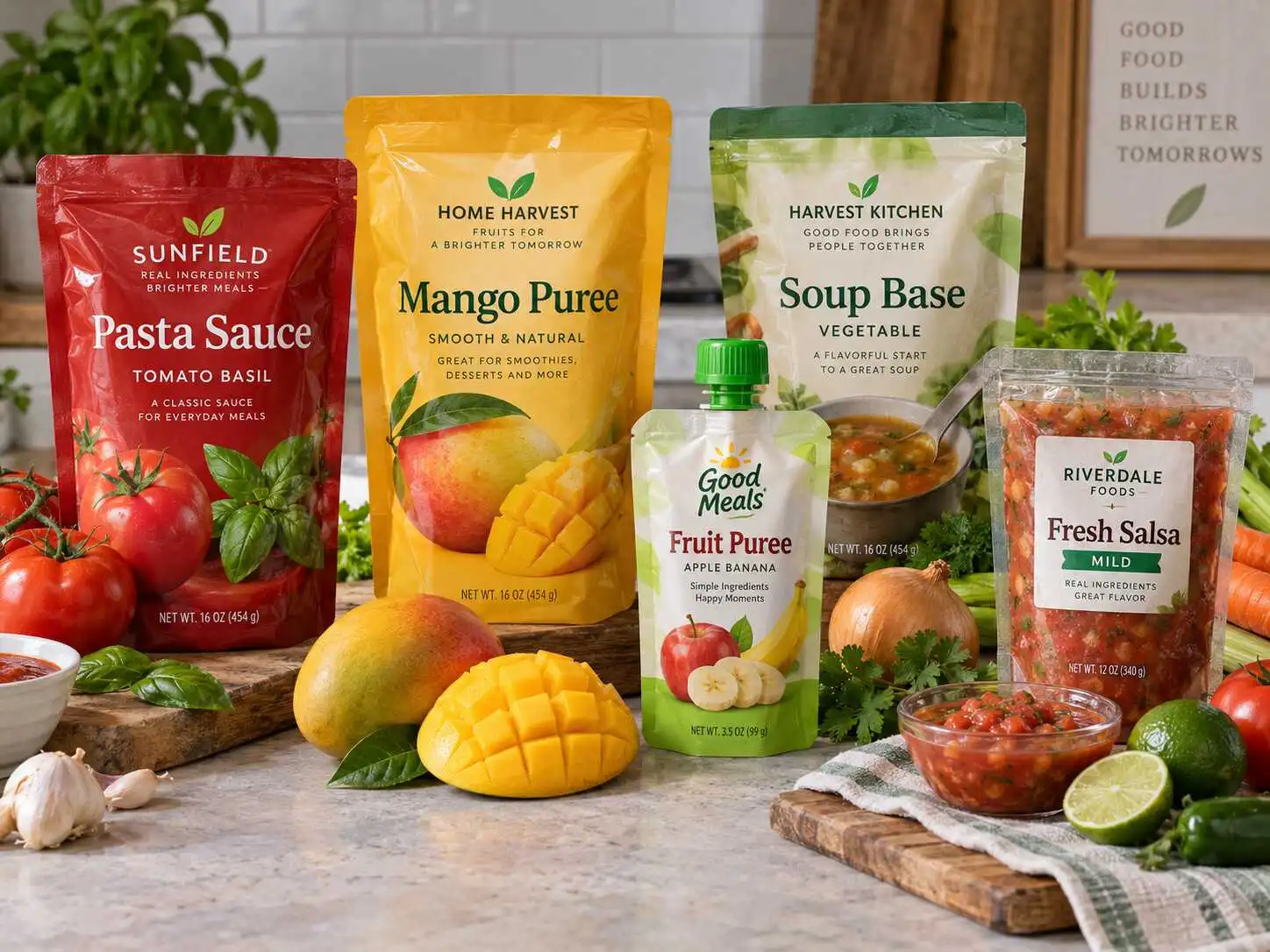
It means flexible packaging intended to remain functional through a defined pasteurization or hot-fill exposure. The phrase alone does not specify a temperature limit, a shelf-life result or a food-safety outcome. Two buyers can ask for a “pasteurization pouch” while needing different package structures because one fills a hot product and the other heats an already sealed pouch.
The package has to protect the food before and after processing while maintaining its seal and required barrier. Its job is different from the food processor’s job of choosing and validating the thermal process.
Hot Fill and In-Pack Pasteurization Are Not the Same
Hot fill before sealing
The food is heated first, filled while hot, then the package is closed and cooled according to the processor’s procedure. The package may be exposed to hot product and a defined hold or inversion step, but the sealed pouch is not necessarily put through the same treatment as an in-pack process.
Confirm fill temperature, contact time, pouch orientation, headspace, closure method and cooling. A product’s fill temperature by itself does not define the full process.
Pasteurization after sealing
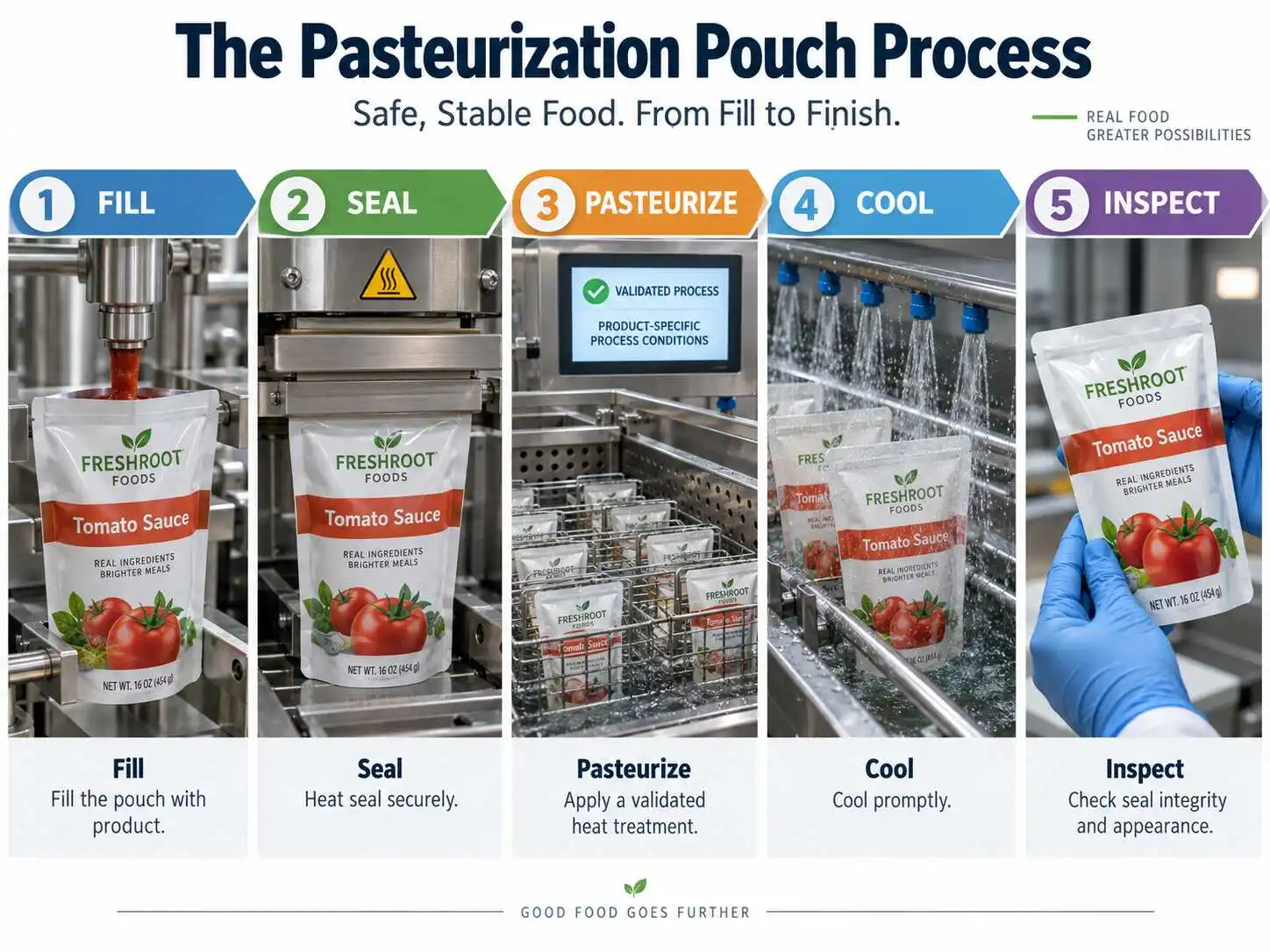
The food is filled and sealed, then the complete package is heated and cooled. The pouch, ink, adhesive and seal all experience the cycle, including any pressure or water exposure involved in the equipment.
Use this route only with packaging designed for the actual cycle and with product-specific process validation.
Pasteurization Pouch vs Retort Pouch
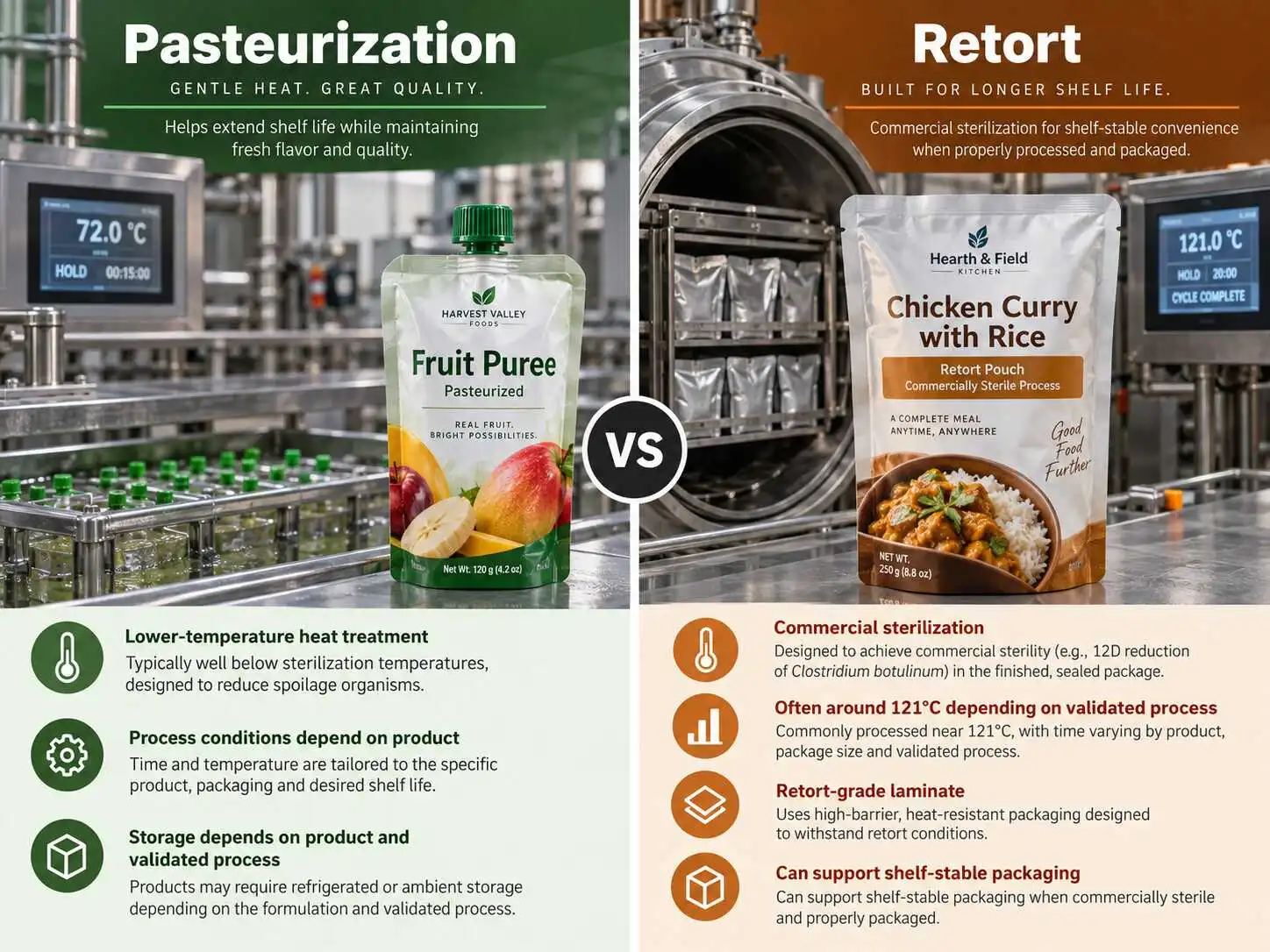
Pasteurization and retort are different process categories. Retort processing is a more severe thermal process used for products requiring commercial sterilization in a hermetically sealed package. Around 121°C is often mentioned as a retort reference point, but no single temperature and time applies to every food, package size, equipment or scheduled process.
| Buyer question | Pasteurization / hot-fill project | Retort project |
|---|---|---|
| What is being treated? | The food may be heated before filling, or the sealed package may undergo a defined pasteurization cycle. | The filled, hermetically sealed package undergoes a scheduled retort process where applicable. |
| What must the pouch handle? | The actual filling or pasteurization exposure, seal conditions, cooling and distribution conditions. | The more severe retort cycle, package pressure and the specified post-process handling. |
| What material to request? | A structure and sealant confirmed for the exact product and heat cycle; there is no universal pasteurization laminate. | A retort-grade structure designed and evaluated for the actual retort schedule. |
| Can storage be assumed? | No. Refrigerated or ambient storage depends on the food, process and applicable requirements. | No. Shelf stability depends on a validated scheduled process and compliant packaging. |
Do not upgrade blindly, and do not substitute blindly. Choose retort-grade packaging when the validated process requires it; do not assume that any heat exposure requires a retort pouch.
Your process is near retort conditions?
Review the separate retort pouch packaging guide before specifying materials.
Seven Questions to Answer Before Choosing a Pouch
1. What is the exact food?
Share the product name, ingredients or food category, acidity or pH if known, oil or fat content, particulates and any unusual product behavior.
2. What is the process route?
State whether the product is hot-filled before closing or whether the sealed pouch is heated afterward. Include the heating medium and equipment type.
3. What is the full heat schedule?
Provide maximum temperature and hold time plus come-up, cooling, pressure or water conditions when relevant. A single peak temperature leaves out important exposure.
4. How is the pouch filled and sealed?
Describe fill weight, fill temperature, headspace, filling equipment, seal jaw and how product is kept out of the seal area.
5. Where will it be stored?
Specify refrigerated, frozen or ambient distribution, expected shelf life, light exposure and the sales market.
6. What protection does the food need?
Identify oxygen, moisture, aroma, light or puncture concerns. Heat resistance and barrier performance are separate design questions.
7. What evidence is required?
Agree on sample format, post-process inspection, seal checks, documentation and who approves the food process versus the packaging specification.
How Food Chemistry Changes the Packaging Decision
Acidic sauces, oily foods, fruit purees, soups and products with sharp particulates can interact differently with packaging materials and seals. Product composition can affect which food-contact materials are appropriate, how the package fills, what can contaminate the seal and which barrier properties matter.
Share the formulation or an accurate food category with the material supplier. Include pH and fat content when available, but do not expect those two values alone to determine a final structure. The use conditions, process, storage, intended market and applicable food-contact requirements also matter.
FDA food-contact tables include a “hot-filled or pasteurized above 150°F (66°C)” condition-of-use category. That is a material-use classification, not a recommended pasteurization temperature, lethality target or safe holding schedule for a particular food. Never use a food-contact use-condition band as the product’s thermal-process specification.
Which Material Layers Matter in a Pasteurization Pouch?
Flexible packages combine layers because one film rarely provides every required property. Use layer descriptions as a conversation starter, not as a fixed recipe. The exact resin grades, adhesive, coating, thickness and conversion method have to be evaluated together against the food and the cycle.
| Layer or feature | What it can contribute | What still needs confirmation |
|---|---|---|
| Outer print layer, such as PET | Print surface, handling and part of the package’s structural performance. | Ink system, adhesive bond and resistance to the actual heating and cooling cycle. |
| Support or toughness layer, which may include PA | Mechanical strength or puncture resistance for some products and handling conditions. | Compatibility with the food, process, forming and sealing conditions. |
| Optional barrier layer, such as metallized film or foil | Can help manage oxygen, light or other barrier requirements, depending on the construction. | Barrier need, flexing, bond strength and post-process performance; metal does not automatically make a pouch retortable. |
| Inner sealant, such as a suitable PE or PP grade | Food-contact surface and heat-sealing function. | Seal initiation, hot tack, sealing window, food compatibility and survival of the full cycle. |
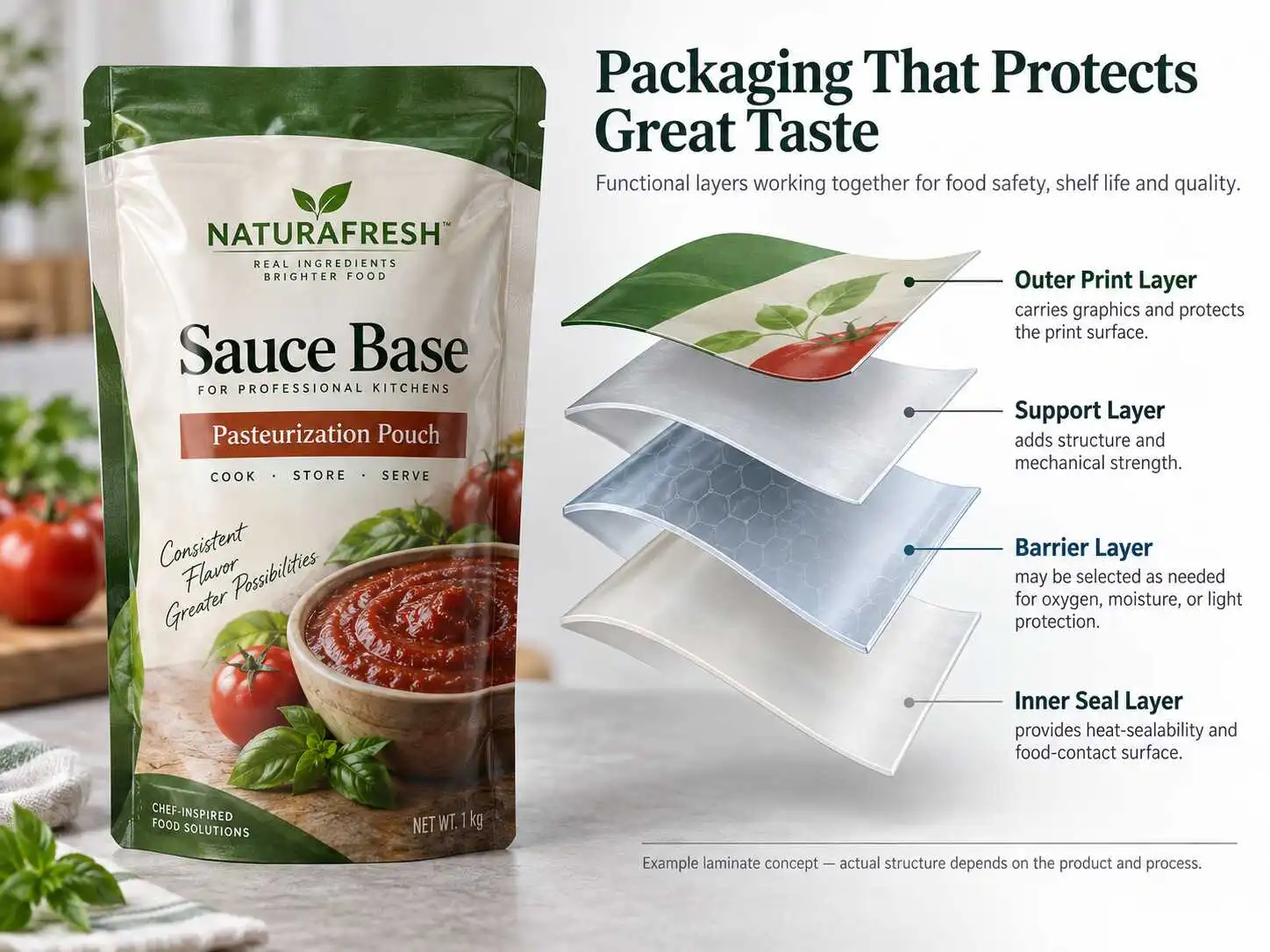
Structures such as PET/PE or PET/PA/PE may be discussed for some compatible applications; metallized or foil layers may be considered when product barrier needs justify them. None of these material names proves that a finished pouch can tolerate a particular thermal cycle. Retort projects need their own retort-grade construction and qualification.
Need oxygen, moisture, light or puncture protection?
Define the product and shelf-life target before choosing a layer stack.
Seal Performance Needs Its Own Review
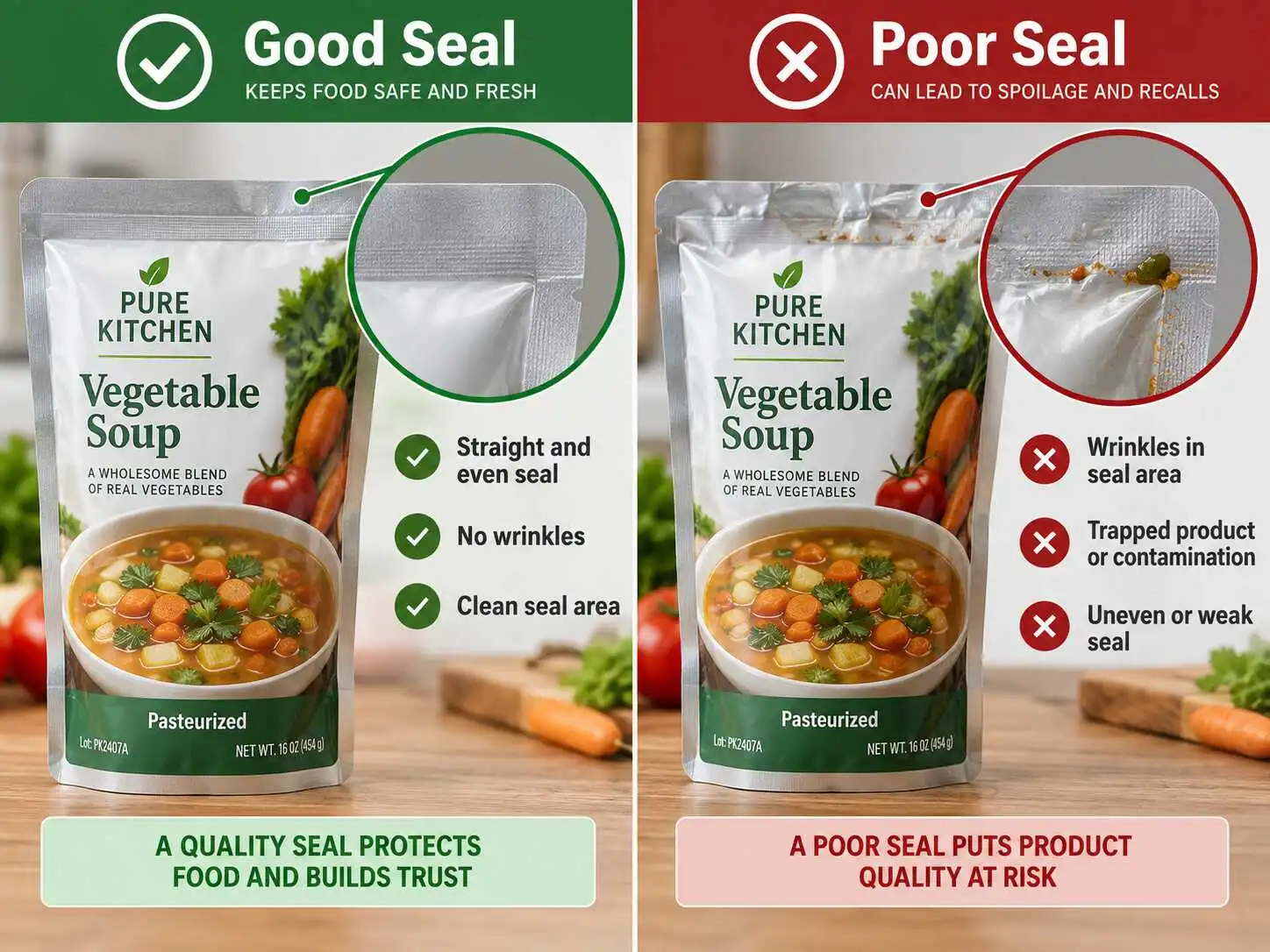
Heating and cooling can change package pressure, film dimensions and seal stress. A suitable laminate can still fail if the seal layer, jaw settings, contact time, pressure or seal cleanliness are wrong. For liquid, oily or particulate foods, controlling splashes and residue around the seal is especially important.
Confirm the pouch sealing method, seal width, equipment settings and expected line speed. Evaluate samples using the intended product or a suitable test fill and the actual planned process route. Visual appearance alone cannot prove that a package is leak-free or that a food process is safe.
Ask the packaging supplier to assess
- Material, adhesive and sealant compatibility with the stated exposure
- Seal behavior with the intended fill and equipment
- Appearance, bond and seal condition after a representative trial
- Available material and food-contact documentation for the target market
Keep food-process validation with the processor
- Scheduled process for the specific formulation and package
- Food safety targets and critical operating limits
- Regulatory review for the product and destination market
- Final approval by the responsible qualified process authority
Set Barrier Requirements for Storage After Processing
A pouch that survives a heat cycle is not automatically a high-barrier pouch. Heat resistance concerns whether the complete structure and seal can tolerate processing. Oxygen, moisture, aroma and light barrier concern how well the package protects product quality during storage and distribution.
Oxygen and aroma
Consider oxidation, flavor loss and aroma retention for the specific formulation and target shelf life.
Moisture
Set water-vapor protection based on product sensitivity, storage humidity and distribution conditions.
Light
Light-sensitive foods may need a structure that limits exposure; the requirement should be tested against the actual product.
Storage route
Refrigerated, frozen and ambient plans may require different barrier and distribution performance. Do not infer shelf stability from a pouch or process label.
Choose a Pouch Format That Fits the Filling Line
Three-side-seal, stand-up, flat-bottom and rollstock formats have different filling, sealing, handling and display characteristics. The format should fit the product, fill weight, headspace, pouch orientation, sealing equipment and thermal-treatment equipment. Do not assume that a format is compatible simply because it is available as a flexible pouch.
For premade pouches, confirm how the bag is opened, filled and sealed and whether the line supports the intended post-fill treatment. For rollstock, also confirm the machine, web, seal arrangement and line settings. A production trial should use a representative package and the intended process route before specifications are approved.
A practical approval sequence
- Document the food, process route, complete heat schedule, cooling and storage conditions.
- Have the processor or process authority confirm the food-safety process and applicable requirements.
- Ask the packaging supplier to propose a structure and pouch format against those conditions.
- Review drawings, seal dimensions, food-contact documentation and production equipment compatibility.
- Run representative filled-package trials and assess seal, bond, appearance and required barrier after exposure.
- Record who approves the process and who approves the packaging specification before commercial production.
Keep two approvals separate: a packaging trial does not validate the food’s scheduled thermal process, and a validated food process does not automatically qualify every pouch structure.
Common Risks When a Pouch Is Chosen by Name Alone
Seal leaks
Possible contributors include contamination in the seal area, incorrect settings, unsuitable sealant or process stress.
Delamination
Bonding may be inadequate for the actual product contact, temperature, moisture or cycle.
Wrinkles or distortion
Package geometry, loading, headspace or thermal and cooling conditions may need review.
Print or appearance changes
Ink, adhesive and outer-layer performance should be evaluated for the intended exposure.
Barrier shortfall
A pouch can remain intact yet fail to protect the food’s quality over the intended storage period.
Wrong storage assumption
Packaging language cannot determine whether a food may be stored chilled or at ambient temperature.
What to Send Your Pouch Supplier
Food and process
- Product and ingredient or food category
- pH and fat/oil details, when known
- Hot-fill or in-pack pasteurization route
- Maximum temperature, holding time and full heating/cooling profile
- Heating medium, equipment and any pressure conditions
- Filling temperature, fill weight, headspace and sealing method
Packaging and commercial plan
- Current pouch or target format, size and drawing if available
- Oxygen, moisture, light and puncture requirements
- Refrigerated, frozen or ambient storage and target shelf life
- Destination market and requested food-contact documents
- Quantity, SKU count, printing and artwork status
- Sample-trial plan, acceptance tests and delivery window
Send the food, heat schedule and pouch details together
Include the product, hot-fill or in-pack route, maximum temperature, holding time, cooling method, storage target, fill weight, pouch size, quantity and destination market. Runlong Pack can review packaging structure and format questions; food-process validation remains with the processor and its qualified process authority.
Pasteurization Pouch Packaging Questions
Can I use a regular stand-up pouch for pasteurization?
What temperature can a pasteurization pouch withstand?
Is a pasteurization pouch the same as a retort pouch?
Which material is best for pasteurization pouches?
Can a pasteurized pouch be shelf-stable?
Can a pouch be pasteurized after it is sealed?
Do pasteurization pouches need an aluminum barrier?
What information should I send for a pasteurization pouch quote?
Official References and Process Responsibility
For U.S. projects, review the FDA’s Food Contact Substances information and its food types and conditions-of-use information for applicable material-use context. Depending on the product and process, 21 CFR Part 113 or 21 CFR Part 114 may also be relevant. Applicability depends on the specific product, package and process.
Food-contact material status, pouch compatibility and food-process validation are related but distinct questions. Ask the appropriate regulatory specialist or qualified process authority to confirm the requirements for the actual product and sales market.
Continue Planning Your Packaging Project