

Start With the Spice, Not Just the Bag
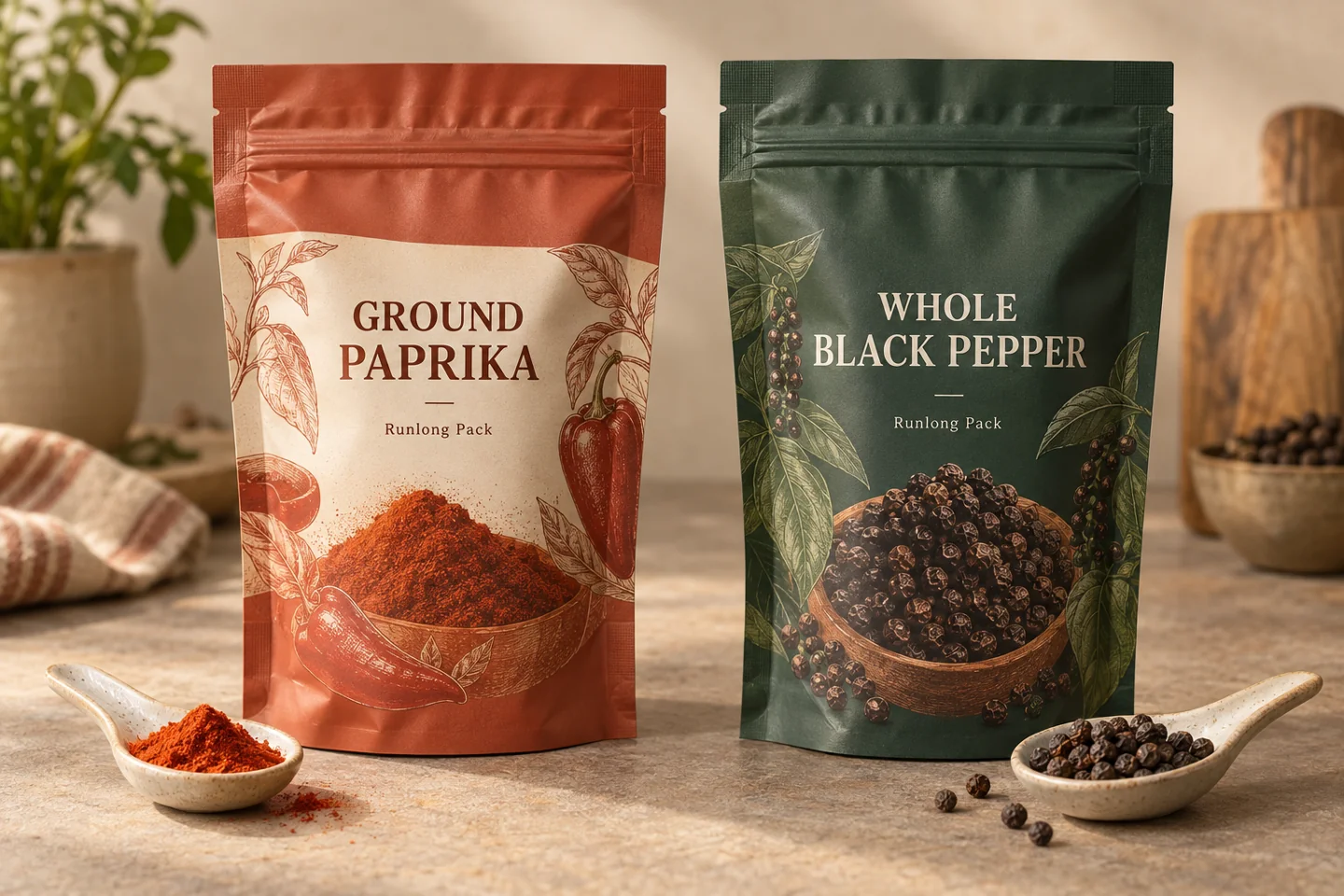
A pouch that works for whole peppercorns is not automatically the right specification for fine paprika or a seasoning blend. Compare the product form, barrier needs and filling process before approving packaging.
Quick Answer
Ground spices often need particular attention to powder flow, aroma protection and keeping the heat-seal area clear. Whole spices require a realistic volume check and, where relevant, attention to pointed or irregular particles. Both need materials selected for the actual product and storage conditions. Use a product-specific filling and sealing trial rather than choosing only by appearance, thickness or net weight.
Quick Facts
- Same weight does not mean the same pouch size: bulk density and settling differ.
- A clear window is a structural decision: review barrier protection, not just artwork.
- Powder adhesion is a symptom: static is one possible cause, not an automatic diagnosis.
- Zippers are for repeated access: initial heat sealing still needs confirmation.
- Decision output: a completed packaging brief and an agreed product trial.
Ground Spices vs Whole Spices: A Packaging Selection Table
| Product form | Questions to ask | Trial focus |
|---|---|---|
| Fine ground spices | Does powder cling, dust or collect at the seal? How sensitive is the product to moisture, oxygen or aroma loss? | Fill accuracy, powder behavior, headspace, clean seals and agreed barrier requirements. |
| Coarse spices or flakes | Do particles bridge at the filler or lodge near the opening? Is the product fragile or irregular? | Filling access, particle handling, settling and seal-zone clearance. |
| Whole spices | How much space does the real dose occupy? Could pointed pieces stress the pouch during handling? | Usable volume, film durability where needed and distribution handling. |
| Seasoning blends | Does the recipe contain moisture-sensitive ingredients, salt, sugar or oils? Do components separate? | Test the actual blend; do not substitute data from one ingredient. |
This table is a starting point, not a fixed laminate prescription. A finely ground product and a whole spice may use the same approved structure in one project and different structures in another. The product and process determine the decision.
1. Define Moisture, Aroma, Oxygen and Light Requirements
Start with the loss of quality you are trying to avoid: caking, aroma change, discoloration or another product-specific concern. Tell the packaging supplier the intended shelf life, storage environment and distribution route. Do not assume that a thicker film automatically provides the right barrier.
Ground material has more exposed surface area than the same material left whole, which can make aroma and oxidation concerns more relevant. However, grinding alone does not establish the required oxygen or water-vapor transmission rate. Formulation, processing and storage conditions also matter.
Ask for the proposed layer structure and the relevant barrier information, including test conditions when numerical data are used. Distinguish a raw-film result from evidence for the complete filled package. Seals, windows, damage and handling can affect performance.
If you want a clear window
Explain what customers need to see and how large the window should be. Opaque foil or ordinary metallized film cannot remain across the transparent area. Evaluate the entire construction and confirm whether the visibility trade-off suits the product. A natural kraft appearance is not proof of barrier performance or recyclability.
2. Select Pouch Size With the Actual Product
A 100 g portion of one spice may occupy a very different volume from 100 g of another. Bulk density, particle shape, settling and the filling method change how the product fits. A printed weight on a sample pouch is not a capacity chart for your spice.
- Measure or trial the target dose of the actual product.
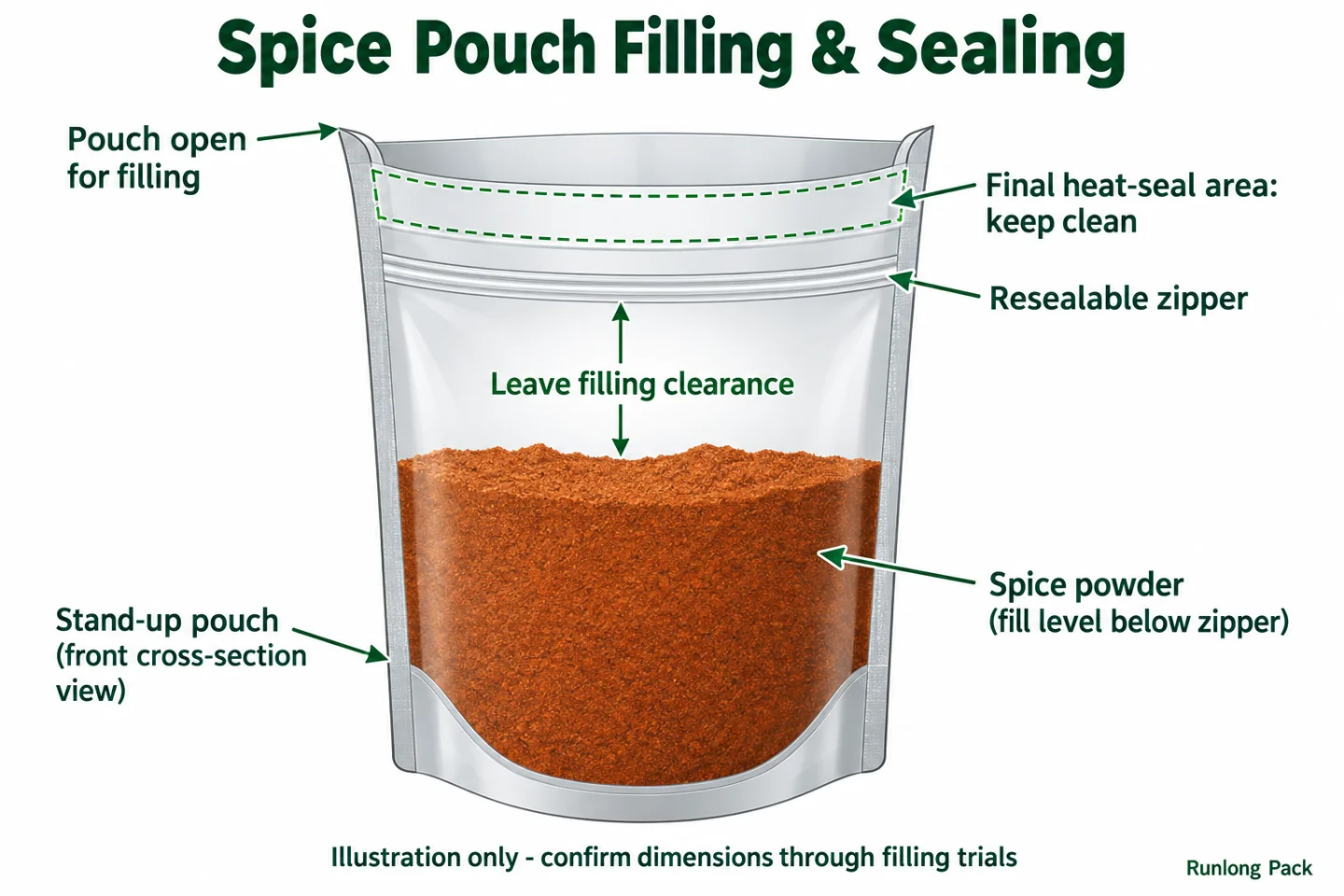
- Allow space for filling, zipper access where used, and the final heat seal.
- Confirm the dimension convention, including how the bottom gusset is measured.
- Check the filled pouch both immediately after packing and after normal settling.
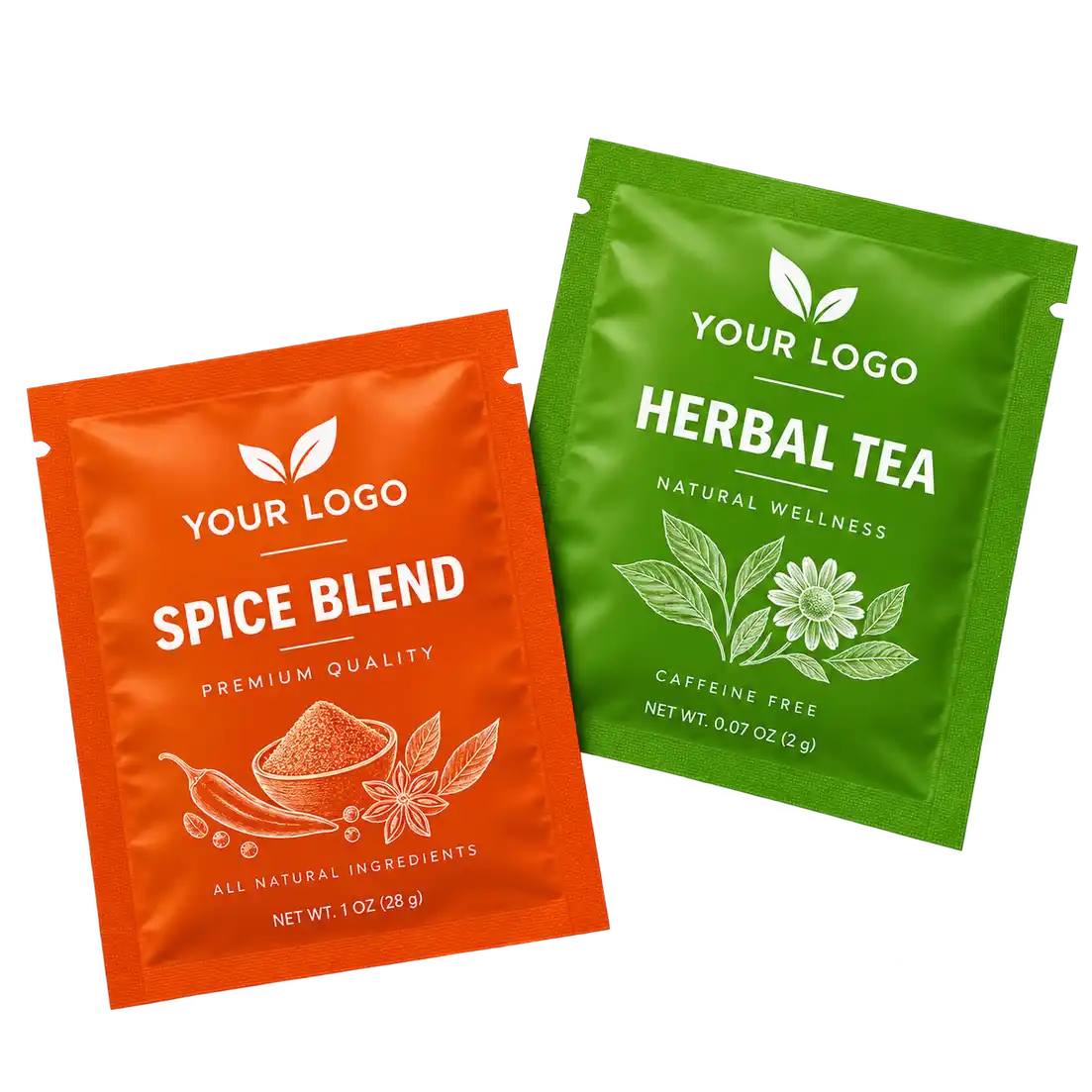
For repeated household use, a suitable zipper pouch may be convenient. For a recipe portion or meal kit, a flat sachet may be more appropriate. Review the packaging bag size guide for the broader sizing method.
3. Separate Static Symptoms From Filling and Sealing Problems
Powder stuck to the film does not prove that the bag needs an anti-static treatment. Record where and when the issue occurs: inside the pouch before filling, during product drop, around the zipper, or at the sealing jaws. Note whether it changes with humidity, batch, speed or equipment settings.
| Observed condition | What to investigate—not a confirmed cause | Useful evidence |
|---|---|---|
| Powder clings to film | Possible static effects, product behavior, surface and environmental conditions. | Video, current film specification, humidity and operating speed. |
| Powder enters the final seal zone | Filling trajectory, insufficient clearance, dusting, timing or product movement. | Fill level, nozzle position, pouch opening and close-up seal images. |
| Intermittent weak seals | Contamination, wrinkles, material compatibility or machine setup. | Clean and affected samples, line settings and inspection results. |
| Poor flow or bridging | Particle distribution, formulation, filler geometry or process settings. | Actual blend sample, filler details and batch comparisons. |
Ask whether a food-contact-suitable anti-static approach can be evaluated for the proposed structure. Agree how performance will be checked under your operating conditions. Do not assume an electronics-style anti-static package is suitable for food, or that an anti-static film replaces equipment grounding, dust control or a site safety assessment.
Keep corrective actions traceable. Change one agreed variable at a time where practical and compare the result. A visual inspection alone does not establish seal strength or the absence of microleaks; agree appropriate test methods and acceptance criteria for the project.
4. Match Premade Pouches or Rollstock to the Production Line
Premade pouches can suit manual, semi-automatic or compatible automatic pouch-filling systems. Rollstock requires equipment that forms the package from film. Neither route is automatically better for all spice brands.
| Route | Confirm with the supplier |
|---|---|
| Manual or semi-automatic premade bags | Usable mouth opening, dosing method, headspace and suitable sealing equipment. |
| Automatic premade pouch line | Machine-approved pouch dimensions, opening and gripping requirements, stiffness and zipper compatibility. |
| Form-fill-seal rollstock | Web width, print repeat, eye mark, unwind direction, core, maximum roll diameter and seal configuration. |
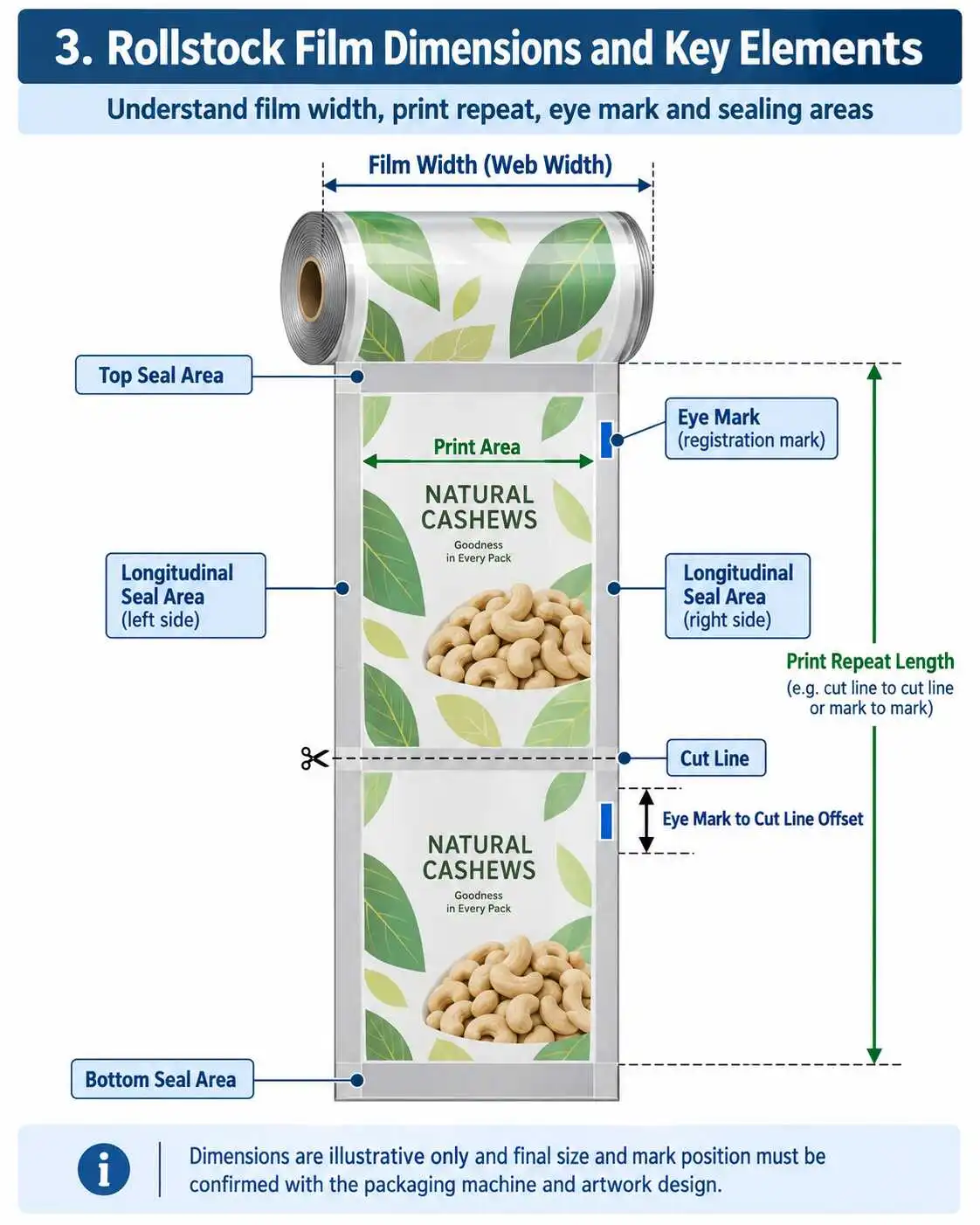
See printed rollstock options and provide the machine specification rather than copying dimensions from another brand’s bag. Test representative production material on the intended line before committing to a critical launch schedule.
5. Compare Orders by SKU, Not Just Total Quantity
Ten designs of 1,000 pouches each are not the same production requirement as one design of 10,000. Tell the supplier the quantity per artwork, common or different pouch sizes, and whether recipes or labels are likely to change.
Choose the printing route around quantity per design, common sizes and the likelihood of artwork changes. Smaller or multi-design trials may suit digital printing; stable repeat orders may justify a gravure comparison. Confirm feasibility and costs for your actual specification.
Use the MOQ guide and digital-versus-gravure comparison for the full production rules. Confirm any additional treatment, sample work and setup cost separately.
Buyer Worksheet: Copy These Fields Into Your Packaging Brief
| Field | Fill in before quotation or trial |
|---|---|
| Product / recipe | ____________________________ |
| Ground, coarse, whole or blend | ____________________________ |
| Fill weight and actual volume | ____________________________ |
| Pouch format or machine model | ____________________________ |
| Existing dimensions / film specification | ____________________________ |
| Storage conditions and target shelf life | ____________________________ |
| Total quantity / quantity per SKU | ____________________________ |
| Zipper, window or other features | ____________________________ |
| Observed static, dust or seal issue | ____________________________ |
| Required documentation and agreed tests | ____________________________ |
| Destination and required arrival date | ____________________________ |
A practical trial sequence
- Confirm the proposed specification and representative sample material.
- Fill the actual spice at the intended dose and operating conditions.
- Review handling, opening, seal cleanliness and agreed integrity checks.
- Record observations and any changes before approval.
- Validate the packed product’s storage performance for its intended use.
Packaging selection does not replace food safety controls, allergen management or product/process validation. Avoid treating a visually attractive pouch as proof that these requirements have been met.
Frequently Asked Questions
Do ground spices always need aluminum foil bags?
No. Select the structure around the product, target shelf life and distribution conditions. Foil is one option, not a universal requirement for every powder.
Can I use the same bag size for ground and whole spices?
Only after confirming actual fill volume, headspace and sealing access. Equal net weights do not establish equal pouch volume requirements.
Will anti-static packaging solve powder in the seal?
Not necessarily. Static is only one possible contributor. Review the filling process, product and environment, then evaluate any material treatment with actual trials.
Is a resealable zipper enough to close the pouch for sale?
A zipper is primarily for repeated access. Confirm an appropriate initial heat seal and the required sealing clearance for the chosen pouch.
What should I send to get a spice packaging recommendation?
Provide the product form and formulation details, fill weight, pouch or machine specification, quantity per design, intended storage, destination and any observed filling or sealing issues.