

Build the Line as One Packaging System
Connect gentle product handling, combination weighing, bag volume, optional nitrogen flushing, printed rollstock and seal control before deciding what “fast” production should mean.
What makes a potato chip automatic packaging line work reliably?
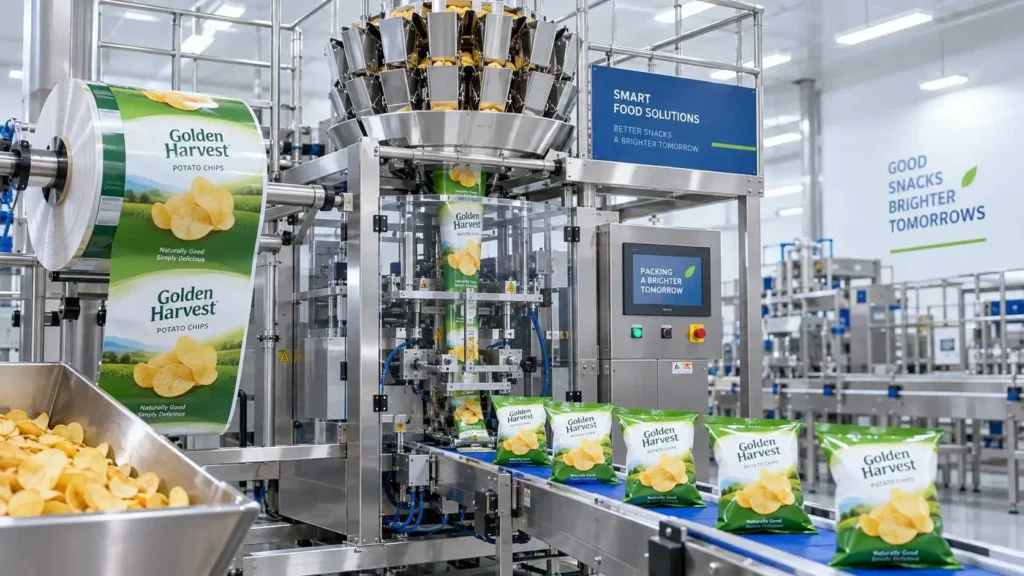
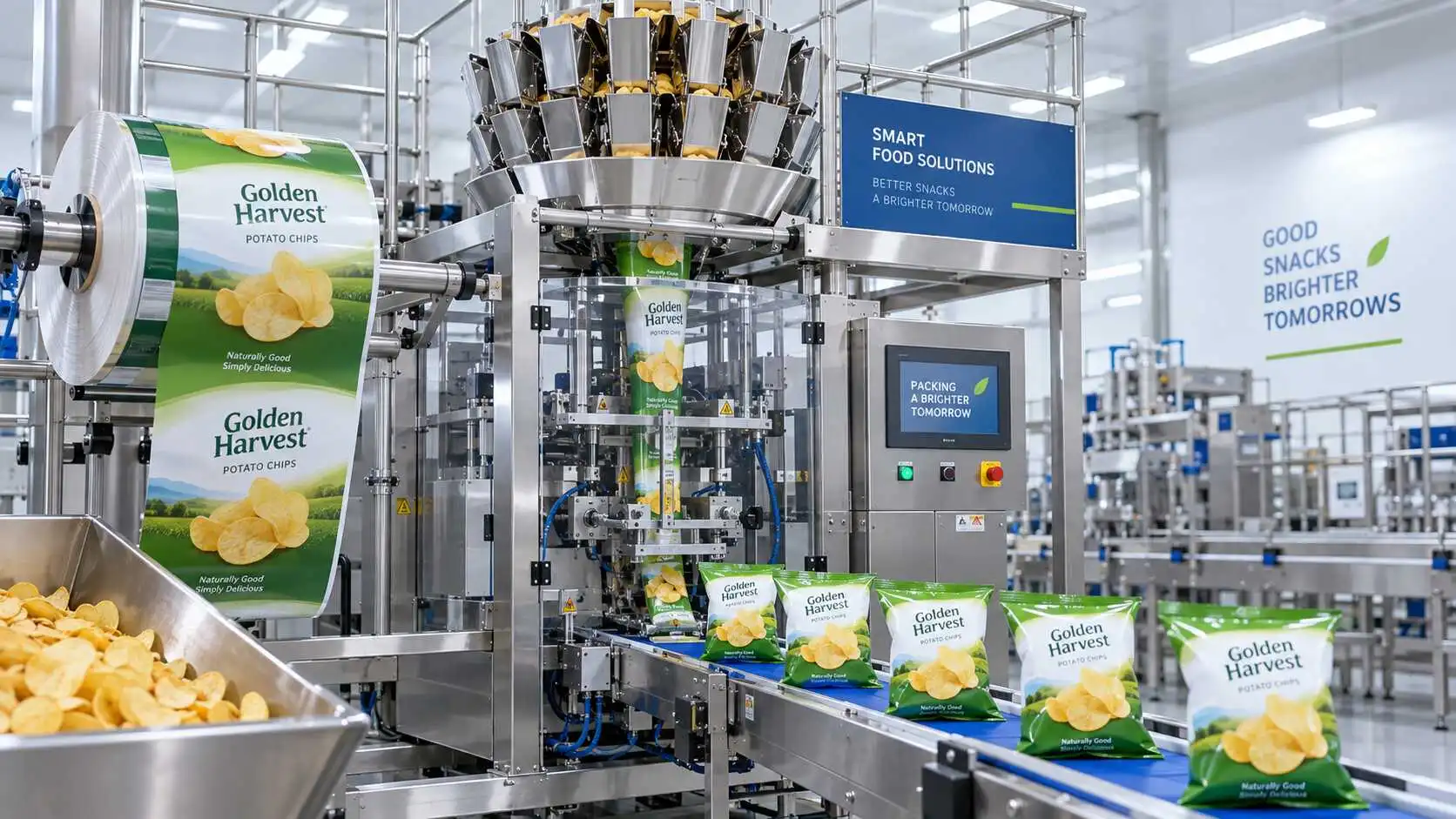
A reliable potato chip line is not just a fast VFFS bagger. It is a coordinated system that cools and buffers the chips, conveys them gently, distributes them evenly to a multihead weigher, limits drop height, forms the bag from compatible rollstock, manages optional nitrogen flushing, keeps crumbs out of the cross seal, codes and checks the pack, and protects it through cartoning and distribution.
Choose bag size from actual chip volume and required protective headspace—not net weight alone. Confirm film width, print repeat, eye mark, unwind direction, core and roll limits with the actual VFFS machine. Nitrogen can help reduce oxygen exposure and create cushioning space, but it cannot replace suitable barrier, sound seals or a validated process.
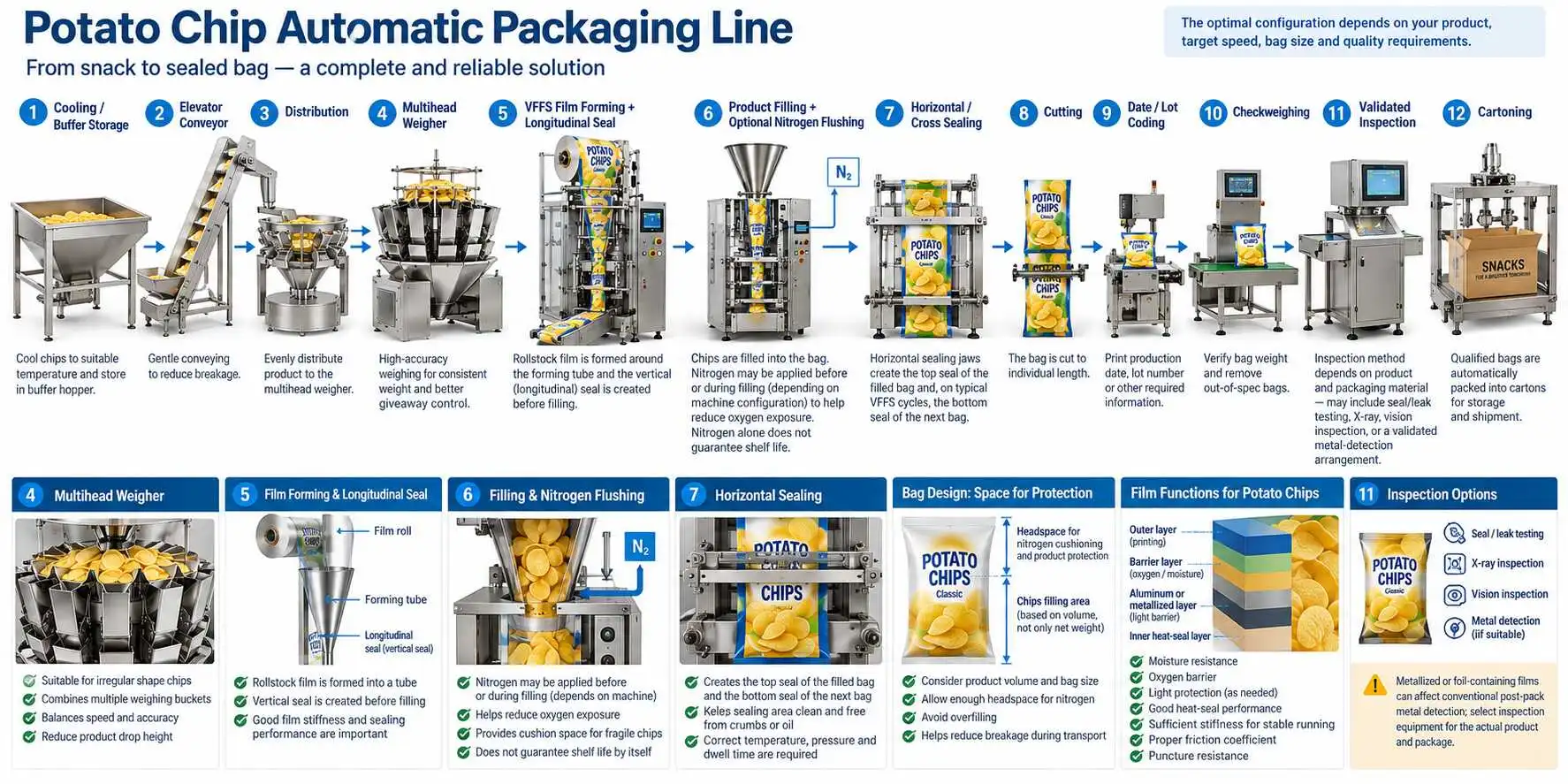
Start with the complete potato chip packaging-line flow
A practical line normally connects product cooling or buffer storage, gentle elevation, controlled distribution, multihead weighing, VFFS bag forming, product filling, optional gas flushing, cross sealing, cutting, date or lot coding, weight control, suitable inspection and cartoning. The exact order and equipment vary by factory, but every interface should have a named owner and an acceptance check.
Stabilize the product before packing
Confirm chip temperature, oil and seasoning condition, product bulk density and the time between frying and packing. Product condition can affect flow, crumbs, seal contamination and the package’s protection needs.
Control every transfer point
Evaluate elevator style, distribution, drop height and accumulation. A fast bagger cannot recover whole-chip yield that was already lost through harsh conveying.
Match dosing to the actual chip
Weigher selection and settings depend on chip size, shape, fragility, seasoning, oil and the target pack weight. One setup should not be copied across every flavor or cut.
Validate the finished pack
Judge weight, bag dimensions, seal integrity, residual oxygen where relevant, product breakage, coding, appearance and distribution performance together.
Use multihead weighing without turning speed into breakage
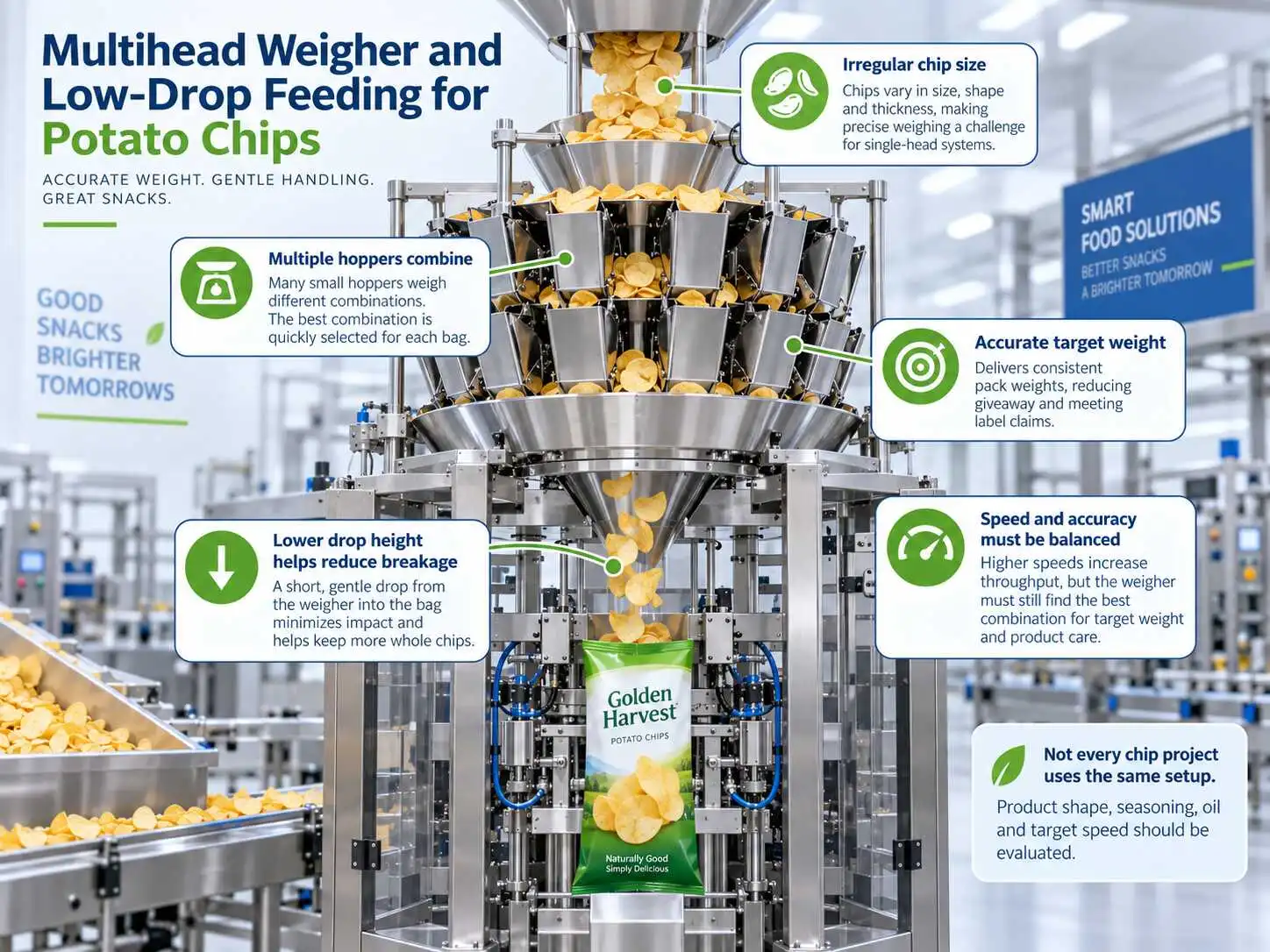
A multihead weigher forms the target dose by combining several smaller hopper weights. This can support consistency and throughput for irregular chips, but the result depends on product distribution, hopper settings, target weight, vibration, timing and the distance from the weigher to the bag.
Reduce uncontrolled drop
Review the vertical distance, chute geometry and impact surfaces from weigher discharge to the forming tube and bag. “Low drop” is a line-layout objective, not one universal dimension.
Keep product feeding even
Poor distribution can starve some weigh heads while overloading others. Stable upstream flow is necessary before increasing the bagger cycle rate.
Measure more than giveaway
Track pack-weight consistency together with whole-chip percentage, crumbs, stoppages and seal contamination. A weight result alone does not describe package quality.
Choose bag size from chip volume and protective headspace
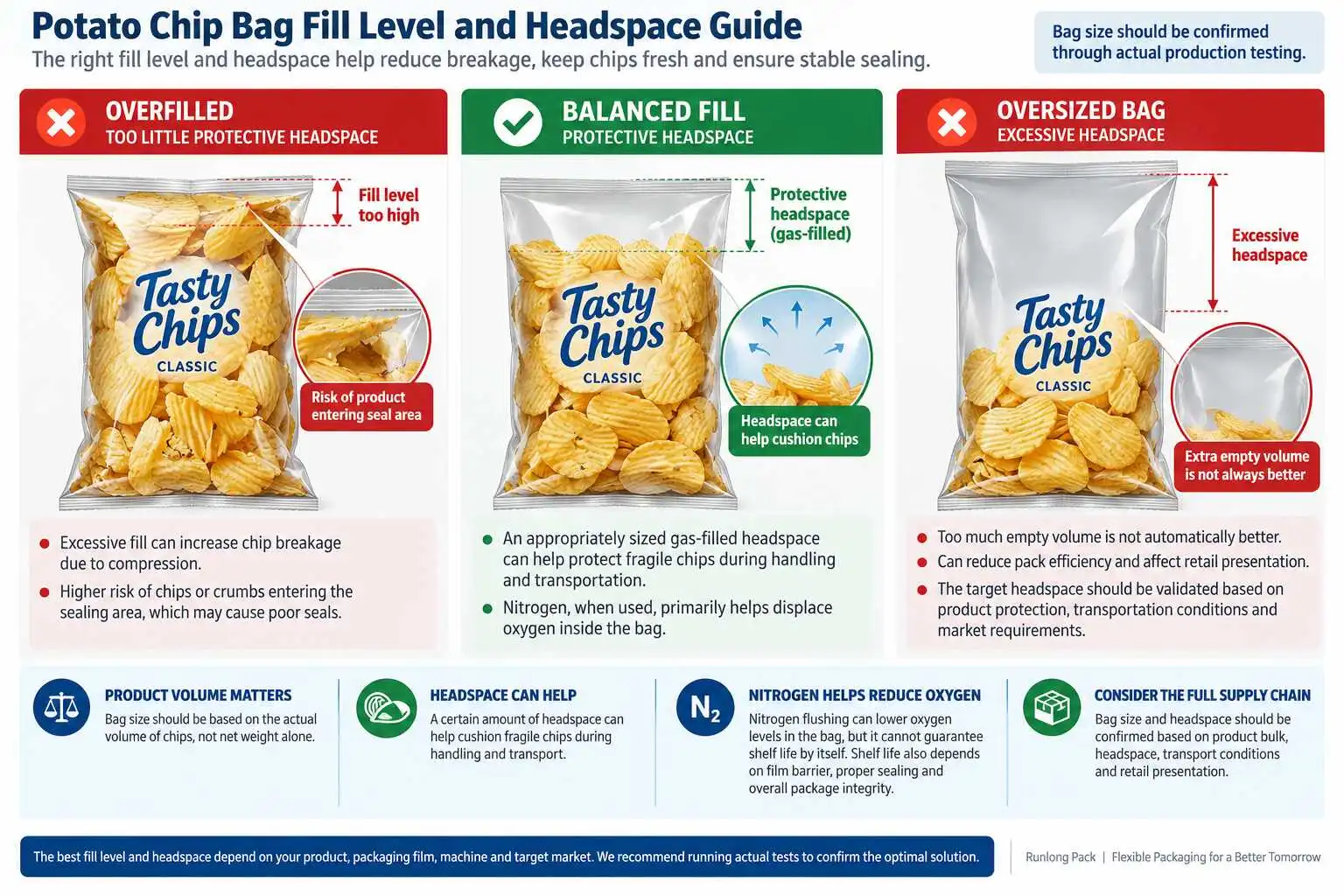
Two potato-chip products with the same net weight may occupy different volumes because of chip diameter, thickness, shape, breakage and settling. Start with actual fill trials or representative product-volume measurements, then add the space required for forming, filling, cross seals and product protection.
| Condition | Likely consequence | What to evaluate |
|---|---|---|
| Too full | More product near the seal, compression and breakage risk | Actual volume, drop pattern, seal clearance and jaw timing |
| Balanced headspace | Room for filling and a gas cushion while maintaining pack efficiency | Product protection, target residual oxygen and transport performance |
| Excessively large | Lower packing efficiency and an appearance that may not suit the market | Carton count, pallet utilization, presentation and real protection benefit |
Still choosing a bag width and length?
Use product volume and an actual fill test before approving the final web and repeat.
Understand where nitrogen fits into the VFFS sequence
The VFFS machine unwinds the film, forms it around a tube, makes the longitudinal seal, creates the first cross seal, receives the weighed chips, completes the next cross seal and cuts the bag. Depending on machine design, nitrogen may be introduced before or during filling to displace air and reduce oxygen exposure.
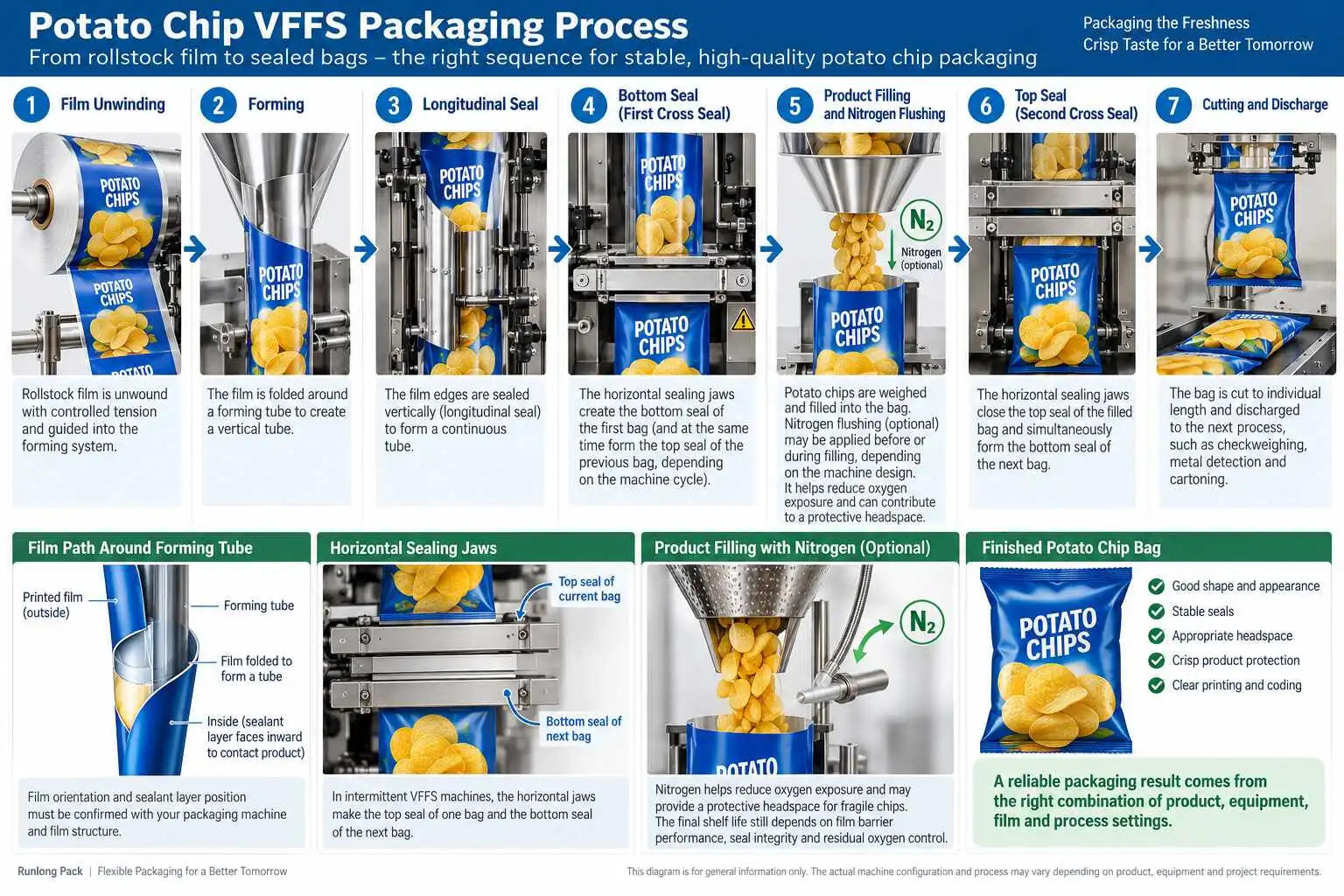
Specify how residual oxygen will be measured, when samples will be taken, how many packs will be checked and what acceptance criterion the food producer requires. The packaging supplier can support film selection, but the food producer remains responsible for validating the packed product and target shelf life.
Select potato chip film by barrier, machinability and sealing needs
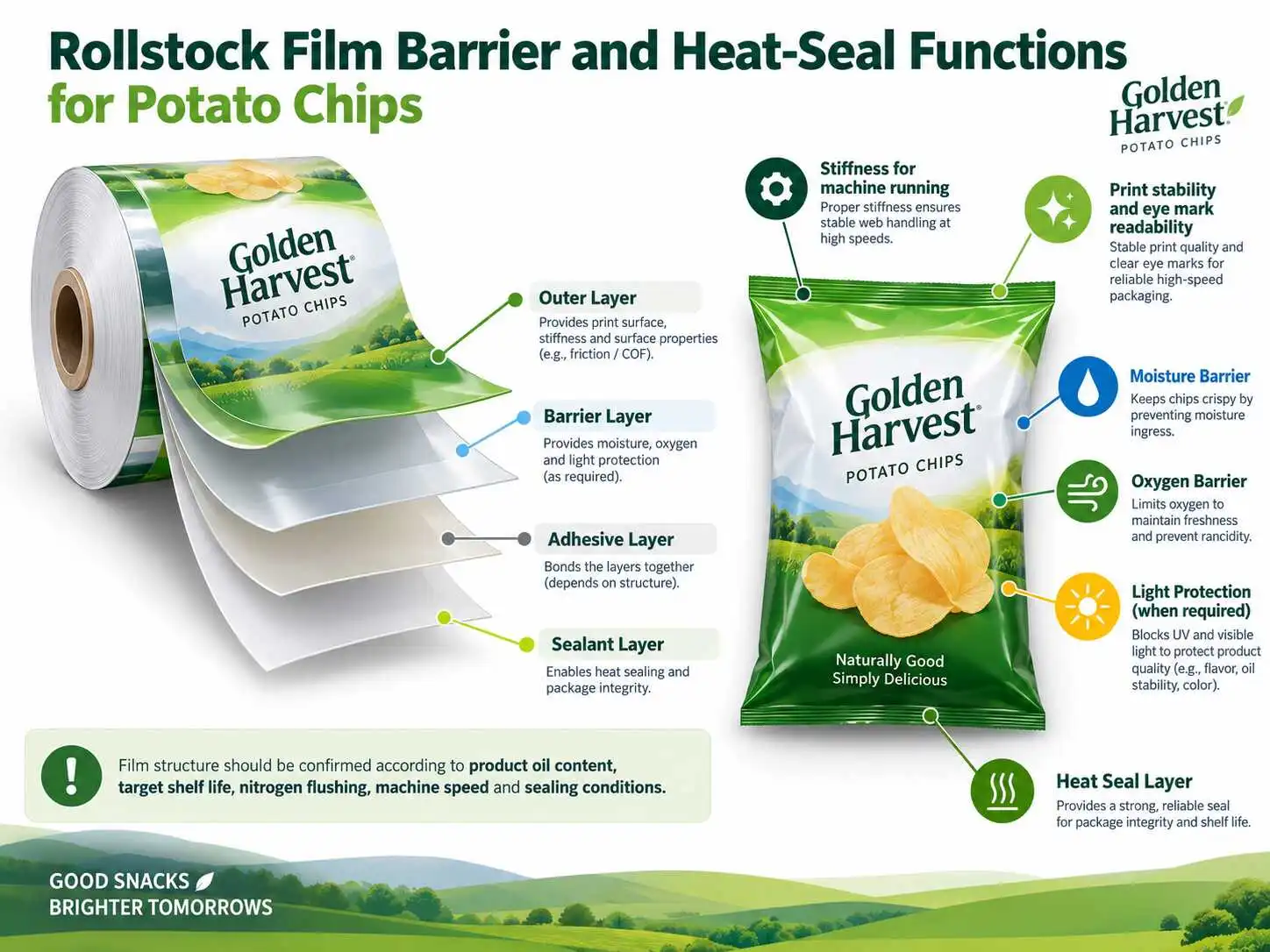
A useful film discussion starts with functions rather than a copied laminate name. The outer layer provides the printing surface and contributes mechanical properties. Other layers may provide moisture, oxygen or light protection as required. The inner layer must seal reliably under the actual machine conditions and contact the product as intended.
Protection functions
- Moisture resistance to help preserve crispness
- Oxygen barrier appropriate to product and shelf-life targets
- Light protection when the product requires it
- Aroma and oil resistance for the actual formulation
- Puncture and flex-crack performance for handling
Machine functions
- Stiffness suitable for forming and stable running
- Surface friction compatible with belts and film path
- Print registration and readable eye marks
- A usable heat-seal window at the intended speed
- Roll construction that fits the unwind station
The final structure should be confirmed from the product, oil and seasoning, target shelf life, filling process, nitrogen use, machine speed, sealing conditions, distribution and market requirements. Food-grade raw materials do not by themselves prove suitability for every food, country or shelf-life target.
Comparing barrier options?
Define the required moisture, oxygen, light, oil and heat-seal functions before approving a structure.
Confirm the VFFS data before printing potato chip rollstock
The bag artwork cannot safely define the film specification by itself. Collect the machine manufacturer and model, forming-set drawing, finished bag dimensions, web width, print repeat, seal allowances, eye-mark size and position, unwind direction, core inner diameter, maximum roll diameter and weight, longitudinal-seal type, target operating speed and acceptable splice method.
| Data group | Information to confirm | Why it matters |
|---|---|---|
| Bag | Width, length, seal areas, target fill and headspace | Defines the pack geometry and usable product volume |
| Repeat, cut position, eye mark, mark-to-cut relationship | Controls registration, graphics and cut accuracy | |
| Roll | Core, outer diameter, weight, winding and orientation | Determines whether the roll loads and unwinds correctly |
| Seal | Fin or lap seal, jaw design, pressure, dwell and speed | Guides sealant compatibility and process validation |
| Product | Chip type, volume, oil, seasoning, temperature and crumbs | Affects filling, contamination, barrier and protection |
Most normal Runlong printed-rollstock projects start around 300 kg. Retort-grade, special high-temperature or special-material projects require separate confirmation. MOQ does not prove machine compatibility, so approve the technical specification and any required test plan before bulk printing.
Need a deeper machine-data checklist?
Use the dedicated VFFS guide for web, repeat, eye mark, unwind, core and seal details.
Keep chips, crumbs and seasoning out of the seal area
Seal contamination may come from overfilling, long product tails, crumbs, poor discharge timing, static, seasoning buildup or unsuitable jaw timing. A stronger heat setting is not automatically the answer: excess heat can also damage the film or narrow the stable operating window.
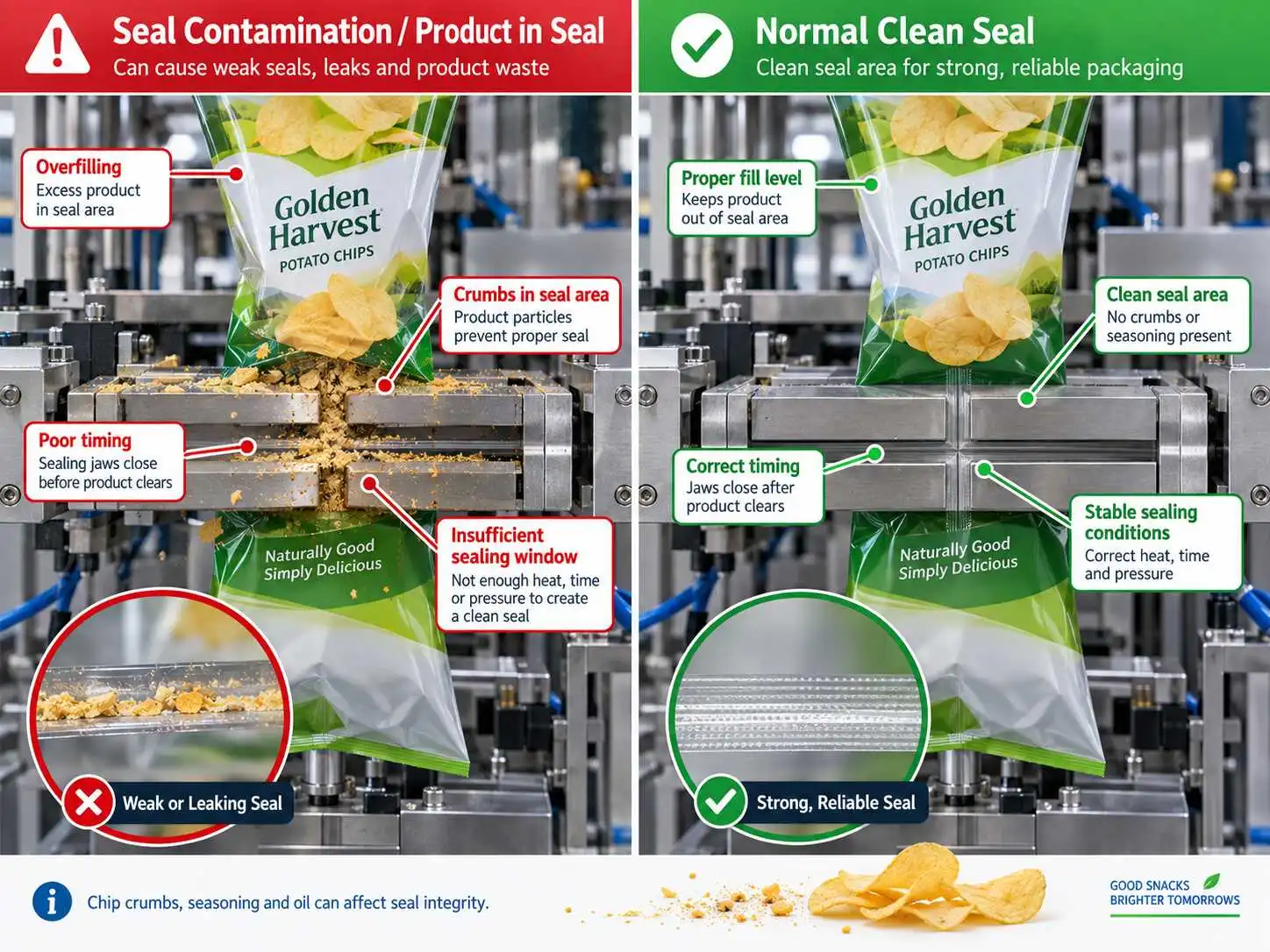
Control the fill level
Leave enough clearance for the product to settle below the seal before the jaws close.
Control the timing
Coordinate weigher discharge, product fall, bag pull and jaw closure at the intended operating rate.
Control the sealing window
Evaluate temperature, pressure, dwell, jaw condition and sealant response as a system. Record settings that produce stable seals, not just one good sample.
Machine nameplate speed is not the same as stable potato chip output
The highest cycle figure on a machine specification does not account for actual chip volume, weigher recovery, long product fall, nitrogen timing, bag length, seal dwell, print registration, rejects, film changes or operator intervention. Compare suppliers on validated output for your bag and product, not an unloaded headline speed.
Define the test product
Use representative chips, seasoning and product temperature. A dry substitute may run differently from the actual food.
Define acceptable quality
Set requirements for weight, whole-chip condition, seal integrity, residual oxygen if used, registration, coding and rejection rate.
Measure sustained output
Record good packs over a meaningful run, including normal stops and recovery. Instantaneous cycles do not equal saleable output.
Test changeovers
Include film roll changes, flavor cleaning, bag-size changes and start-up waste if they matter to the production plan.
Check the package, product and line result together
A quality plan can include weight verification, bag dimensions, print registration, code readability, seal appearance, seal or leak testing, residual oxygen where nitrogen flushing is used, whole-chip or breakage checks and distribution testing. The appropriate combination depends on the food, laminate, line and market requirements.
| Check | Question it answers | Important limitation |
|---|---|---|
| Checkweighing | Is each pack inside the approved weight control plan? | Does not confirm seal integrity or product protection |
| Residual-oxygen testing | Is the gas-flushing process reaching the specified result? | Sampling method and timing must be defined |
| Seal or leak test | Does the pack remain closed under the selected method? | Test method and acceptance level must match the package |
| Vision inspection | Are print, code and pack presentation acceptable? | Cannot replace physical seal and barrier evaluation |
| Foreign-body inspection | Does the chosen system suit the risk plan? | Metallized or foil-containing film can affect post-pack metal detection; confirm equipment compatibility |
| Distribution test | Does the pack protect chips through handling and transport? | Use a route and carton configuration relevant to the real supply chain |
Troubleshoot from the symptom back to the system
| Symptom | Possible areas to check | Useful evidence |
|---|---|---|
| Too many broken chips | Transfer points, drop height, vibration, overfill, bag headspace and distribution | Whole-chip checks at each transfer point and after transport |
| Weight variation | Product distribution, weigher settings, product buildup and feed stability | Head utilization, reject trend and product-condition records |
| Product in cross seal | Fill level, product tail, timing, static, crumbs and bag length | Slow-motion observation and seal-contamination samples |
| Weak or leaking seal | Contamination, temperature, pressure, dwell, jaw condition and sealant compatibility | Machine settings, seal test and failure location |
| High residual oxygen | Gas delivery, lance position, timing, fill pattern, leaks and sampling method | Gas-flow record, residual-oxygen trend and leak results |
| Print or cut drift | Eye mark, sensor, tension, repeat, slipping and film path | Actual film layout, sensor setup and registration trend |
Do not change several variables at once. Record the film lot, product, machine settings and defect sample, then test one controlled correction at a time.
Prepare one shared inquiry checklist for the film and machine teams
Complete information reduces the risk of approving a bag that looks right but does not run correctly. Package artwork shown in the illustrations is a demonstration concept and does not represent a Runlong customer product.
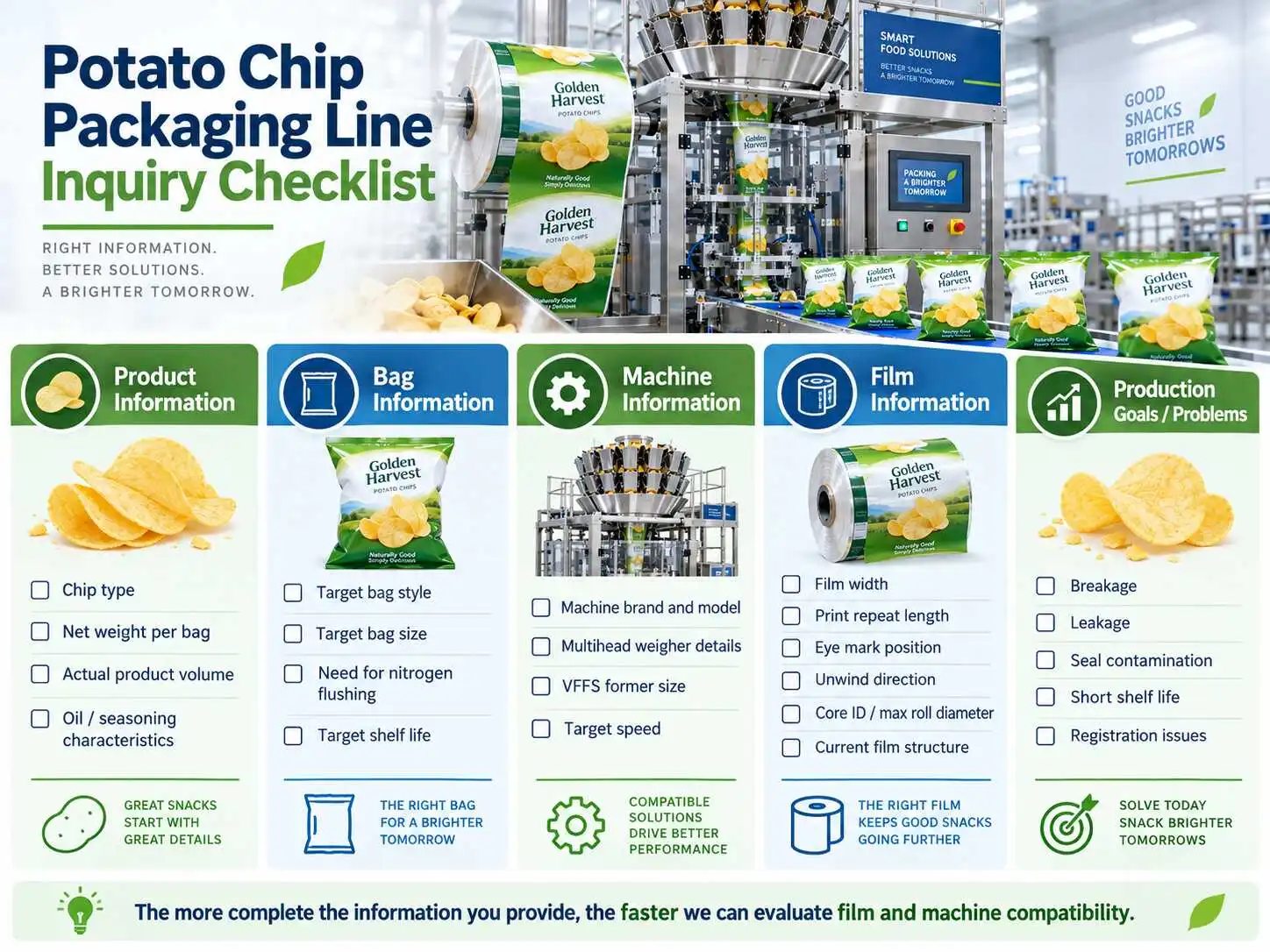
Product and package
- Chip type, cut, oil and seasoning
- Net weight and actual product volume
- Target bag style and finished dimensions
- Need for nitrogen flushing
- Target shelf life and distribution conditions
- Artwork, SKU count and destination market
Machine and film
- Machine manufacturer, model and forming set
- Target stable speed and current problems
- Film width, repeat and eye-mark position
- Unwind direction and longitudinal-seal type
- Core ID, maximum roll diameter and weight
- Current film structure and available trial data
Potato chip automatic packaging line FAQ
What equipment is normally included in a potato chip automatic packaging line?
Why is a multihead weigher commonly used for potato chips?
Does nitrogen flushing guarantee potato chip shelf life?
How should potato chip bag size be selected?
Which film structure is best for potato chips?
What causes potato chips or crumbs to enter the seal?
How fast can a potato chip VFFS line run?
What information does Runlong need to review potato chip rollstock?
Send the chip, bag, machine and film data together
For a useful rollstock review, include chip type, oil or seasoning, net weight, actual product volume, target bag size, shelf-life target, nitrogen requirement, quantity and artwork, plus the VFFS model, film width, print repeat, eye mark, unwind direction, seal type, core and target stable speed.
Continue the packaging specification
All equipment and package visuals are illustrative planning assets. Demonstration artwork does not indicate a customer relationship or an approved production specification.